
AI Commerce News Digest (August 27, 2026)
Gmarket's CEO on why open marketplaces win the AI commerce era, LTK's agentic creator marketing launch, and the Payouts.com and Casper x402 payment implementation lead today's AI commerce news roundup.


Key Takeaways
- Gmarket's CEO argues open marketplaces will win the AI commerce era
- LTK brings an agentic experience to creator marketing
- Agent-ready implementations land across payments and logistics
Here is your AI commerce news roundup for August 27. Today's highlights are Gmarket CEO's "wholesaler of the AI era" strategy and LTK's agentic platform launch for creator marketing. Following yesterday's Albertsons conversational commerce results and eComID's funding round, platform operators themselves are now redefining where they stand in the agent era. In payments, a new x402 protocol implementation emerged, while logistics saw the arrival of a seller-facing AI agent, showing agent-readiness advancing across every layer of the transaction flow.
Today's Top News
Gmarket CEO Bets Open Marketplaces Will Win the AI Commerce Era

Gmarket CEO James Chang says open marketplaces will gain an edge in the AI era, as first-half transaction volume rose 14% in the first rebound in four years.
en.sedaily.comJames Chang, the CEO of Korean marketplace giant Gmarket and a Lazada co-founder, laid out his AI commerce strategy in an interview with the Seoul Economic Daily. Less than a year into his tenure, first-half transaction volume rose 14% year over year, the first increase in four years, with monthly spending per customer up 12% and purchase conversion up 14%.
The core of his argument is that the very structure of an open marketplace becomes an advantage when AI agents do the shopping. Agents need enormous product variety and data to surface the right item, and a commission-centered model with little advertising revenue to protect can genuinely welcome AI visitors in place of human ones, Chang explains. He positions Gmarket as a "wholesaler of the AI era," supplying product data to multiple shopping agents.
In a Korean market led by Coupang's direct-purchase model, this is a bet in the opposite direction. Gmarket also plans to launch "G Mall," a Gmarket-guaranteed curation, early next year, making it a test case for marketplace design built around agent-mediated distribution.
LTK Brings Creator Marketing Into the Agentic Era
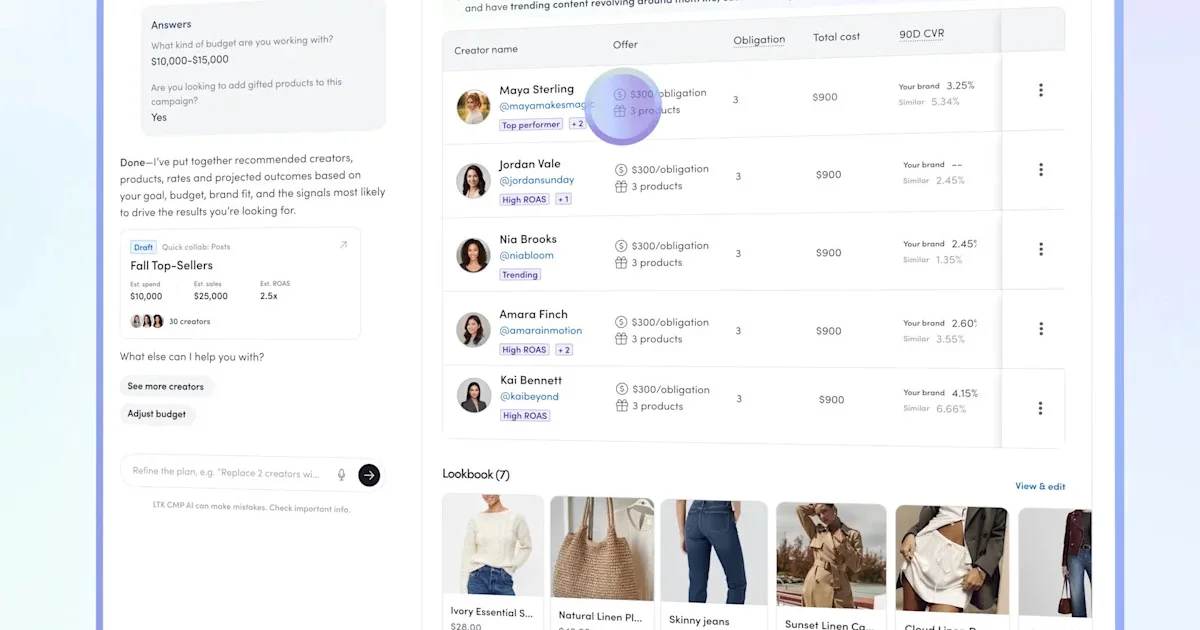
LTK, the pioneer of Creator Commerce, introduced a new agentic experience for the AI-native LTK Brand Platform that changes how marketers build and scale creator campaigns.
finance.yahoo.comLTK, the creator commerce platform powering more than $6 billion in annual retail sales, announced an agentic conversational experience for its Brand Platform. Marketers state an objective and budget, and the system supports everything from campaign design and creator selection to launch, optimization, and next-action recommendations.
The foundation is a proprietary intelligence graph built from more than 100 billion commerce signals across 15 years. Rather than waiting for the right question, the experience proactively surfaces trends and high-potential creators. A limited beta begins in September with major retailers and beauty and luxury brands, with general availability planned for Q4 2026.
With U.S. creator ad spend projected to reach $44 billion this year, campaign operations keep growing more complex. The shift from task-level AI assistance to agents that drive entire workflows is now reaching the marketing infrastructure behind commerce.
Agentic Commerce
Forbes Op-Ed: Agentic Commerce Changes Who Owns the Customer

Many are still investing in their customer channels. Very few ask what happens when an AI agent answered the question and completed the transaction somewhere else.
www.forbes.com"Your customers are still coming. They just may not be coming to you." A Forbes op-ed frames the essence of agentic commerce as a transfer of customer-relationship ownership. Search engines took a fee but always handed the customer over; an assistant that can complete the task keeps the context, the preferences, and the transaction on its own side.
The author describes a structural demotion of company channels from "where the experience happens" to "where fulfillment occurs," and proposes keeping customer context, memory, and policy in-house while exposing a narrow, governed surface to external channels. The observation that systems of record hold the record but not the reasoning is a useful starting point for agent-era data strategy.
Payments and Fintech
Payouts.com Picks Casper Network as Settlement Layer for AI Agent Payments

AI agents gain a dedicated payment rail as the partnership aims to remove reliance on human card details for software-led purchases.
cfotech.com.auPayments platform Payouts.com selected Casper Network as the settlement layer for purchases made by AI agents. Built around the x402 protocol, which uses HTTP's 402 status code, the split of duties has Payouts.com's policy engine approving what an agent can buy and under what conditions, while Casper settles approved transactions on-chain in the csprUSD stablecoin.
With Google, AWS, Visa, Mastercard, Coinbase, and Stripe involved in the x402 Foundation, the case shows the agent payment standardization race entering its implementation phase. Rollout will proceed in stages; financial terms were not disclosed.
Read more: Payouts.com Partners with Casper Network to Build an x402 Settlement Layer for AI Agent Payments
Splitit CEO: AI Is a Competitive Weapon, Not a Productivity Tool

For payments executives, artificial intelligence is quickly becoming less interesting as a productivity tool than as a competitive weapon.
www.pymnts.comNandan Sheth, CEO of installment payments provider Splitit, warned the payments industry in a PYMNTS interview that efficiency gains and automation are merely table stakes. The real threat, he argues, is a competitor using AI to redesign the economics of the market itself.
When a player removes entire layers of friction, cost, and intermediaries with AI, which parts of today's payments architecture still need to exist? His argument that competitive advantage belongs to those willing to question existing structures, not those with the most AI tools, resonates with this week's progress in agent payment standardization.
Logistics and Fulfillment
Ship.com Launches SHIP AI Shipping Manager and an MCP for Agents

Ship.com today announced two artificial intelligence tools designed to streamline shipping processes for sellers and AI builders: SHIP AI and SHIP MCP.
www.prnewswire.comShipping platform Ship.com announced SHIP AI, an AI shipping manager for e-commerce sellers, and SHIP MCP, which embeds shipping capabilities into AI applications. SHIP AI analyzes incoming orders, corrects addresses, and optimizes shipping methods in advance, letting sellers shift to approving work that has already been completed. Monetary actions such as label purchases require seller approval by default.
In the first week of the beta launch after August 11, more than 30% of orders were purchased through SHIP AI. SHIP MCP opens over 35 shipping capabilities to Claude and other AI products via the MCP standard, letting agents call rating, labeling, and tracking directly. Agent-facing standardization is now reaching the final leg of the transaction.
Advertising and Retail Media
Advertising in Google AI Mode: Feed Quality Beats Bidding

Google AI Mode ads are built from your Merchant Center feed, not written by advertisers. Here's which attributes and campaigns get ecommerce products chosen.
www.searchenginejournal.comSearch Engine Journal published a practical guide to e-commerce advertising in Google AI Mode, which has passed a billion monthly users. The defining feature: advertisers do not write the ads. Gemini generates them on the fly from Merchant Center product feeds, so data quality, not bidding or targeting, decides whether you appear.
Queries in AI Mode run about three times longer than traditional searches, and a bare product title with a one-line description cannot answer conversational questions. Adding Q&A attributes and conversational fields like material and fit, and enrolling in eligible campaigns such as Performance Max and AI Max, are the prerequisites for placement. The battleground of paid search is shifting from bid design to product data operations.
E.l.f. Beauty's TikTok Live Playbook: 15 Streams a Month, Record Day-One Launch

Shoppers spent nearly $12 billion on TikTok in the first six months of 2026. E.l.f. insiders and TikTok's beauty boss share how they use edutainment to make live shopping irresistible.
www.fastcompany.comFast Company detailed how E.l.f. Beauty built its sales machine around TikTok Live. For its June haircare line launch, the brand ran a four-hour TikTok Shop livestream a week ahead of the Target rollout, delivering the biggest day-one category launch in company history.
U.S. consumers spent $15.8 billion on TikTok Shop in 2025 and another $11.8 billion in the first half of 2026, with livestream conversion rates around 10%, far above the 2% to 3% typical of e-commerce sites. Running roughly 15 streams a month at two to six hours each, E.l.f.'s "edutainment" storefront is a reference case for brands operationalizing live commerce.
Consumer Trends
Ryder Annual Study: 64% of U.S. Shoppers Now Use AI Shopping Tools
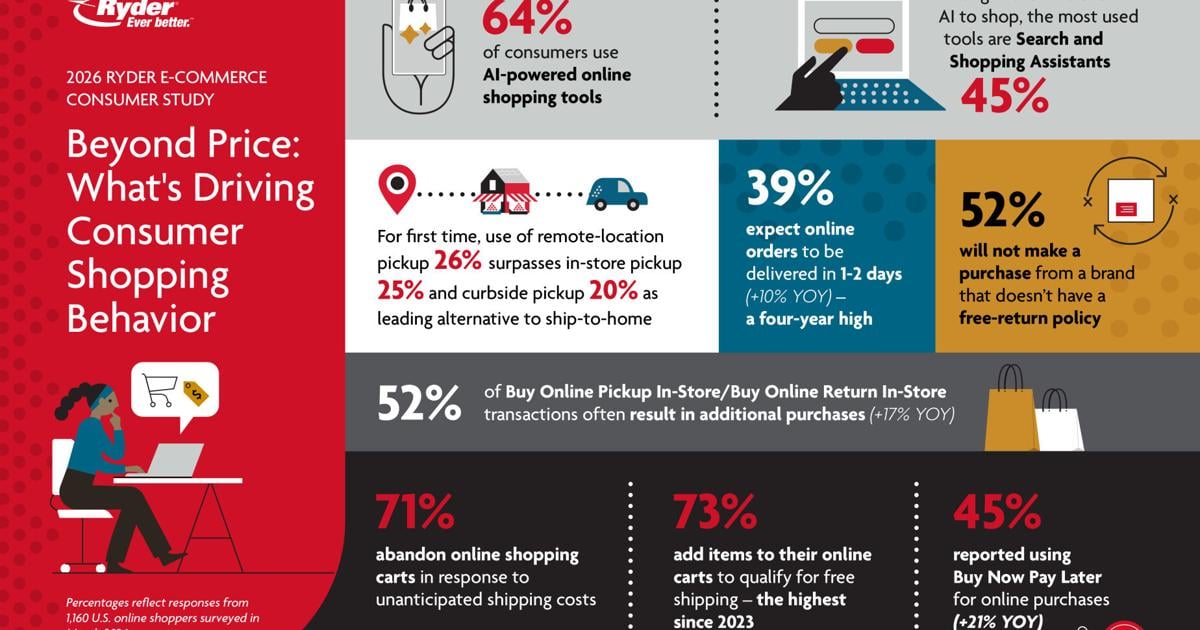
Ryder published its 12th annual benchmark study of U.S. consumer online shopping behaviors, revealing broad AI adoption and buying factors beyond price.
www.ncnewsonline.comLogistics giant Ryder released its 12th annual U.S. e-commerce consumer study. Among 1,160 online shoppers surveyed in March 2026, 64% now use AI-assisted shopping tools, led by search and shopping assistants at 45%, review summaries at 37%, and visual search at 33%.
Price influence declined 12% among apparel shoppers and 13% in beauty, while materials, ingredients, and environmental factors gained ground. On delivery, 39% of consumers now expect arrival within one to two days, a four-year high, while free shipping's influence dropped 14%. The executive warning that products not optimized for AI-powered search lose consideration connects directly to the Google AI Mode story above.
NIQ: 92% of Urban Indian Shoppers Used AI Tools in the Past Month

Indian shoppers increasingly use AI tools for product discovery and purchasing decisions, as quick commerce adoption and Gen Z reshape the consumer economy.
m.economictimes.comAt NIQ's summit in India, survey findings showed that 92% of urban Indian consumers used at least one AI tool while shopping in the past month. Some 93% are interested in AI helping manage household shopping, and 87% are comfortable with AI-powered product recommendations.
Quick commerce reaches 82% of urban consumers, with 65% willing to pay a premium for 30-minute delivery. India's e-commerce market is projected to hit $345 billion by 2030, growing about 2.5 times faster than the global rate. NIQ's analysis that the battleground is shifting to recommendation engines and algorithms as discovery, evaluation, and purchase converge into a single AI-guided journey shows the same structural shift unfolding in emerging markets.
Global E-commerce
Malaysia to Require Registration of E-commerce Platforms (Update)

The Finance Ministry and the Ministry of Communications will take immediate steps to introduce regulatory measures, including registration requirements for e-commerce platforms.
theedgemalaysia.comMalaysia's government announced it will move immediately on regulatory measures including registration requirements for e-commerce platforms. The Cabinet decision follows complaints about electrical and electronics products that may not meet safety standards and questions over halal certification. The communications regulator has received 1,964 e-commerce related complaints since January 2025.
This advances the new e-commerce law direction we covered on August 24 into concrete registration-scheme design by the Finance and Communications ministries. The government stresses it has no intention of shutting down platforms, making this a bellwether for Southeast Asia's tightening e-commerce regulation.
Fire Destroys Drone-Hit Wildberries Warehouse in Russia (Update)

A drone attack caused a massive fire that destroyed a warehouse run by Russian e-commerce giant Wildberries, as Ukraine targets online retailers.
www.reuters.comA logistics center of Wildberries, Russia's largest e-commerce player, was completely destroyed by fire after a drone attack in the Tambov region. The facility spanned roughly 100,000 square meters, the equivalent of 14 soccer pitches, and two people were wounded.
Following yesterday's news of attacks expanding to Ozon, Reuters satellite analysis counts more than 20 Wildberries and Ozon warehouses attacked since mid-July, with at least 1.9 million square meters of warehouse space severely damaged by fire. The degradation of e-commerce infrastructure, one of the few growth areas in Russia's economy, has entered a new scale.
Corporate Moves and Partnerships
Coles Turns E-commerce Profitable on Ocado, Online Now Near 16% of Sales

The Australian grocery giant has been using Ocado as part of a wider digital transformation turnaround that's delivering results.
diginomica.comAustralian grocery giant Coles has turned its e-commerce business profitable on the back of Ocado's automation technology. Online now accounts for nearly 16% of total sales, and the customer fulfillment centers in Melbourne and near Sydney achieved positive EBITDA in only their second year of operation. It is a striking contrast to Kroger and Sobeys scaling back their Ocado deployments.
CEO Leah Weckert named conversational shopping and agentic commerce as the next wave. The plan combines data from 10.3 million active loyalty members with a network of more than 1,800 stores to complete discovery, transaction, and post-purchase support through AI. It reads as a realistic agent-readiness roadmap for grocery retail.
Wrap-up
Today's news shows the agent-era repositioning underway at every layer. Gmarket is reframing the open marketplace structure itself as an agent-friendly asset, while LTK is handing entire marketing workflows to an agent. Payments saw another x402 implementation stack up, and shipping gained MCP-based agent connectivity.
At the same time, as the Forbes op-ed argues, a world where agents hold the customer relationship forces companies to decide what stays on their side. Given the speed of consumer AI adoption shown by the Ryder and NIQ studies, unglamorous work like feed optimization and data readiness will translate directly into visibility. We will keep watching platform operators' agent strategies and payment standard implementations in the days ahead.