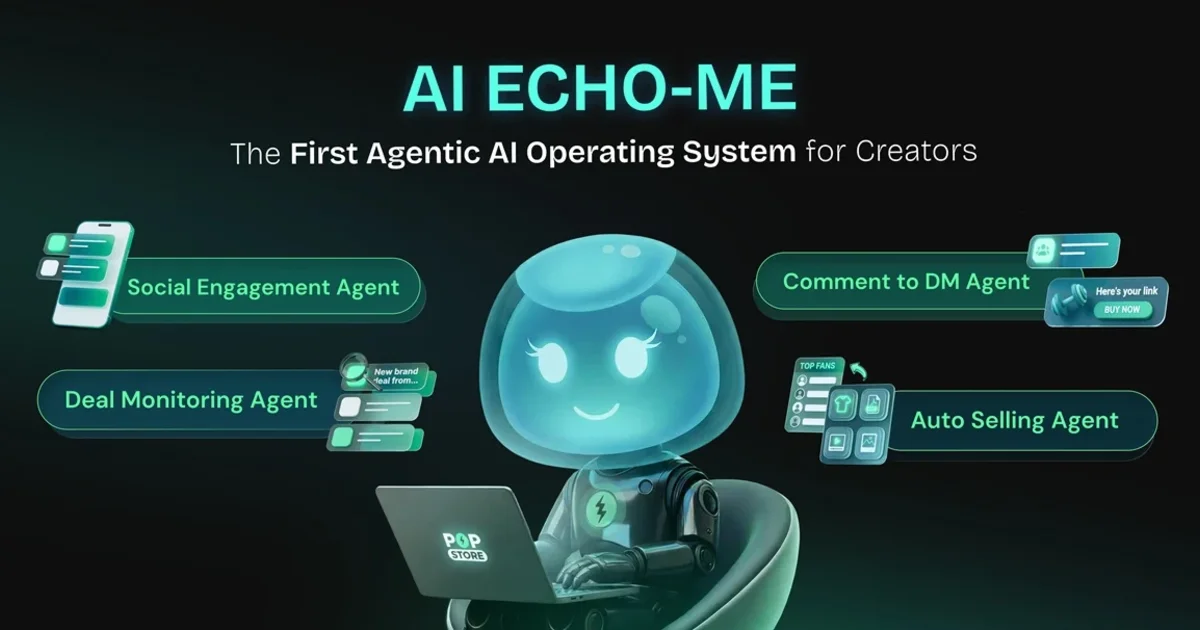
LTK Launches Agentic Creator Marketing, Adding Conversational AI to the Platform Used by 3,700 Brands
Creator commerce leader LTK is adding an agentic, conversational experience to its Brand Platform, letting AI handle campaign design, creator selection, and optimization. What it means for e-commerce brands.

Key Takeaways
- LTK, a leading creator commerce platform, announced an agentic, conversational experience for its Brand Platform. Marketers state a goal and AI handles campaign design, creator selection, execution, optimization, and next-step recommendations
- The system runs on a proprietary intelligence graph built from more than 100 billion commerce signals accumulated over 15 years. A limited beta starts in September 2026, with general availability planned for Q4
- U.S. creator ad spend is projected to reach $44 billion this year. As creator programs grow more complex to operate, letting AI run them is becoming a competitive axis that e-commerce brands cannot ignore
Inside the "Agentic Experience" LTK Announced
DALLAS, August 26, 2026. LTK, the pioneer of Creator Commerce, today introduced a new agentic experience for the AI-native LTK Brand Platform that changes how marketers build and scale creator campaigns.
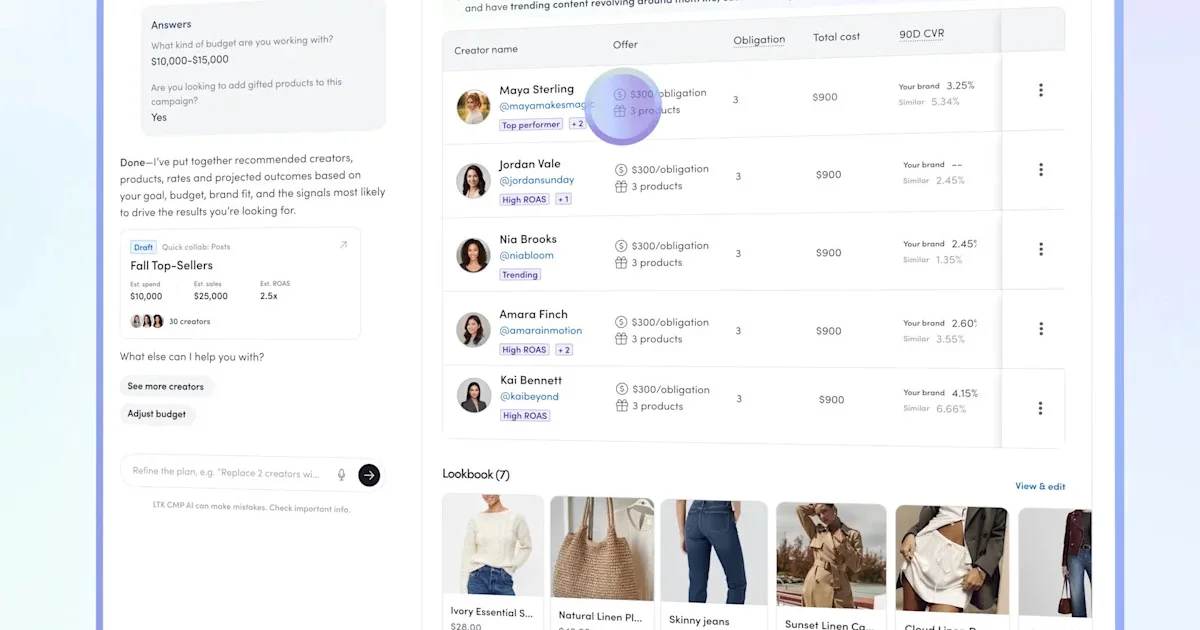
finance.yahoo.comCreator commerce platform LTK announced on August 26, 2026 that it is bringing a new agentic experience to its LTK Brand Platform. Through a conversational interface, brands describe what they want to accomplish, and LTK's intelligence helps plan the campaign, identify the right creators, launch and optimize the program, and determine what to do next.
The usage model is concrete. Marketers simply start with a goal, such as "launch a campaign to drive sales of our new skincare launch," "help me reach Gen Z consumers with a $100,000 budget," or "which creators should we work with for holiday and why." The agent interprets the objective and works out everything from campaign structure and creator recommendations to identifying the next best action.
What stands out is that the design goes beyond reactive answers. Rather than waiting for a marketer to ask the right question, the system monitors across creators, consumers, products, and campaign performance, and LTK says it proactively surfaces emerging trends, high-potential creators, and actions likely to drive results. Marketers can build campaigns through conversation and carry them through to execution, including gifting and the flat-fee collaboration feature Quick Collabs.
Rollout will be staged. A limited beta begins in September 2026 with brand partners spanning major retailers, beauty, and luxury fashion, with broader availability planned for the fourth quarter of the year.
Powered by 15 Years and Over 100 Billion Commerce Signals
Underpinning the agentic experience is LTK's proprietary commerce intelligence graph. Built from creator, consumer, brand, and transaction behavior accumulated over 15 years since the company's founding in 2011, it reportedly holds more than 100 billion signals.
How does this differ from generic generative AI? According to LTK, the graph lets it apply distinctive knowledge to its recommendations: which creators drive purchase behavior, what consumers respond to, how products sell, and which campaign structures generate business outcomes. Co-founder and president Amber Venz Box contrasted it with the first wave of AI, which helped marketers complete individual tasks such as search, analysis, summarization, and generation, saying the new agentic experience replaces "hours or even weeks of searching, configuring and coordinating" with an intelligent workflow.
Creator Marketing Has Become an Always-On Channel
Behind the announcement is a structural shift in creator marketing. According to IAB research, U.S. creator ad spend reached $37 billion in 2025 and is projected to hit $44 billion this year. The category is growing roughly four times faster than the overall media industry, and about half of ad buyers now treat creators as a must-buy channel.
Alongside the spending growth, operational weight has become a problem. LTK's own research shows the number of creators brands invest in has increased by more than 275%. The market has moved from one-off campaigns to always-on operation of large creator networks, inflating the number of creators, campaigns, and decisions all at once. Today, more than 3,700 brands use the LTK Brand Platform to run discovery, campaign management, gifting, and performance measurement on a single system.
Lining up LTK's recent moves shows this announcement sits on a series of deliberate steps. The company made the core features of its brand platform free in September 2025, then launched Quick Collabs in March 2026, letting brands spin up campaigns in minutes without contract negotiations. Widen the funnel of participating brands, cut the friction of running campaigns, then place an agentic layer on top. A platform with over $6 billion in annual retail sales, 44 million monthly users, and 8,000 retailers has now stepped into automating the operation itself.
Where It Sits in the Industry, and What to Discount
The agentic wave is not LTK's alone. Enterprise-focused CreatorIQ promotes AI-driven analytics and fraud detection, and Captiv8 partnered with Perplexity in 2025 to launch natural-language campaign intelligence. Amid that competition, LTK's differentiation comes down to holding 15 years of transaction data that extends through to purchase, not just ad exposure data.
At the same time, everything known so far comes from the company's own announcement, which calls for caution. The accuracy of the agent's recommendations and concrete performance metrics from beta brands are undisclosed. LTK says marketers stay in control of every decision, but public information does not clarify how far the agent's proposals execute automatically or at what granularity human approval is required. With the limited beta centered on major brands, smaller merchants will need to wait for the Q4 general release to judge the terms on which they can use the same experience.
Implications for E-commerce Businesses
Discussion of agentic commerce tends to focus on the consumer side, where AI agents discover and purchase products. LTK's announcement shows the mirror image advancing at the same time: the agentification of the supply side, meaning marketing operations. As consumers begin delegating shopping to AI, brands are beginning to delegate campaign design and execution to AI. Agents are starting to act on both sides of the transaction.
There are two practical implications. First, the competitive axis of creator programs shifts from "who you partner with" to "how fast and how much you can run." Brands that hand operations to an agent can test more creators and campaigns with the same headcount, and the gap in experiment volume versus manually operated brands will widen. Second, because these agents ground their recommendations in accumulated commerce data, brands with richer product information and sales history on the platform become more likely to be recommended. The same structure seen in AI search optimization is emerging inside creator marketing.
Conclusion
From an era where people assemble campaigns to one where you state a goal and delegate to an agent. LTK's announcement is an attempt to rewrite the operating model of creator marketing, one of the fastest-growing channels in the industry. The September limited beta will be the first test of how much revenue campaigns born from conversation actually move. The performance data disclosed on the way to Q4 general availability will be the first real yardstick for this transition.