Gmarket CEO Unveils a 'Wholesaler of the AI Era' Vision, Betting Open Marketplaces Win AI Commerce as H1 GMV Rises 14%
Gmarket CEO James Chang argues open marketplaces will win the AI commerce era. We unpack his 'AI agent friendly' commission model thesis, the wholesaler vision, the G Mall plan, and what e-commerce operators should take away.

Key Takeaways
- Gmarket CEO James Chang says open marketplaces will hold the advantage in the AI commerce era. First-half transaction volume rose 14% year over year, the first increase in four years
- His case rests on two points: AI agents need enormous product variety and data, and ad-dependent platforms cannot welcome agent visits. He calls Gmarket's commission-centered revenue model "AI agent friendly"
- For e-commerce operators, the key insight is that revenue structure determines a platform's stance toward AI agents. Auditing how your own revenue model collides with agent-mediated transactions is the practical takeaway
A Turnaround Four Years in the Making
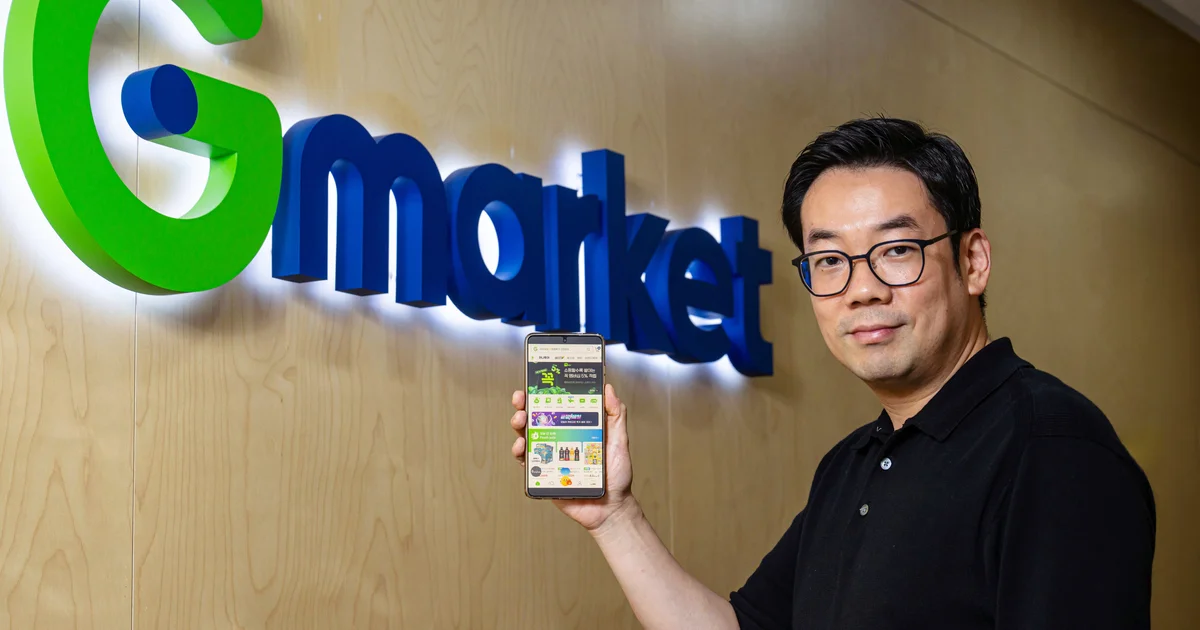
Gmarket CEO James Chang says open marketplaces will gain an edge in the AI era, as first-half transaction volume rose 14% in the first rebound in four years.
en.sedaily.comJames Chang (Chang Seung-hwan), CEO of the Korean e-commerce platform Gmarket, discussed the company's turnaround and its AI commerce strategy in an interview with Seoul Economic Daily. Less than a year into his tenure, first-half transaction volume rose 14% year over year, the first increase in four years. Average monthly spending per customer climbed 12%, the purchase conversion rate rose 14%, and the number of sellers grew 5% to 660,000.
Chang's own career is one of the most interesting threads in the story. He co-founded the Southeast Asian e-commerce company Lazada in the Philippines in 2012 and went on to lead its Singapore and Indonesia operations. Lazada was acquired by Alibaba in 2016. That same Alibaba agreed with Shinsegae Group in late 2024 to jointly invest in Gmarket, and Chang took over as Gmarket CEO in September 2025. The two groups' joint venture, Grand Opus Holdings, launched in September 2025 after conditional approval from the Korea Fair Trade Commission, placing Gmarket and AliExpress Korea under a 50-50 holding company.
The turnaround context matters as well. Korea's e-commerce market has long been dominated by the Coupang and Naver duopoly, which together hold the majority of the market, and Gmarket had stagnated for years. Chang was candid in the interview, saying that through the two inflection points of mobile and algorithmic personalization, "Gmarket responded by adjusting at the service level instead of building the underlying technology, and that remains as tech debt." Until recently, the app offered no personalized recommendations: a search for jeans showed everyone the same jeans regardless of age or gender.
The Structure of the "Open Marketplaces Win the AI Era" Argument
The most assertive claim in the interview is Chang's answer to which business model wins the AI commerce era. His position runs directly against the current structure of the Korean market, which is led by the first-party retail model exemplified by Coupang, where the platform holds its own inventory.
The first pillar is assortment and data. "For an AI agent to present precisely the right product for a customer's experience, it needs enormous product variety and data on the back end," Chang said, arguing that the structure of an open marketplace, a model in which many independent sellers list products freely and which gives Gmarket 660,000 sellers, becomes an asset in the AI era. He also cited the product, seller, and customer data accumulated over the platform's long history.
The second pillar is revenue structure. Chang described Gmarket's revenue model, centered on transaction commissions with relatively little advertising, as "AI agent friendly." Platforms that rely on advertising cannot easily welcome AI agents visiting in place of humans, because a visitor who never sees an ad generates no revenue. With little advertising income to protect, Gmarket can keep its doors open to multiple shopping agents.
The extension of this logic is his vision of Gmarket as a "wholesaler of the AI era." Build data integration structures so AI agents can make full use of Gmarket, and supply products to agents the way a wholesaler would. Then Gmarket is no longer fighting with its single app but competing alongside countless AI agents. It is a departure from the platform playbook that treats traffic to one's own app as the only channel that counts.
At the same time, Chang expects areas where consumers shop for themselves to persist even as agents spread. "It will split into a structure where AI handles errand-like shopping and consumers handle enjoyable shopping," he said, naming fashion, beauty, food, leisure, and hobbies as the enjoyable side. Gmarket plans to build up beauty as a strategic category and will launch "G Mall" (a tentative internal name), a curation carrying Gmarket's guarantee, early next year. G Mall has two goals: giving brands hesitant about joining an open marketplace the confidence to do so, and widening the range of customer experiences. To fund the rebuild, Gmarket has already announced a plan to invest 100 billion won annually in AI technology development.
The Tension with Ad-Driven Models Is Already Real
Chang's point that ad-dependent platforms will not welcome agents is not an abstraction. In the United States, Amazon sued Perplexity over its Comet shopping agent and won a federal district court injunction in March 2026. Amazon's advertising revenue reached roughly 68.6 billion dollars in 2025, and when an agent goes straight from query to checkout, every sponsored placement in between is bypassed. Amazon has invested in its own agent, Rufus, while broadly blocking outside agents. The litigation makes concrete the very structure Chang describes: revenue models determine how platforms treat agents.
Still, his claims deserve some reservations. Agent-mediated purchasing itself has not yet taken off. OpenAI pushed Instant Checkout to complete purchases inside ChatGPT, but reversed course in March 2026, shifting to a model that routes users to retailers' own sites. Opening the doors to agents is one thing; when the transaction volume flowing through them becomes material is another, and the timing remains uncertain.
A second reservation concerns the structural weakness of open marketplaces. A model built on diverse sellers cannot avoid variance in quality and reliability, and in a world where AI agents execute purchases, delivery certainty and product data accuracy become stricter selection criteria, not looser ones. First-party retailers that control inventory and logistics have room to turn this into an advantage. The G Mall concept, a guaranteed curation, can be read as Chang's own acknowledgment of this weakness. Given his admission that even personalization was missing until recently, there is still distance between the vision and the implementation.
What E-commerce Operators Should Take Away
For e-commerce operators, the practical exercise this interview suggests is a revenue model audit. How much of your revenue depends on advertising or traffic referral? What happens to that revenue when visits by AI agents grow? Chang's phrase "AI agent friendly" signals that competitiveness in the agent era is decided at the revenue design stage.
The wholesaler framing is also worth borrowing. Rather than treating your own site or app as the sole channel, structure product data so agents can read it and build a route for supplying products to external AIs. This direction is not limited to large platforms: for small and mid-sized merchants it translates into structured product data and well-maintained feeds. At the same time, his observation that "enjoyable shopping" categories like fashion and beauty still require human-facing experience investment offers a practical guide for balancing AI readiness against existing CX spending.
Conclusion
Gmarket's recovery has only just begun, and the open marketplace thesis is still a hypothesis. Even so, by redefining its business model around the tension between advertising revenue and agent access, and by articulating a position as a wholesaler to AI agents, this interview maps the coordinates of platform strategy in the AI commerce era. Next year, as G Mall launches and integration with Alibaba's AI infrastructure deepens, the first numbers measuring this bet should arrive.