AI Commerce News Digest (September 29, 2026)
AI commerce news for September 29, 2026: Shopify opens checkout to browser-based AI agents, Naver plans to pilot in-agent payments this year, server logs show AI assistants reading stores 2.4 times as often as Google, and Adobe forecasts a record holiday season.


Key Takeaways
- Shopify opens checkout to browser-based AI agents
- Naver plans to pilot in-agent payments this year
- New data puts numbers on how visible stores are to AI
Here is the AI commerce news for September 29. Two stories today push AI agents all the way to the "buy" button. Shopify now lets AI agents running in a shopper's browser place orders through official tools instead of reading the screen. In South Korea, Naver plans to start testing payments inside its own shopping agent before the end of the year. After Shopify turned on direct checkout for Meta by default (covered in our September 25 digest), the paths for agent-led purchases keep widening quickly. We also have new data on how often AI assistants read online stores, and on which marketplaces appear most often in AI answers.
Today's Top Stories
Shopify extends WebMCP to checkout, letting browser-based AI agents complete purchases after the buyer approves
Shopify is expanding WebMCP support to checkout, allowing browser-based AI agents to update order details and complete purchases with a buyer’s authorization.
techcrunch.comOn September 28, Shopify announced that AI agents running in the browser can now complete purchases at checkout on merchants' sites. According to TechCrunch, WebMCP previously covered storefronts and carts, so agents could search for products and add them to a cart, but had to stop there. Support now extends to checkout, including Shop Pay.
WebMCP is a way for a website to expose its functions as "tools" to AI agents in the browser. Shopify added three tools: get_checkout, update_checkout and complete_checkout. With them, an agent can inspect a checkout, change the address or delivery option, and place the order once the buyer approves. It does not need screenshots or page scraping. The feature is rolling out to all eligible merchants.
Until now, browser agents operated by reading what was on screen, so they broke easily when layouts changed, and stores had a hard time telling them apart from ordinary visitors. Where Amazon shut Meta's Muse out of its site, Shopify is building an official entrance and inviting agents in. Merchants should check which stores qualify and how the change affects checkout extensions and measurement.
Related article: Shopify Extends WebMCP to Checkout, Letting Browser-Based AI Agents Place Orders: How It Works and What Merchants Should Check
Naver plans to pilot payments inside its AI shopping agent in some categories this year, with transaction value up about fourfold since March

Naver’s AI Can Find What You Want. Soon It Could Help You Buy It, Too.
koreabizwire.comSouth Korea's Naver plans to pilot in-agent payments in selected product categories before the end of the year, letting shoppers pay without leaving its AI shopping agent. Korea Bizwire reported the plan, citing people in the ICT industry. Today, shoppers decide what to buy with the AI and then move to another screen to complete the purchase.
Usage is growing. Last month, the agent's monthly active users and average daily conversations were each about five times their levels in March, shortly after launch. Average daily transaction value through the agent rose about fourfold over the same period. Digital devices and home appliances account for 40% of that value, categories where shoppers need help comparing specifications or checking whether an appliance will fit.
Naver keeps adding features: suggesting products that can arrive by a desired date based on the shopper's address, including fast-delivery items when the conversation signals urgency, and explaining gift recommendations that account for the recipient's age and the occasion. It also plans a PC version by year-end. The design puts discovery through payment inside a single conversation, and it will now be tested with real transaction data on one of Korea's largest portals.
Related article: Naver to Pilot In-Agent Payment in Its AI Shopping Agent: What 4x Transactions and a 40% Electronics Share Reveal
Agentic Commerce
Meta offers Meta Business Agent for free in Vietnam, guiding shoppers through to bank payments inside Messenger
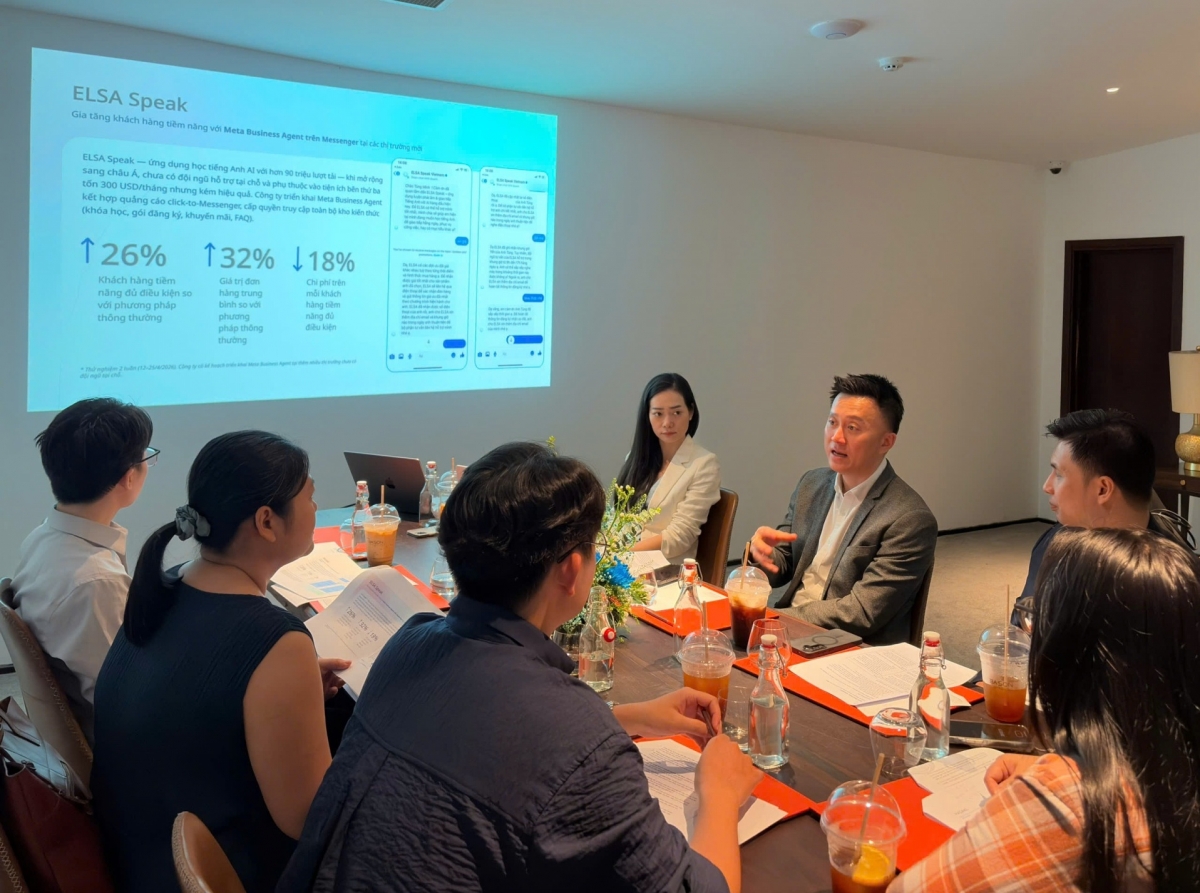
Vietnam is becoming a testing ground for AI-powered social commerce, Meta Vietnam's Khoi Le and PMAX's Nguyen Viet Anh tell VIR.
vir.com.vnIn an interview with Vietnam Investment Review, Meta Vietnam country director Khoi Le described Vietnam as a testing ground for "agentic social commerce." The business AI agent, Meta Business Agent, is currently offered free of charge. Businesses can hand it part or all of the sales process on Facebook and Messenger, including payment. With Pay by Bank, customers can pay inside Messenger through banking apps and e-wallets such as ACB, BIDV, MoMo and ZaloPay.
Meta's survey found that 83% of Vietnamese consumers prefer to reach businesses by message, while 70.2% say they already receive too many irrelevant messages. Sportswear e-commerce brand HADAKI automated its sales advice with the agent on Messenger, raising its conversion rate by 20% and doubling the volume of messages it could handle. These figures come from Meta, but they show an agent handling everything from advice to payment in a market where chat is a main shopping channel.
AI Commerce Tools
AI shopping assistants should be judged on incremental sales, says a Lyro report that examines the evidence behind retailer results
About 30% of U.S. consumers now use generative AI to compare products and decide what to buy. What the retailer results show, where a conversation adds sales rather than moving the same order, and how to size a pilot that survives returns, cannibalization and operating cost.
www.getlyro.aiLyro, the AI agent from chatbot provider Tidio, published a report that reviews the evidence behind AI shopping assistant results using 39 published sources. Amazon says its assistant delivered nearly $12 billion in incremental annualized sales in 2025, and Walmart says users of its assistant Sparky have an average order value about 35% higher than non-users.
The report does not treat these numbers as equivalent. It notes that Amazon explicitly calls its figure incremental, while comparing users with non-users only shows an association. It cites an Etsy A/B test in which a recommendation change raised clicks by 28.3%, yet about half of the conversion gain was offset by reduced search activity. Revenue attributed to an assistant can rise without the store's overall revenue rising. For retailers considering a rollout, the report recommends tests that compare a group shown the assistant with one that is not.
South Korea's Sabangnet adds AI to its multi-marketplace management tool, connected to about 700 malls, with "Sabangnet 2.0"

Daou Technology's integrated shopping mall management service Sabangnet unveiled 'Sabangnet 2.0' at the 2026 Korea E-Commerce Fair, featuring significantly enhanced AI-powered seller workflow automation.
finance.biggo.comDaou Technology announced on September 28 that its mall management service Sabangnet showcased "Sabangnet 2.0" at the 2026 Korea E-Commerce Fair, held in Seoul from September 17 to 19. Built on commerce data from integrations with about 700 shopping malls, it lets sellers manage products, orders, inventory and shipping across multiple malls in one system.
The new AI features automatically generate mandatory product information disclosures and draft responses to customer inquiries. The company has acquired WiseTracker, an AI-based personalized marketing solution, and plans to combine customer analytics and repeat-purchase marketing with its integrated management functions. For sellers operating across many malls, the update reduces repetitive work such as listings and inquiry handling.
AI Search Visibility
AI assistants requested store pages about 2.4 times as often as Google, according to a Shopify agency's server log analysis

Many retailers are missing live customer queries because AI assistants now fetch product pages far more often than Google does.
ecommercenews.com.auPratham Jani, founder of New Zealand Shopify agency Tripster Developers, analyzed the server logs of two of the company's own sites. Between September 1 and 27, crawlers from OpenAI, Anthropic, Perplexity and Meta made 6,826 requests, about 2.4 times Googlebot's 2,810. Of those, 859 were assistants fetching a page live to answer a user's question.
The analysis also surfaced problems. About one in ten requests carrying an AI company's name were attacks probing for configuration files and vulnerabilities. Nearly one in five requests from genuine AI crawlers ended in an error. Some content delivery networks block AI crawlers by default on new sites, so stores can drop out of AI answers without noticing. Because these visits do not appear in Google Analytics, checking access logs is the place to start.
Amazon is the marketplace mentioned most in ChatGPT and Perplexity answers, Onclusive finds in a comparison of AI visibility
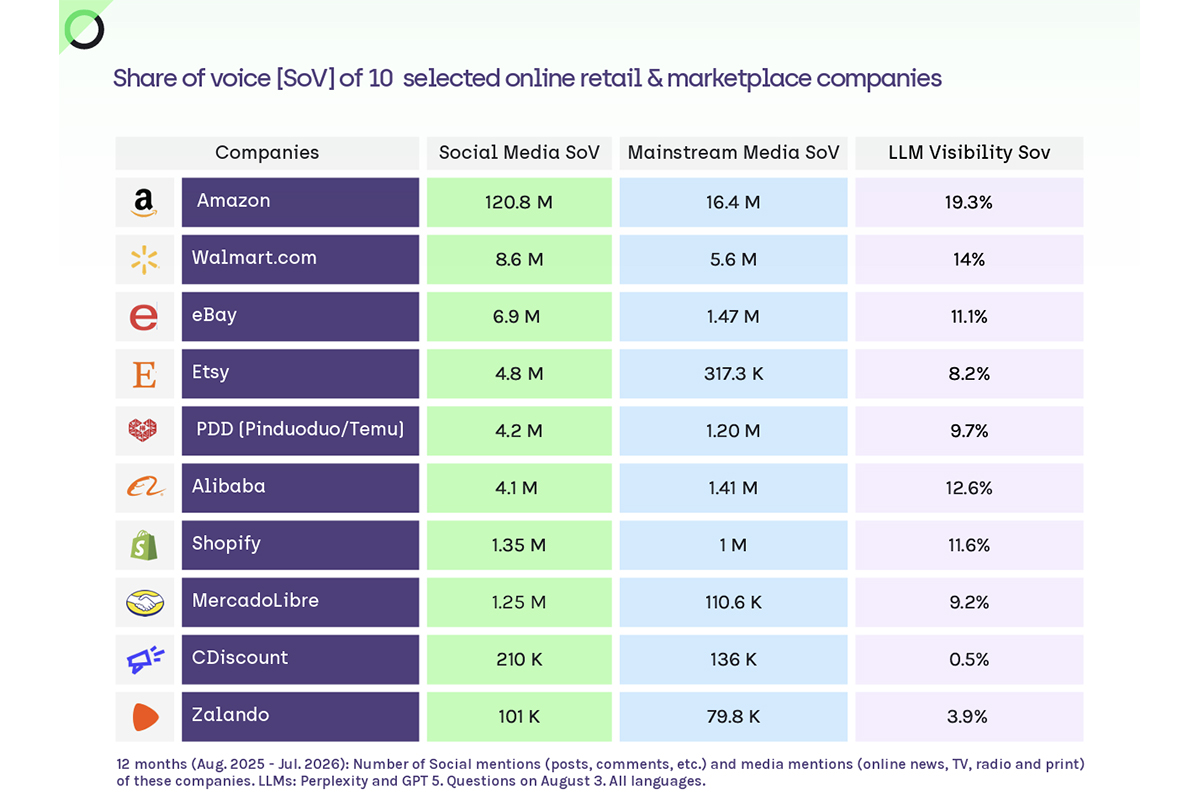
Amazon tops major online marketplaces for AI visibility in responses generated by ChatGPT and Perplexity.
channelx.worldMedia intelligence firm Onclusive analyzed how often major marketplaces appear in answers from ChatGPT and Perplexity. Amazon led with a 19.3% share of voice, followed by Walmart at 14%, Alibaba at 12.6%, Shopify at 11.6% and eBay at 11.1%. Temu, at 9.7%, is close behind Shopify and eBay.
Amazon also had the highest prominence score, which measures how early a brand appears in an answer, at 92% versus Walmart's 84%. The analysis found that marketplaces with more traditional media coverage tend to have higher AI visibility, and Amazon also ranked first in media mentions with 16.4 million. The study shows exposure in AI answers being compared as a metric separate from search rankings.
E-commerce Operations and Platforms
Market America sells the SHOP.COM domain to Shopify and consolidates into a rebuilt site running on Shopify

Market America Worldwide has sold the SHOP.COM domain name to Shopify as it consolidates its e-commerce operations.
www.citybiz.coMarket America Worldwide has sold the SHOP.COM domain to Shopify. It acquired the domain in 2011 and developed it for 15 years. Financial terms were not disclosed. On September 22, the company launched a rebuilt MarketAmerica.com running on Shopify, bringing its brands, products, shopping technology and distributor program into a single site.
The new site includes Atlas, an AI shopping assistant that helps customers find products. Shopify has not said how it will use the domain, but the company runs consumer-facing products such as the Shop app, which makes the acquisition of the short, memorable "shop.com" worth watching.
A critical Magento and Adobe Commerce flaw is being exploited, with card data theft at more than 3,800 online stores

Sansec discovered StyleSmuggler, a Magento and Adobe Commerce zero-day that gives unauthenticated attackers remote code execution. Attacks started September 4th.
sansec.ioCybernews' research team reported a mass exploitation campaign using "StyleSmuggler," a critical zero-day vulnerability in Magento and Adobe Commerce. Security firm Sansec disclosed the flaw in early September; it carries the maximum CVSS score of 10.0 and affects versions 2.4.4 through 2.4.9. An exposed server belonging to an attacker calling itself Lockster contained data stolen from at least 3,834 websites. Those sites have processed at least 2 million orders in 2026.
The attacker gained root access, installed credit card skimmers and exfiltrated private keys for payment gateways such as Braintree. Victims include a French kitchenware retailer and a Nordic health supplement retailer. Adobe released an emergency hotfix, but Cybernews says stores also need to rotate credentials and remove hidden backdoors. Merchants running Magento should check their stores right away.
Global E-commerce Trends
Shein's European sales fell 13.9% in the second quarter after it raised prices and cut ads ahead of the EU's low-value parcel fees

Fast-fashion platform Shein reported a sharp drop in sales in Europe in the second quarter after it hiked prices and cut online advertising in anticipation of the European Union imposing fees on low-value e-commerce parcels from July 1.
wsau.comAccording to Reuters, Shein's second-quarter sales were $11.08 billion, with European revenue down 13.9% to $3.77 billion and U.S. revenue down 6% to $2.5 billion. Growth in Latin America offset those declines, leaving overall sales up just 0.9% from a year earlier. Since July 1, the EU has charged 3 euros per customs code on low-value e-commerce parcels, and Shein raised prices and cut advertising in anticipation.
Its net profit margin fell to 2.1% from 6.2% a year earlier, as higher fuel and freight costs linked to the Middle East conflict pushed fulfillment expenses up 18.1%. Shares that debuted in Hong Kong on September 1 are down 27.3% from the offer price. CEO Sky Xu signaled a shift toward higher-priced brands and a multi-brand strategy that may include acquisitions, suggesting the low-price cross-border model is under pressure to change.
UAE e-commerce reached $11.5 billion in 2025 and is expected to exceed 20% of retail sales by 2030

E-commerce sales totaled AED 42.2 billion, equivalent to USD 11.5 billion, in the United Arab Emirates last year.
anba.com.brAccording to a report by EZDubai Logistics Hub and Euromonitor International, UAE e-commerce sales reached AED 42.2 billion ($11.5 billion) in 2025, up from AED 17.6 billion in 2020, an annual growth rate of about 19%. Online sales made up 15.7% of retail sales in 2025 and are expected to exceed 20% by 2030.
The market is forecast to grow 9.9% a year from 2026 to 2030, reaching AED 67.2 billion ($18.3 billion). Apparel and footwear is the largest category, followed by electronics and home products. E-commerce across the Middle East, North Africa and South Asia (MENASA) more than doubled, from $63.2 billion in 2020 to $141.4 billion in 2025.
Company News and Partnerships
U.S. grocer Hy-Vee aims to cut online order time from about 40 minutes to five, using AI to preload carts by season

CEO Jeremy Gosch said the regional grocer is looking to cut the time it takes for shoppers to place an order on its website to no more than five minutes.
www.grocerydive.comHy-Vee CEO Jeremy Gosch set a goal in his keynote at Groceryshop in Las Vegas to let shoppers complete an online order in five minutes or less. Today, it takes about 40 minutes on average.
AI that preloads the cart is central to the plan. Pointing to how much baskets change across the four seasons in the Midwest, Gosch described using AI to recognize shifting preferences and put items into the cart in advance. The grocer is doing a full rewrite of its digital properties and will begin beta testing new capabilities within the next month. In July it introduced delivery and pickup in as little as 30 minutes. For routine grocery shopping, AI is starting to take over the work of finding items altogether.
Payments and Fintech
Poland's BLIK joins Stripe's dynamic payment methods in more than 30 countries, with joint work on agentic commerce planned
Stripe merchants in over 30 countries can now automatically offer BLIK to Polish shoppers, with agentic commerce flagged for joint work.
thepaypers.comPolish mobile payment method BLIK is now part of Stripe's dynamic payment methods. Stripe merchants in more than 30 countries can automatically show BLIK to Polish shoppers based on location and currency, without a separate integration. BLIK accounts for more than 70% of transactions in Polish e-commerce, and Stripe says businesses offering it see an average conversion increase of 46%.
The two companies also plan to jointly develop solutions for agentic commerce, in which digital agents assist users across the shopping journey and may eventually handle payments. They say these will preserve security mechanisms and user control, but no timeline has been given. In July, BLIK recurring payments became available for subscriptions such as ChatGPT Plus.
71% of shoppers in emerging markets are unlikely to buy without local payment options, dLocal finds in a seven-country survey

dLocal’s report finds local payment options are key to purchasing decisions among shoppers in seven emerging markets.
thepaypers.comCross-border payments platform dLocal published a survey of 1,358 consumers in seven countries across Latin America, Southeast Asia and Africa. 71% said they would be unlikely to buy from a site that does not support their local currency or local payment methods, and 93% said they would be more likely to buy from a foreign brand if they could use their preferred method.
The lack of BNPL was cited as a barrier by 39%, and the lack of alternatives such as e-wallets and bank transfers by 37%. In the Philippines, 64% said support for their preferred payment method matters more than shipping when buying from European brands. For cross-border sellers, the payment options at checkout influence conversion as much as acquisition efforts do.
Consumer Trends
Adobe forecasts a record $275.1 billion in U.S. online holiday sales, with traffic from AI up 130% year over year
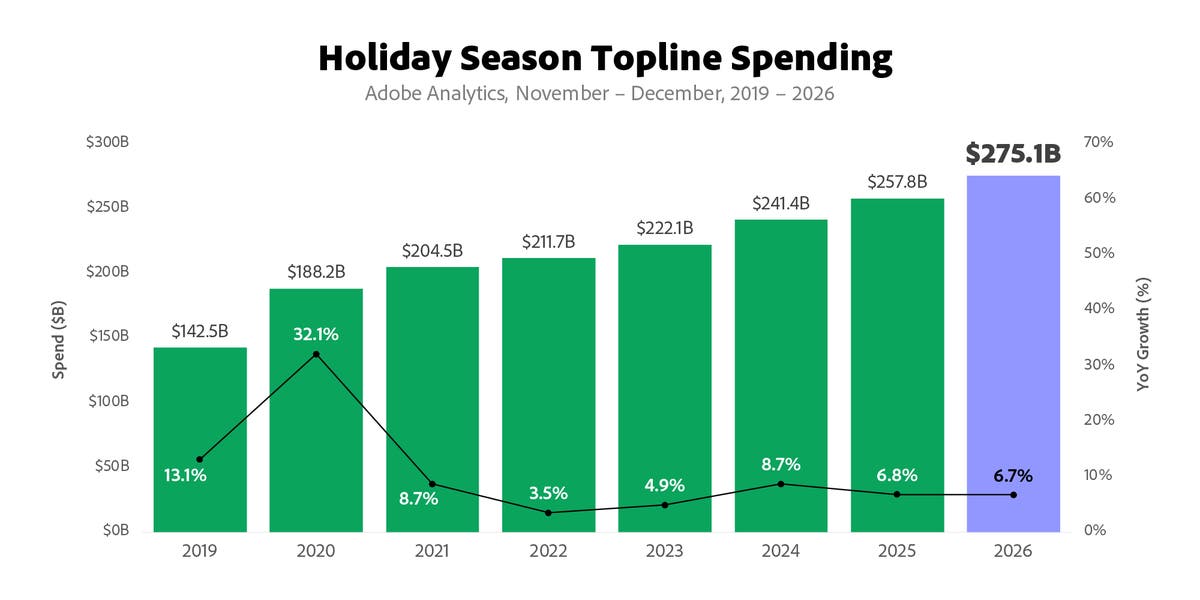
Adobe released its online shopping forecast for the 2026 holiday season, covering the period from Nov. 1 to Dec. 31, 2026, estimating the season will cross a $275 billion milestone.
news.adobe.comAdobe expects U.S. online sales from November 1 to December 31 to reach $275.1 billion, up 6.7% year over year. Cyber Monday is set to be the biggest day ever at $15.1 billion, while Black Friday, at $12.9 billion, will grow faster. Adobe also expects $9.9 billion in spending during the Prime Day event on October 6 and 7.
The standout figure is AI traffic to retail sites, expected to rise 130% year over year. The biggest jump is expected on Thanksgiving, up 159%, followed by Black Friday at 95% and Cyber Monday at 88%. In Adobe's survey of 5,000 consumers, 77% of those who used AI for online shopping said they felt more confident in their purchase, and 69% said they were less likely to return an item. BNPL is expected to drive $21.3 billion over the two months.
30% of French consumers say AI influences their purchases, rising to 64% among 18- to 24-year-olds, an Ipsos survey finds

Selon une étude Ipsos pour Joko, 30% des Français déclarent que l’IA influence leurs achats, et 64% chez les 18-24 ans.
www.ecommerce-nation.frIn an Ipsos survey of 1,000 people aged 18 to 75 conducted for Joko, 30% of French respondents said AI influences their purchasing decisions, rising to 64% among 18- to 24-year-olds. Overall, 32% consult an AI such as ChatGPT or Gemini before buying at least occasionally, and that figure is 70% among 18- to 24-year-olds.
Trust varies by age. Overall, 37% trust AI to help them find the right product, far below the 72% who trust search engines. Among 18- to 24-year-olds, though, the figure is 62%, just 11 points behind search engines at 73%. A quarter of users value AI's independence from sponsored recommendations, which raises the question of how AI shopping can keep that trust as it is monetized.
Australians who expect AI to make holiday shopping easier rose from 29% to 40%, a Sinch survey finds

Budget-conscious households are embracing AI for practical holiday tasks, with confidence rising fastest among the eight markets surveyed by Sinch.
ecommercenews.com.auIn a survey by communications platform Sinch, the share of Australian consumers who expect AI to make holiday shopping easier rose from 29% a year earlier to 40%. It was the fastest increase among the eight markets surveyed, while the global figure fell from 48% to 43%. At the same time, 45% of Australians plan to spend less this year.
The most common use for an AI chatbot was checking order status, at 53%, followed by learning about a product before buying at 44% and contacting customer service outside business hours at 40%. Privacy was the top concern for 47%, and 57% would trust a person's product recommendation over one from AI. Adoption is spreading through practical tasks that save time.
55% of Australian online fashion shoppers have walked away over a returns policy, a Loop survey finds
.jpg)
More than half of Australian online fashion shoppers have walked away over returns terms, underscoring a costly retention risk for retailers.
ecommercenews.com.auIn research commissioned by returns platform Loop, 55% of Australian online fashion shoppers said a returns policy had led them to abandon a purchase or stop buying from a brand. Only 10% of retailers, however, see customer loss as the main financial impact of returns, highlighting a gap in perception.
Eighty-five percent of shoppers check the returns policy before buying at least sometimes, and return fees influence how 91% shop, and 86% would accept an exchange instead of a refund in some circumstances. Returns terms have become a pre-purchase decision factor, and the same holds when AI agents compare stores. Stating return and exchange terms clearly is a prerequisite for being chosen by both people and AI.
Summary
Today's news shows platforms building the paths through which AI agents complete purchases. Shopify has opened an official entrance for agents in the browser, and Naver is working to build payments into its own agent. In Vietnam, Meta is offering a free agent that guides shoppers through to payment inside Messenger.
At the same time, Lyro's report underlines the need to measure the sales impact of AI assistants carefully, and the server log analysis shows stores being left behind without realizing AI cannot read them. Adobe expects AI traffic to rise 130% this holiday season. Now, before the peak season begins, is a good time to check whether your site can be read correctly by AI and whether agents can get all the way through to purchase.