Google's Universal Cart Launches in the US: What Changed Since I/O and What Merchants Need to Get Their Products In
Google's Universal Cart is now live in the US across Search and the Gemini app. We compare it with the I/O 2026 announcement and explain the UCP Cart API, the Merchant Center integration hub, and what retailers need to appear in the cart.

Key Takeaways
- On October 15, 2026, Google launched Universal Cart for US users across Google Search and the Gemini app. It offers four functions: saving products from multiple retailers, price drop and back-in-stock notifications, payment suggestions based on card perks plus promo codes, and checkout powered by UCP
- Compared with the I/O announcement in May, this launch says nothing about YouTube and Gmail, the compatibility check, or AP2. Google has repositioned the cart as a tool the shopper controls rather than an agent that buys on their behalf
- To make products purchasable in this cart, merchants must first implement UCP capabilities such as the Cart API, then apply through the Merchant Center integration hub that began rolling out in the US in October and wait to be selected. Selection criteria and timelines are undisclosed
Five Months After I/O, the Cart Arrives Without Calling Itself an Agent

The new shopping tool is available in the U.S. across Google Search and the Gemini app.
techcrunch.comOn October 15, 2026, Google announced on its official blog that Universal Cart is now available to US users across Google Search and the Gemini app. The feature was previewed at Google I/O 2026 on May 19, when Google said it would roll out "this summer." The actual launch slipped to mid-October, right at the start of the holiday shopping season. TechCrunch framed it as Google's latest shopping move, following conversational product discovery in AI Mode and "Let Google Call."
Reading the two official posts side by side, what stands out is not the feature count but the choice of words. In the May announcement, Vidhya Srinivasan, VP and GM of Ads and Commerce, called Universal Cart the next step that brings UCP and the payments infrastructure together, presenting it as the culmination of Google's agentic commerce work.
This time the post was written by Suresh Ganapathy, Senior Director of Product Management for Consumer Shopping. He splits Google's efforts into two tracks: unlocking agentic capabilities that act on the user's behalf, and building practical tools that give shoppers confidence and control. Universal Cart, he writes, was built for the second track. The post makes no mention of AP2, the payment protocol designed to let agents pay securely, or of agents buying automatically once conditions are met. The most natural reading is that Google lowered expectations from "AI buys for you" to "AI organizes your shopping" before shipping.
Comparing the May Announcement With the October Launch
What shipped, and what quietly dropped out of the messaging? Here is how the two official posts and related coverage line up.
| Item | May 19, 2026 (I/O announcement) | October 15, 2026 (US launch) |
|---|---|---|
| Timing | Rolling out in the US this summer | Launched in the US on October 15 |
| Surfaces | Search and the Gemini app, with YouTube and Gmail to follow | Search (including AI Mode) and the Gemini app. No mention of YouTube or Gmail |
| Price and inventory | Deal and price drop detection, price history, back-in-stock alerts | Price drop and back-in-stock notifications |
| Compatibility check | Flags incompatible PC parts and suggests alternatives | Not mentioned |
| Payment suggestions | Considers card perks, loyalty information and merchant offers | Suggests payment methods based on card perks and shows promo codes |
| Checkout | Google Pay, or transfer items to the merchant's site | Same two paths. Confirmations and support come from the merchant |
| Retailers | Nike, Sephora, Target, Ulta Beauty, Walmart, Wayfair, Shopify merchants (Fenty, Steve Madden) | Nike, Sephora, Target, Ulta Beauty, Walmart, Wayfair, many Shopify merchants |
| Outside the US | UCP checkout to Canada and Australia in the coming months, later the UK | Merchant Center integration hub for Canada and Australia next year. No date for the UK |
| AP2 | Coming to Google products in the coming months, starting with Gemini Spark | Not mentioned in this announcement |
The biggest gap is in surfaces. In May, Google said explicitly that YouTube and Gmail would follow. The new post mentions only Search and the Gemini app. The I/O vision of adding items you spot in a YouTube video or a Gmail newsletter to the same cart is, for now, limited to Search and Gemini in the US. Timing for YouTube and Gmail is undisclosed.
The custom PC compatibility check, one of the most talked-about I/O demos, is not among the four functions either. Whether it is live or has been pushed back cannot be determined from the announcement, so its status is undisclosed. Payment suggestions have also narrowed: May listed card perks, loyalty information and merchant offers, while October lists card perks and promo codes.
Some things did not change. The named retailers (Nike, Sephora, Target, Ulta Beauty, Walmart and Wayfair) are the same as in May, and the Shopify reference shifted from "Shopify merchants such as Fenty and Steve Madden" to "many Shopify merchants." Whichever path the shopper takes, the merchant remains the seller of record, and the new post reiterates that confirmations and customer support come directly from the merchant.
Reading the Four Functions From the Seller's Side
The four functions Google lists take on a different meaning when read from the seller's side.
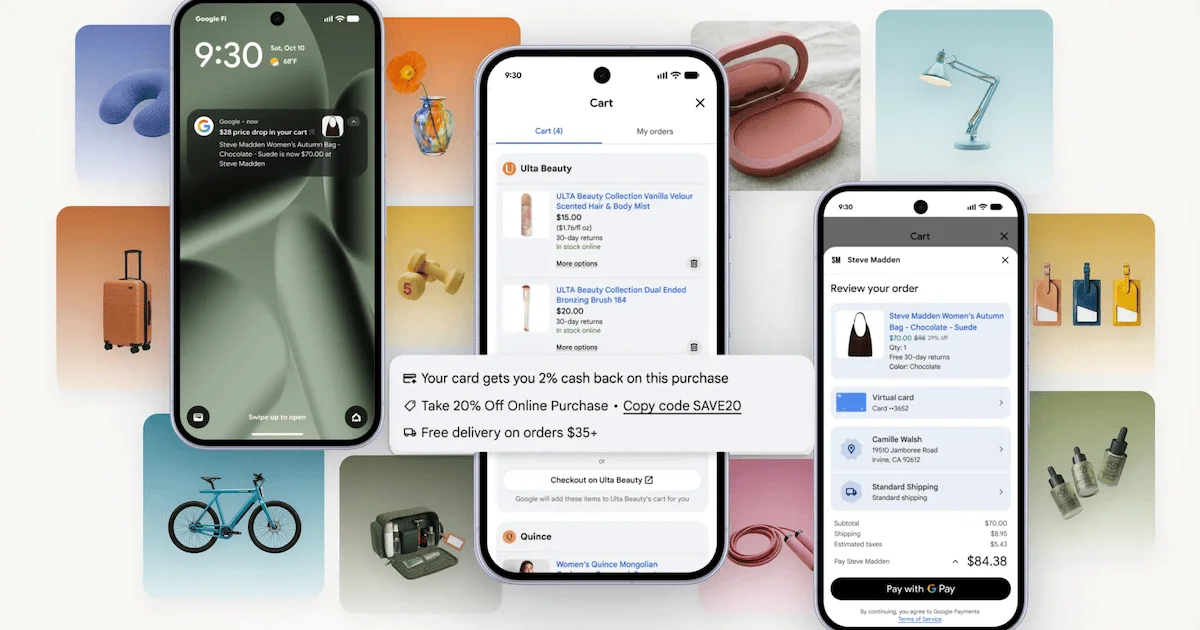
First, saving products from multiple retailers in one cart. In Google's example, a shopper adds a Steve Madden handbag in AI Mode in Search, then later adds a Quince sweater and an Ulta Beauty lip gloss in the Gemini app, and all of it stays in the same cart. The comparison work shoppers used to do across browser tabs and screenshots is being pulled into Google's own interface. The place where comparison happens moves upstream, before the shopper ever reaches the merchant's site.
Price drop and back-in-stock notifications run on the Shopping Graph, with more than 60 billion continually refreshed product listings. When the price or stock of a saved item changes, Google alerts the shopper. Put the other way, the price and inventory data merchants send to Merchant Center becomes raw material for notifications to shoppers. A price cut can trigger an alert from Google, while a slow feed update means missing that opportunity.
The payment and promo code function is built on Google Wallet. It suggests a payment method based on the perks of the shopper's credit cards and shows relevant promo codes in the cart. The product image Google provided shows lines such as "Your card gets you 2% cash back on this purchase," a 20% off code, and free delivery on orders over $35.
Google has not said where it sources the promo codes it displays. On the protocol side, UCP's discount implementation guide specifies that Google sends discount codes only after a merchant declares the discount capability (dev.ucp.shopping.discount) in its profile as an extension of the checkout capability.
Finally, checkout has two paths. Shoppers can pay with Google Pay in a few taps inside the cart, or transfer the items to the merchant's cart and finish on the merchant's site. How that transfer path actually works was largely unclear in May.
Under the Hood: The UCP Cart API Is Still One-Way
The transfer path runs on UCP's Cart API (capability name dev.ucp.shopping.cart). Google's developer guide states that it supports the Universal Cart feature and describes it as designed for basket building before the user has expressed explicit intent to check out.
The flow is simple. While the shopper adds items, Google sends nothing to the merchant. Only when the shopper clicks a transfer button such as "Checkout on merchant" does Google call CreateCart (POST /carts) once, with all accumulated line items. The merchant creates a pre-populated cart and returns its URL (continue_url), and the shopper is sent there.
What stands out is how limited it is. The initial release covers only cart creation and transfer. Updating, deleting or synchronizing cart contents between Google and the merchant is not supported. The cart is a one-way handoff from Google to the merchant, so price or stock changes on the merchant's side after transfer do not flow back to Google's cart. Prerequisites include support for UCP version 2026-04-08 and a profile published at /.well-known/ucp.
There are performance targets as well. Google does not enforce formal SLOs (service level objectives), but it recommends responding in under one second, planning capacity for the referral traffic expected during peak campaigns, and throttling with HTTP 429 when limits are exceeded.
Google cites upselling opportunities on the merchant's site as a benefit of transfer. With Google Pay, the transaction ends on Google's screen; with transfer, the final screen is the merchant's own site. Which paths to offer comes down to how much a merchant values its own on-site experience.
Getting Your Products In: The Merchant Center Hub Is Selection-Based
The most practical change for merchants happened nine days before the launch. According to Search Engine Land, Google began gradually rolling out a UCP integration hub in Merchant Center to US merchants. There, merchants choose which capabilities to support from three options: cart transfer to their own site, native checkout on Google, and identity linking to connect member accounts.
Not everyone can use it right away. The Merchant Center help page lays out three steps. First, complete the technical implementation in the UCP developer guide. Second, submit an interest form. Third, once Google selects you, you are notified and gain access to the onboarding experience. There, a sandbox lets you validate your integration, and Merchant Center alerts you to anything that needs fixing in feed attributes, returns or account configuration.
The order matters: it is not "apply, review, build" but "build, apply, get selected." Merchants bear development costs up front without knowing whether they will be chosen. How many merchants have been selected, the selection criteria, and the time from application to access are all undisclosed. The help page tells merchants who rely on a third-party service provider or platform to check with that provider directly.
The conditions for showing a Buy button on Google were set out in a help page published in March. According to PPC Land, only listings with the native_commerce attribute display the button, payment uses cards stored in Google Wallet, and the merchant's payment service provider (PSP) must be able to accept a Google Pay payment token. Fees and other commercial terms for native checkout do not appear in the announcements or help pages reviewed, and remain undisclosed.
Plans outside the US have slipped. In May, Google said UCP-powered checkout would expand to Canada and Australia in the coming months and later to the UK. The current help page now says Canada and Australia will follow next year for the integration hub. PPC Land notes that an earlier version of the help page described a rollout in the US, Canada and Australia "in the coming months." No date is given for the UK, and Japan is not mentioned.
What the Holiday Season Will and Will Not Reveal
There is a reason Google timed the launch for the holidays. Adobe projects US online holiday sales (November and December) of $275.1 billion in 2026, with traffic from AI chat and browser tools to retail sites up 130% year over year. Just as AI-driven shopping is set to peak, Google has put comparison, saving and payment inside its own interface.
That forecast, however, measures referrals from AI services, not Universal Cart usage. Google has disclosed no user numbers, no count of participating merchants and no volume of purchases made through the cart.
Concerns remain. When the cart was announced in May, Retail Dive cited experts warning that as AI platforms consolidate the shopping journey, retailers risk losing their ties to customer data, quoting Wharton professor Kartik Hosanagar: "Whoever controls the agents now has the power." Because the cart lives on Google's screens, Google decides what gets compared, which price drops trigger alerts and which codes are shown. Even with merchants remaining the seller of record, control over where comparison happens sits with Google, and this launch makes that structure real.
Conclusion
Universal Cart has moved from the May vision of a smart cart spanning every Google surface to a practical tool focused on Search and Gemini, now live in the US. YouTube and Gmail, the compatibility check, and AP2-powered delegated buying do not appear in this announcement.
For merchants, the questions are whether their products get into the cart and where the purchase is completed. Getting in requires accurate price and inventory data in Merchant Center; choosing the purchase path requires implementing the Cart API and other capabilities first, then waiting for selection. The next things to watch are how much usage data Google shares after the holiday season, and how quickly the selection gate opens.