Lightspeed AI Adds Agentic Capabilities That Plan Inventory Transfers and Draft Purchase Orders, Moving POS AI From Answers to Action
Lightspeed has added agentic capabilities to Lightspeed AI that prepare inventory transfers, purchase orders and product updates for approval. We explain the approval model, availability, how it compares with Shopify and Square, and what it means for physical retailers.

Key Takeaways
- POS provider Lightspeed has extended Lightspeed AI, which until now only answered questions in chat, with agentic capabilities that plan inventory transfers, prepare purchase orders and update product information, starting with an opt-in beta for select retail customers
- With a three-step safeguard of preview, explicit approval and audit log, Lightspeed joins Shopify and Square in a design where "the AI proposes, the merchant decides," which is fast becoming the norm for in-store commerce platforms
- Pricing, eligible plans and general availability timing have not been disclosed. Physical retailers first need to clean up their product catalog and stock thresholds and decide who approves what
Lightspeed AI Moves From Answering to Acting

Lightspeed Commerce Inc., the unified omnichannel platform powering ambitious retail, golf and hospitality businesses in over 100 countries, today announced new agentic capabilities within Lightspeed AI that go beyond answering […]
www.lightspeedhq.comOn October 15, 2026, Montreal-based Lightspeed Commerce announced new agentic capabilities for retail within Lightspeed AI. Lightspeed provides cloud-based POS (point of sale) and inventory management to independent specialty retailers and chains. Until now, Lightspeed AI was a conversational assistant that answered questions about sales and inventory.
With the new capabilities, the AI reasons across catalog, inventory, sales and purchasing data, recommends what to do next and prepares the task, all within the same conversation. The retailer asks a question, receives a recommendation, and reviews and approves the prepared task.
Founder and CEO Dax Dasilva said AI should make a retailer's day easier rather than add another system to manage. CTO Bhawna Singh emphasized that the value of an AI agent comes from its context about the business and its ability to work inside the systems merchants already use every day.
The Back-Office Work the Agent Takes On
Every task named in the announcement is the kind of unglamorous work that store operators handle by hand several times a week.
| Task | What the agent does | What the human decides |
|---|---|---|
| Reordering low-stock items | Identifies products at risk of stocking out from inventory, sales and purchasing data and prepares a purchase order | Confirms and approves order quantities and contents |
| Inventory transfers between stores | Plans moving inventory toward the locations with the strongest demand signals | Approves whether to execute the transfer |
| Updating product information | Prepares changes to product data such as prices and descriptions | Approves whether to apply the change |
| Handling unsold items | Prepares tagging of unsold items as clearance | Approves whether to mark them down |
| Finding sales opportunities | Surfaces sales opportunities from the data | Decides whether to act on them |
The most significant of these is inventory transfers between locations. The announcement says the agent can move inventory toward the locations where demand signals are strongest. In multi-store specialty retail, it is routine for a size to sit unsold in one store while another store is out of stock. Until now, staff compared per-store inventory and sales reports and wrote transfer slips by hand.
The agent takes over that cross-checking and drafting. The human decision narrows to a single question: is this transfer the right one?
Purchase order preparation follows the same pattern. The agent identifies low-stock products and drafts the purchase order. In March 2026, Lightspeed also released in beta an AI OCR feature that scans supplier packing slips or invoices and creates a draft purchase order automatically. The product line is clearly being aligned to reduce manual entry both when receiving stock and when placing the next order.
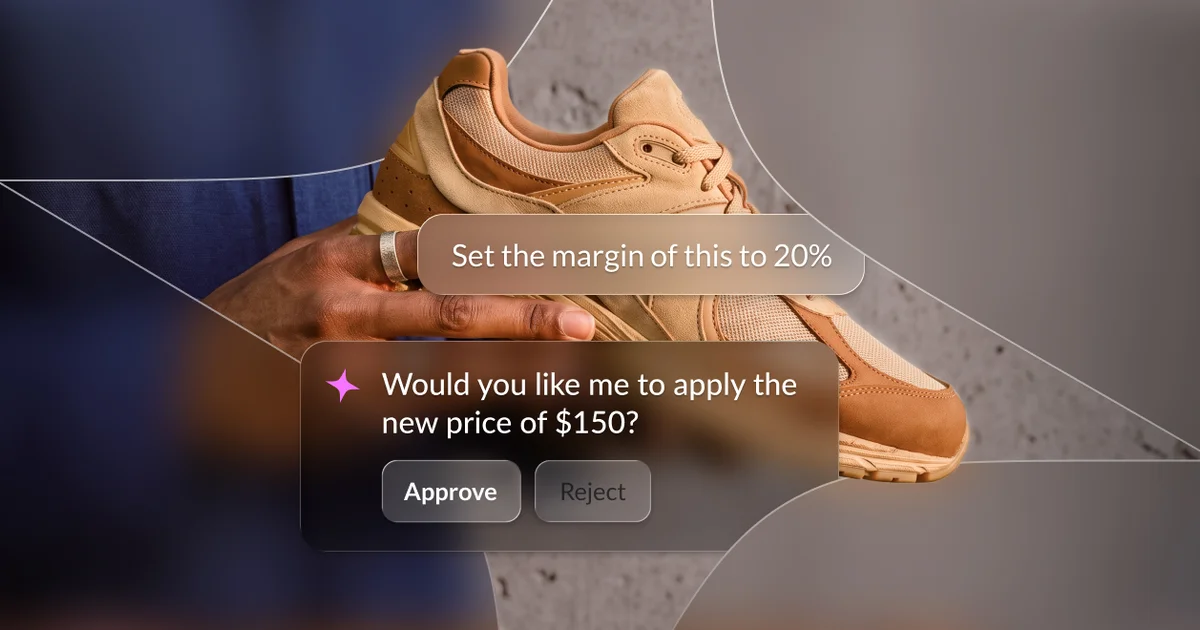
Updating product information covers changes to prices, descriptions and tags. The announcement image shows a user asking the AI to set the margin of an item to 20%, and the AI asking whether to apply a new price of $150, with Approve and Reject buttons. Tagging unsold items as clearance is also given as an example, suggesting the agent is meant to handle everything up to the point of a markdown decision.
Preview, Explicit Approval and Audit Log
An AI that rewrites inventory and prices carries the risk that a wrong change goes straight to the store shelf or the online store. Lightspeed answers this with three safeguards.
Before making a change, the AI shows a preview of what it will do. It then waits until the retailer explicitly approves. Completed actions are recorded in an audit log, so it is possible to trace later who approved what. Lightspeed describes this as a faster way to get work done without giving up visibility or accountability.
This "the AI proposes, the human decides" pattern is not unique to Lightspeed. In April 2026, Square expanded the open beta of Managerbot, an agent that monitors store operations and automates routine tasks. According to PYMNTS, Managerbot proposes an action and waits for the seller's approval before executing. Square described its design philosophy as one in which the AI proposes and the seller decides.
Sidekick, built into the Shopify admin, also states in its official help documentation that it cannot make changes to a store without approval and only presents options for review and approval. That all three companies draw the same line indicates that for small-business operations agents, approval-gated semi-automation rather than full autonomy will be the standard for now.
Nine Months of Building Toward This Release
This announcement did not come out of nowhere. In January 2026, timed to the NRF retail show, Lightspeed launched Lightspeed AI. At that point it was a conversational assistant that could answer questions like "What were my best selling items last weekend?" The company also signaled that it would evolve into a more autonomous agent that analyzes trends and recommends next steps.
In March it added the AI OCR feature mentioned above, and in July it added AI blog creation and other tools. In its recap of the product showcase event published on September 30, Lightspeed said AI would soon draft purchase orders and suggest inter-store inventory transfers. The October announcement turns that preview into an actual beta.
Availability and Pricing: Much Remains Undisclosed
Most of the conditions that prospective users would most want to know have not yet been published.
| Item | What the announcement and public information confirm |
|---|---|
| Availability model | Opt-in beta for select customers |
| General availability | Described only as coming soon. Timing not disclosed |
| Business type | Retail (this announcement does not mention hospitality) |
| Eligible plans | Not disclosed (the existing Lightspeed AI is available on Lightspeed Retail (V9) plans, with features varying by plan) |
| Pricing | Not disclosed |
| Regions and languages | Not disclosed |
| Approval model | Shows a preview before acting, waits for explicit approval, and records actions in an audit log |
| AI models used | Not disclosed (the AI Terms state that third-party AI providers may be used) |
What is certain so far is only that the capabilities are being introduced to select customers through an opt-in beta, with broader availability "coming soon." This announcement covers retail and does not mention Lightspeed Restaurant for hospitality.
For the existing Lightspeed AI, the product page says it is available on Lightspeed Retail (V9) plans and that available features vary by plan. However, the announcement does not say which plans will include the agentic capabilities or whether there will be an additional charge.
Competitive Positioning: Multi-Location Inventory Is the Battleground
Shopify, Square and Lightspeed all place AI agents inside the merchant's admin. Where they differ is the center of gravity of the data the agent works with.
| Item | Lightspeed AI | Square Managerbot | Shopify Sidekick |
|---|---|---|---|
| Main users | Physical specialty retailers, including multi-location | Small US businesses in food and beverage, retail, health and beauty | Merchants using the Shopify admin |
| Execution model | Preview, explicit approval, audit log | Proposes an action and executes after approval | Makes no store changes without approval |
| Example tasks | Preparing purchase orders, inter-store transfers, product updates | Tracking stock against sales velocity and flagging shortages, drafting staff schedules, flagging catalog issues | Answering questions, applying generated content |
| Status | Beta for select customers (from October 2026) | Open beta (expanded in April 2026) | Available |
| Pricing | Not disclosed | No additional cost for eligible sellers | Not stated in the official help page referenced |
Shopify's Sidekick is a general-purpose assistant that can be called up from any page of the admin that ecommerce merchants use. Square targets a broad range of small US businesses in food and beverage, retail, health and beauty, and offers its agent at no additional cost. Lightspeed, by contrast, has put forward the context specific to physical specialty retail: multi-location inventory and purchasing.
There is a reason for this difference. After a strategic review, Lightspeed narrowed its focus to North American retail and European hospitality. Rather than competing head-on with Shopify and Square on price and breadth of features, going deep with multi-store specialty retailers, where inventory turnover drives profit, is the more promising path. Investment analysis site Simply Wall St also noted that the new capabilities could widen Lightspeed's reach in higher-value, multi-site accounts.
Caveats: Beta Results and Layoffs
It is too early to judge the product on the vendor's own account. In the same article, Simply Wall St listed competition from Shopify, Toast and others, along with execution and pricing dependence, as risks. It said the next thing to watch is whether the company can quantify how many retailers opt in to the beta and how much the features are used for purchase orders and inventory transfers.
Two days before the announcement, Canadian media reported that Lightspeed would cut 250 roles. The figure combines layoffs and vacancies left unfilled, and the company said the move is meant to simplify operations and reinvest in customer growth and product innovation. It did not say which areas were affected and said it would provide more detail with its quarterly results in November.
Accountability also deserves attention. Lightspeed's AI Terms place responsibility for verifying outputs, including AI-generated recommendations and "actions," on the user. They also state that Lightspeed is not responsible for decisions made or actions taken based on outputs. Once the approve button is pressed, that inventory transfer or price change is treated as the retailer's own decision.
What It Means for Physical Retailers
Whether an approval-gated agent actually saves time depends less on the AI's capability than on the state of the store's data. If minimum and maximum stock thresholds are not set, the AI has no basis for deciding that stock is "low." If the product catalog contains duplicates or inconsistent naming, transfer suggestions will be wrong too.
For small and mid-sized specialty retailers in Japan that do not use Lightspeed, checking whether POS inventory data is accurate per store and whether order units are registered for each supplier is a prerequisite for adopting any POS vendor's agent. Internal rules on who can approve orders and markdowns up to what amount also matter; if they remain on paper, the audit log loses much of its value.
As approval volume grows, "approval fatigue," where staff press approve without checking, also becomes an issue. A realistic sequence is to start by delegating low-impact, easily reversible tasks such as inventory transfers, and to expand more cautiously into tasks that move money, such as price changes and purchase orders.
Conclusion
Lightspeed's announcement shows that AI built into the POS is starting to shift from something you read reports from to something that drafts your paperwork. Alongside Shopify and Square, approval-based operations agents are becoming a standard feature of management tools for small and mid-sized merchants.
The next thing to watch is how much Lightspeed reveals about beta usage and pricing in its November results. Real data on how often retailers approve the AI's proposals as-is for money-moving tasks like purchase orders and inventory transfers will be the first yardstick for measuring what this kind of agent can actually do.