DRESSX Launches AI Commerce Analytics: How It Tracks Shoppers From ChatGPT and Gemini Recommendations to Purchase, and Its Limits
DRESSX has launched AI commerce analytics that connect AI visibility with revenue. We explain the metrics, data collection, pricing, differences from Profound, and the measurement limits posed by unstable AI answers, for ecommerce teams.

Key Takeaways
- DRESSX has launched AI commerce analytics that combine "AI Visibility," which measures how brands appear in AI answers, with "AI Revenue Tracker," which follows AI-referred visits through to orders
- AI-referred traffic is growing, yet analytics tools often bury it in "Direct," which has made the link between AI visibility and revenue hard to measure
- Because recommendation rankings shift from answer to answer, ecommerce teams should read "what share of answers name us" and "how much revenue each AI drives" separately, rather than chasing rank
What DRESSX Announced
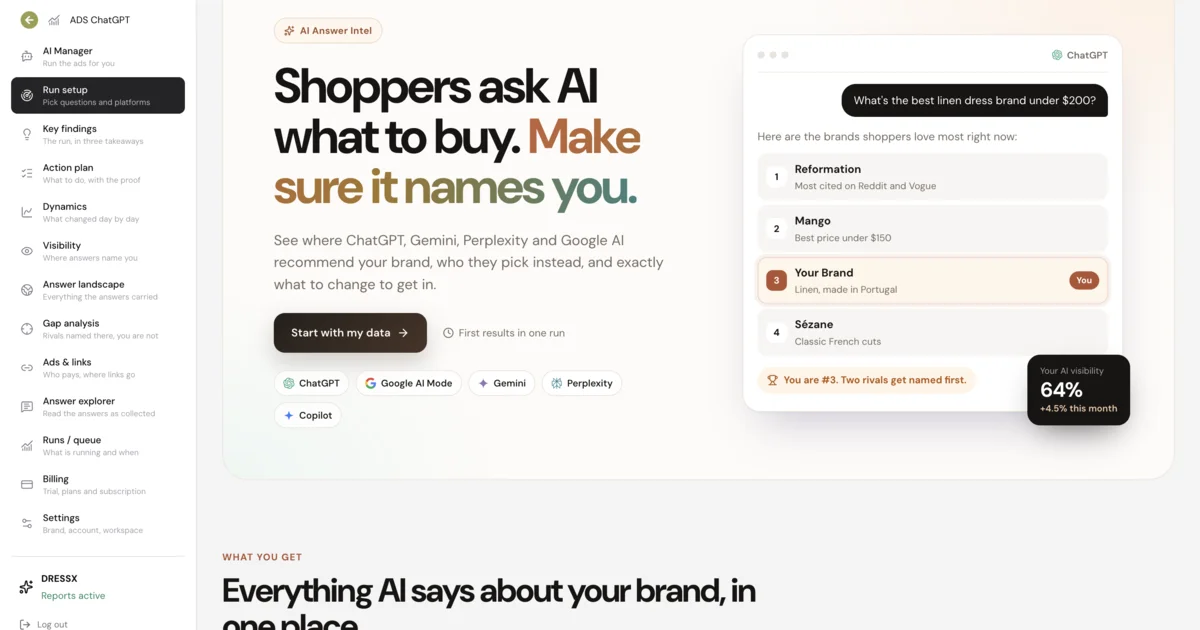
DRESSX is launching a new suite of AI commerce analytics tools designed to change that, giving brands a 360° view of how consumers discover and engage with…
retailtimes.co.ukOn October 15, 2026, Retail Times reported that DRESSX has launched AI commerce analytics for brands and retailers. What consumers ask AI, what recommendations they receive, and how many then visit the store, add to cart, and buy. The pitch is to connect that entire flow in a single measurement.
The suite has two tools. AI Visibility examines what appears when consumers ask AI what to buy. AI Revenue Tracker shows which AI platforms send traffic to a brand's site and how those visitors move on to carts and orders.
DRESSX is known for digital fashion and has supplied retailers with Virtual Try-On and AI styling. This launch extends the business from customer-facing technology into analytics that measure customer behavior.
The suite is offered through More Dash Ads, which DRESSX operates. According to the More Dash Ads privacy notice, the operator is "More Dash Inc., doing business as DRESSX," an independent intermediary that creates, manages, and measures ad campaigns that may appear through OpenAI's advertising services. In other words, these analytics tools sit alongside a business that sells ads inside ChatGPT.
Co-founders Daria Shapovalova and Natalia Modenova said in the announcement:
We've learned how to measure search and social. Now we need to understand AI in the same way.
Why Measure AI "Answers" Now
By the numbers, AI is already a traffic source retailers cannot ignore. Digital Commerce 360, reporting Adobe Analytics data, says AI-referred visits to U.S. retail sites rose 62% year over year in July 2026, and 1,219% compared with October 2024. AI-referred visits converted 60% better and generated 53% more revenue per visit.
Yet those visits are not counted correctly in analytics. Analytics vendor Clickport's explainer lays out how clicks from ChatGPT lose their referrer. When in-app browsers and similar paths drop the referrer and no utm_source=chatgpt.com tag is attached, GA4 classifies the visit as "Direct." In the company's April 2026 snapshot, 35.7% of recognized AI sessions arrived with a tag but no referrer.
GA4 added an "AI Assistant" channel on May 13, 2026, but traffic from Google's AI Overviews and AI Mode remains in Organic Search. More fundamentally, whether an AI answer recommended your brand or a competitor never shows up in your own site logs. DRESSX CTO Ivan Zaparovannyi put the situation in a phrase:
The answer is the new shelf. It decides which brands get discovered, which ones get recommended, and which ones never enter the customer journey at all.Source: Ivan Zaparovannyi, CTO of DRESSX
AI Visibility: Ask the Questions, Count the Answers
The AI Visibility product page describes a simple method. A brand registers and enters three questions a buyer would actually ask. The tool then sends the same questions to ChatGPT, Google, Gemini, Perplexity, and Copilot and aggregates the answers. The same page also says "7 AI engines in one check," so the stated number of engines is inconsistent.
The report covers six metrics:
- Visibility: the share of answers to your questions that name your brand
- Share of voice: the rivals named ahead of you and their share
- Cited sites: the sites AI reads before it answers
- Links to you: answers that link to your site
- Ads in answers: who paid to be in the answer
- Gap analysis: pages AI cites that name a rival but not you
In the sample report, the brand is named in 21 of 41 answers, shown as "Visibility 51%." The report also flags issues such as "2 questions flip between repeats" and suggests next steps.
The standout is Gap analysis. By surfacing pages that AI cites yet that never mention your brand, it makes concrete which outlets you need coverage in to enter AI recommendations, a core question in AI search optimization (GEO and LLMO).
The first brand check is free, and a 3-day free trial is offered. Ongoing pricing, the number of trackable questions, and run frequency are not disclosed on the public pages.
AI Revenue Tracker: Following AI Visits Through to Orders
What is new here is placing visibility and revenue in the same product. The revenue side is handled by AI Revenue Tracker.
It works through a pixel, a short snippet of tracking code placed on every storefront page. The pixel automatically finds and records five events: page view, product view, cart, checkout, and order. It supports Shopify, WooCommerce, Magento, BigCommerce, and custom storefronts, and the company says no developer work is required.
The method for identifying AI visits is described in four steps:
- Recognize the assistant from the referrer (such as
chatgpt.com), the link's UTM tag, or a parameter attached to the click - Keep that source on the visitor for the whole session, not just the landing page
- Attach the source to product, cart, checkout, and order events
- Roll those up into revenue by AI platform
It covers six AI sources: ChatGPT, Perplexity, Gemini, Copilot, Claude, and Google AI Mode. Each number is said to carry "how the source was detected, and how certain it is." The company says that if a shopper arrives from ChatGPT on a phone on Monday and orders on a laptop on Thursday, the order stays credited to ChatGPT.
Pricing is public:
| Plan | Monthly price | Key features |
|---|---|---|
| Starter | $49 | AI source revenue overview, basic product and page tracking, 30-day history, 25k AI events per month, one store |
| Growth | $149 | Sources, products and pixel health, cart, checkout and order value, 90-day history, 100k AI events per month |
| Scale | $249 | Full journey explorer, currency, country and device filters, 12-month history, 250k AI events per month, rewrite event detectors in plain words |
All plans include a 3-day trial, and annual billing gives two months free.
However, the public pages do not explain how visits across devices are linked to the same person (whether by login or by inference), or how accurate that linking is. The revenue figures on the product page are labeled "illustrative." The number of customers and actual results are not disclosed.
How It Differs From Existing AI Visibility Tools
There are already many tools that measure how brands appear in AI. The category leader, Profound, also lists "Agent Analytics" on its pricing page for tracking AI-sourced traffic and attribution. The differences lie in how data is collected and how far measurement extends into revenue.
| Item | DRESSX (More Dash) | Profound | GA4 AI Assistant channel |
|---|---|---|---|
| Visibility measurement | Yes (AI Visibility; starts with three questions) | Yes (trial: 50 prompts for 7 days; enterprise: custom) | No |
| AI engines (visibility) | ChatGPT, Google, Gemini, Perplexity, Copilot and others | Trial: 3; enterprise: up to 9 | None |
| Traffic and revenue measurement | Storefront pixel with five events (view through order value) | Agent Analytics (integrations with CDNs, GA and others) | Classifies AI assistant referrals (AI Mode and similar stay in Organic Search) |
| Pricing | Visibility: first check free, ongoing pricing not disclosed; revenue tracking: $49 to $249 per month | Trial free; enterprise quote-based | Free |
| Business background | Intermediary for ads inside ChatGPT | AI search optimization and AI marketing | Web analytics |
Profound's traffic measurement works through integrations with CDNs (content delivery networks) and Google Analytics. AI Revenue Tracker uses a storefront pixel to capture cart and order values directly. With pricing from $49 a month, it is also easier for smaller brands to try than Profound, whose ongoing plan is quote-based.
On the other hand, Profound's enterprise plan tracks up to nine AI engines and allows custom prompt sets. For large brands that want deep analysis of AI visibility, Profound is the more substantial option. DRESSX's strength is less analytical depth than putting visibility and revenue on one screen.
The Limits: Unstable Answers and Who Is Measuring
Three issues are not visible from the vendor's pitch alone.
The first is the instability of AI answers themselves. Search Engine Land reported on research by SparkToro's Rand Fishkin and Gumshoe.ai's Patrick O'Donnell: 600 volunteers ran 12 identical prompts through ChatGPT, Claude, and Google's AI nearly 3,000 times, and the odds of getting the same brand list twice were under 1 in 100. The study concluded that recommendation rankings are so unstable they are effectively meaningless.
The DRESSX product screen shows a message like "You are #3." In light of this research, tracking rank movements is risky. The same study found that visibility percentage, the share of answers that name a brand, held up relatively well. DRESSX's Visibility metric is exactly that, so it is a usable measure. Still, three questions cannot represent an entire market; more questions and repeated runs are a prerequisite. Note also that one of the researchers sells AI visibility tracking, and the work was not peer-reviewed, which should be weighed when reading it.
The second is the reach of revenue measurement. AI Revenue Tracker runs on a storefront pixel. When a purchase completes inside an AI interface, no storefront page is loaded. The public information does not address how such purchases are handled. And visits that arrive with neither a referrer nor a UTM tag remain unidentifiable by any tool.
The third is who is doing the measuring. More Dash Ads' core business is selling ads that appear below ChatGPT answers. OpenAI introduced a self-serve Ads Manager and cost-per-click bidding in May 2026. AI Visibility includes an "Ads in answers" metric, so visibility findings feed directly into ad buying. When the ad seller also measures performance, readers of the numbers need to verify the measurement assumptions themselves.
What Ecommerce Teams Should Do First
Before buying a paid tool, there is free groundwork. Start by using GA4's AI Assistant channel and tags such as utm_source=chatgpt.com to see how many people already come from AI. If the numbers are small, there is no rush for advanced attribution.
To start measuring visibility, write questions in buyers' own words for your core categories and track, at fixed intervals, what share of answers name your brand. Look at visibility rather than rank, and at averages across repeated runs rather than a single result. Then turn the outlets that AI cites without naming you into PR and content actions.
When you are ready to measure revenue attribution, pixel-based tools like DRESSX's become candidates. Before adopting one, confirm how it links visits across devices and how it handles purchases completed inside AI interfaces.
Conclusion
DRESSX's launch is an attempt to draw a single line from AI visibility to revenue. At $49 a month and up, even small brands can now check how much revenue AI is driving.
Still, AI answers change with every question, and purchases that finish inside an AI interface never reach a storefront pixel. Even if "the answer is the new shelf," the order on that shelf is reshuffled every time. Whoever first establishes metrics built around that instability will decide whether AI commerce analytics can stand alongside search and social analytics as a standard tool.