Microsoft Publishes a 90-Day Playbook for AI Shopping: Full Catalog Feeds and UCP Enablement Are the First 45 Days
A close read of Microsoft Advertising's agentic commerce playbook: what the full-catalog product feed, UCP enablement in Merchant Center, Copilot Checkout, and Clarity AI Visibility steps actually require, and where availability limits bite.

Key Takeaways
- Microsoft Advertising published an implementation guide for the agent era on August 21, titled Prepare for the Age of AI Shopping. It is organized into three chapters: get discovered, be chosen, and understand what is working, and closes with a 90-day activation roadmap
- The first 45 days ask merchants to send their entire catalog to Merchant Center rather than the advertising subset, refresh it at least daily, and fill in the UCP store settings. The company's argument is that agents do not give partial credit
- Copilot Checkout, UCP enablement, and AI-native ads are all US-only today. For merchants outside the US, the work that is actually available now narrows to feed quality and measurement in Clarity
A guide named for the moment AI does the shopping
The headline on Microsoft Advertising's August 21 blog post was "How businesses win when AI does the shopping." The premise is set from the first line: the shopper is the AI, not the person.
Microsoft Advertising on Friday released an agentic commerce blueprint to guide businesses, retailers, and developers into the massive shift when AI agents make purchases on behalf of humans.
www.mediapost.comWhat shipped is a 26-page PDF called Prepare for the Age of AI Shopping, authored by Shirley Chen, Senior Director of Product Marketing for AI commerce. According to MediaPost, it was unveiled alongside an online briefing for marketers.
The structure runs get discovered, be chosen, and understand, followed by a 90-day activation roadmap. It reads as though written for the person who manages product data rather than the person who buys media, with settings paths and field names spelled out, which is unusual for a vendor white paper. The framing premise is a contrast: human shoppers respond to imagery and brand storytelling, while LLMs and agents evaluate products on structured data.
Advertising-only feeds are no longer enough
The largest share of the playbook goes to product feeds in chapter one, and the asks are specific.
First, send 100% of your catalog to Merchant Center. Sending only the products you promote in campaigns has been standard practice, and the stated reason to stop is that everything else stays invisible to AI. Microsoft's phrasing is that agents do not give partial credit. Incomplete data does not simply lower your ranking; it can remove you from the recommendation entirely.
Then the attributes. Titles, descriptions, GTIN/MPN, real-time availability, pricing, and product category are named as the six that carry the most weight in AI recommendations. GTIN (a global trade item number) and MPN (a manufacturer part number) are the keys that let a product be matched across sources. When AI works out where a product can be bought and at what price, an item that cannot be matched never reaches the comparison table.
Refresh cadence gets its own treatment. Update feeds at least daily, and consider more often for fast-moving inventory, because stale prices and out-of-stock mismatches are the top reasons products lose visibility. Among the submission methods is an import tool for Google Merchant Center, so merchants whose Google operations are already settled can skip much of the initial lift. We covered how this layer changed in our piece on Merchant Center and the product feed.
UCP settings are where store promises go
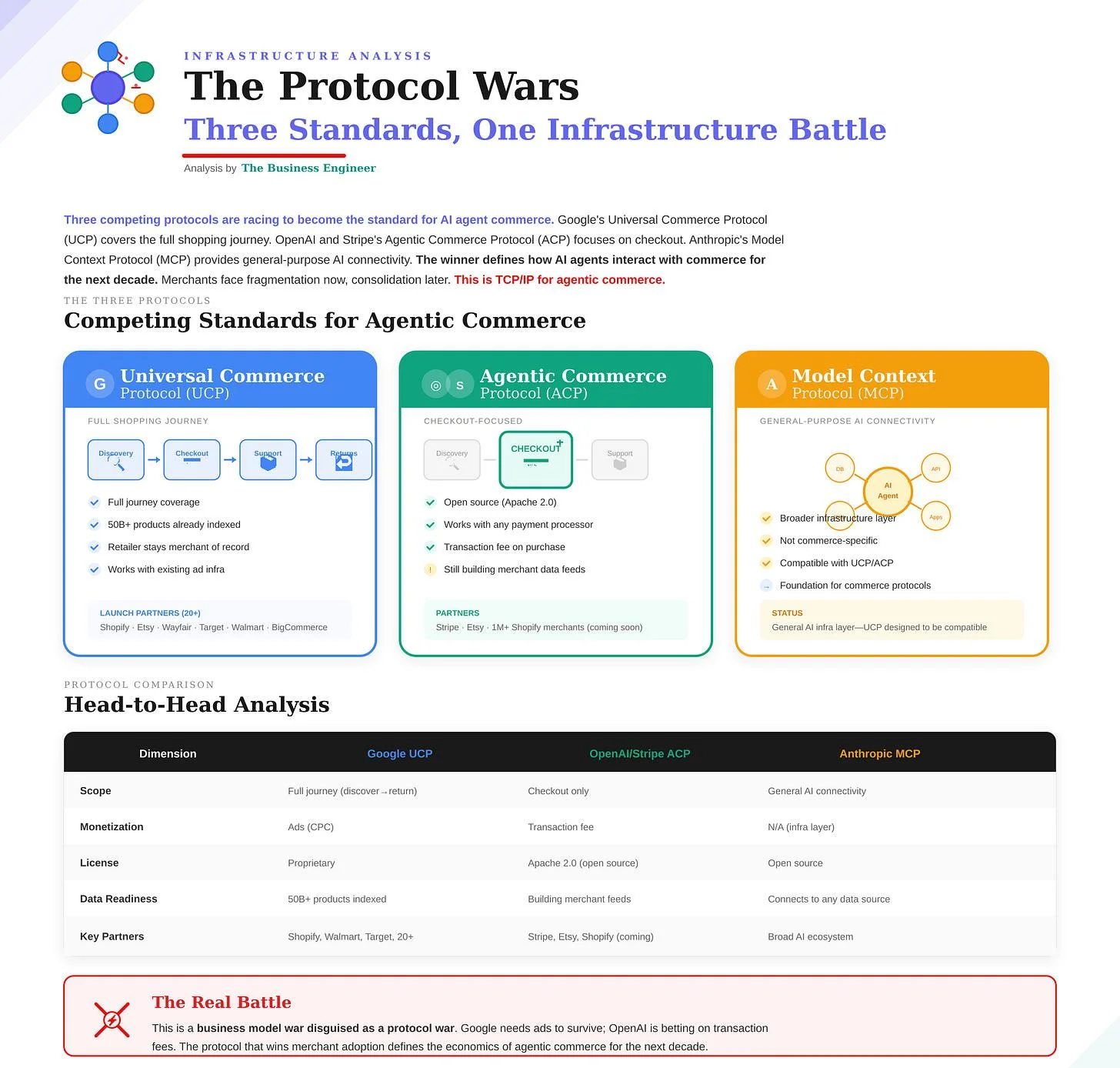
The other pillar of chapter one is enabling UCP (Universal Commerce Protocol) in Merchant Center. UCP is the shared language that lets AI assistants and commerce platforms talk without custom integrations. Google and Shopify founded it, and five companies including Microsoft joined the Tech Council in April 2026. MediaPost renders the acronym as "UPC," but the correct form is UCP.
The work splits in two. Brand-wide context goes in under Settings, then UCP settings, starting with return policy details and customer support contacts. Product-level context travels through feed attributes, and for categories where it applies, such as toys and regulated goods, consumer_notice_type (safety, legal, health) and consumer_notice_message (the warning text itself) are required.
What stands out is the nature of the information requested. Not product specs, but the return policy and the support contact, the promises a store makes. When AI recommends a product, it is being asked to explain what happens after the purchase too. The playbook notes that more attributes are coming. Enablement, however, is limited to US advertisers, aggregators excluded.
Being chosen means checkout and conversation
Chapter two pairs two products of quite different character: Copilot Checkout and Brand Agents.
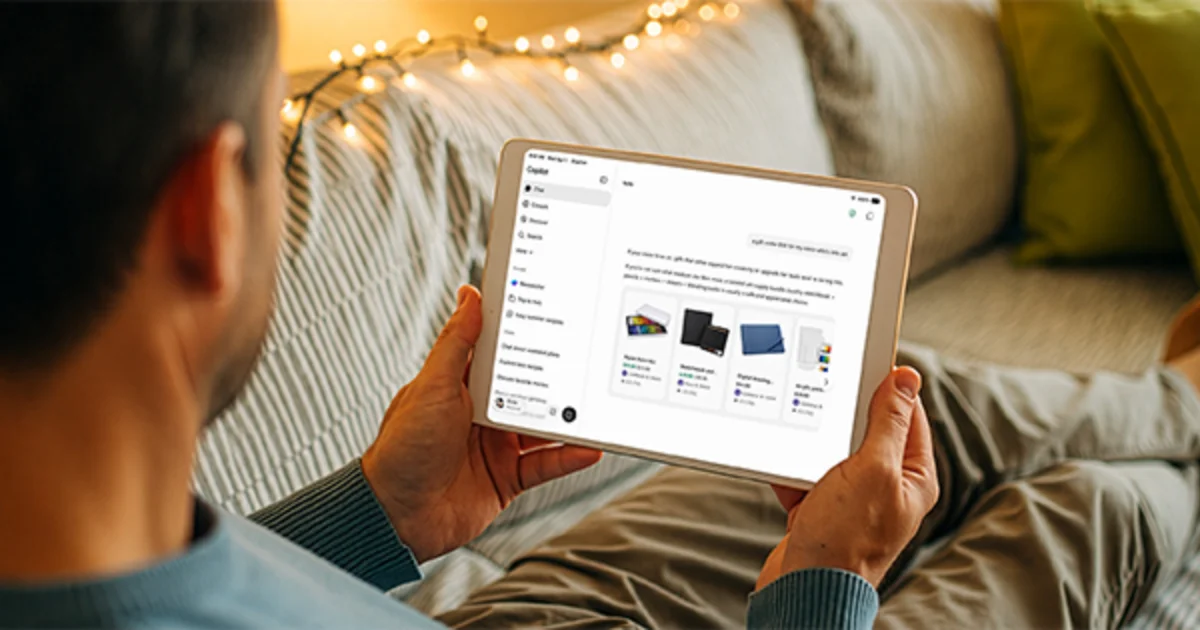
Copilot Checkout completes purchases inside the conversation on Copilot.com and the mobile app. The design point that matters is that the merchant remains merchant of record: existing payments, fulfillment, and reconciliation systems process the transaction, and the customer relationship and data stay with the merchant. There are three onboarding paths. Eligible Shopify merchants are auto-enrolled with controls in the Shopify admin, Stripe offers its Agentic Commerce Suite, and PayPal's Store Sync covers cart creation through checkout completion.
AI is changing how commerce works, and as with every technology shift, it needs new infrastructure. Stripe is building that infrastructure, and Microsoft is putting it to use by enabling commerce inside Copilot.
Brand Agents is the other half: a shopping assistant that runs on your own site. Turn it on in Clarity settings and the agent generates itself from your Shopify or WooCommerce store data, syncing the catalog, setting up search, and matching brand voice. After launch you track conversions, average order value (AOV), and session engagement in a dashboard. Microsoft cites internal analysis showing 2x higher conversion in Brand Agent-assisted sessions.
Easy to miss is a line filed under secondary benefits. Once enabled, your Shopify or WooCommerce catalog becomes part of Microsoft's commerce ecosystem, and your products can surface in Copilot and Bing. It presents as an on-site assistant, but it also functions as a pipe that feeds product data to Microsoft.
Availability varies enough to matter, so here is the sequencing picture.
| Initiative | Availability and prerequisites | What the playbook says about cost |
|---|---|---|
| AI-ready product feed (Merchant Center) | No stated market limit. Assumes the full catalog is submitted and refreshed at least daily | No cost noted for using Merchant Center itself |
| UCP enablement (Merchant Center) | US advertisers only. Aggregators excluded | Not disclosed |
| AI-native ads (Copilot and Bing) | US. Requires a live Performance Max, AI Max, or Shopping campaign | Included in existing ad spend. No extra fee noted |
| Copilot Checkout | US only, English, USD. In pilot. Onboard via Shopify (eligible merchants auto-enrolled), Stripe Agentic Commerce Suite, or PayPal Store Sync | Not disclosed. The merchant remains merchant of record |
| Brand Agents (Clarity) | Body text says globally available, but a Shopify or WooCommerce store is required. The endnote says Shopify stores (beta) | Not disclosed |
| Clarity and AI Visibility | Global | Free. Explicitly no session cap and no credit card required |
Only the measurement layer is free and global
Chapter three is measurement, and the product is Microsoft Clarity, with AI Visibility at the center. There are four views. AI Bot Activity shows which crawlers visit you, Citations shows how often you were cited and which grounding queries sat behind it, Share of Authority benchmarks your slice of AI citations in a topic area, and Topic Insights surfaces the areas where competitors get cited and you do not.
Grounding queries are worth understanding. In an August 12 post on Clarity, Microsoft explains query fan-out, where a single prompt is broken into several retrieval queries run in parallel, and argues that grounding queries should be read alongside the traditional search terms report. What the user typed and what the AI actually searched are different things.
And Clarity is free, with no session cap, available globally. Of everything in this playbook, it is the only piece a merchant outside the US can adopt today without conditions.
How far the numbers carry
The playbook's persuasive weight rests on the figures up front. Trace the sources and different kinds of data are mixed together.
The blog post cites AI-referred retail traffic up 693% year over year last holiday season, and AI and AI agents influencing 20% of global retail sales over that same holiday period, roughly $262 billion, both attributed to Adobe Analytics. In the same position in the PDF, the claim that automated traffic is growing eight times faster than human traffic comes from HUMAN Security's bot traffic report, whose count of automated traffic includes crawlers and malicious bots that never buy anything. Growth in AI as a shopper and growth in machine access generally are numbers to read separately.
One more: the claim that 72% of consumers expect AI-assisted shopping experiences within a year comes from Microsoft's own US consumer survey (n=1,028, August to September 2025). The 2x conversion figure for Brand Agents is internal analysis from March 2026, with no third-party verification shown.
On market size, Bain & Company estimates US agentic e-commerce will account for 15% to 25% of online retail sales by 2030, or $300 billion to $500 billion. Where things stand today looks different. A research report published August 17, AI Shopping Agents and Agentic Commerce 2026, notes that AI adoption in commerce remains concentrated in the early stages of the journey. Usage reaches roughly 62% for product comparison against about 23% at checkout and 19% post-purchase. Payment authorization, digital identity, and consumer trust remain the principal barriers to autonomous AI transactions.
In other words, the discovery layer has real demand while the buy-on-my-behalf layer is still experimental. That the playbook puts feed work on day one and labels Copilot Checkout as in pilot is consistent with this. On cost, neither Copilot Checkout fees nor Brand Agents pricing is disclosed. Only Clarity is stated to be free.
Where merchants outside the US should start
Line up the availability constraints and the actionable set becomes clear.
First, feed completeness. It carries no market restriction and pays off beyond Microsoft, because Google Merchant Center, ChatGPT product feeds, and your own structured data all want the same accurate titles, descriptions, GTIN/MPN, real-time availability, pricing, and category. Widening from the advertised subset to the entire catalog is the sensible starting move.
Second, measurement. Clarity is free and global, so you can establish a baseline for which AI crawlers reach you and which queries cite you. The grounding query list you get is foundational data on how you look to AI search in general, not just a Microsoft tactic. We treat this in more depth in LLMO for e-commerce sites.
Third, preparing the information UCP will carry. Enablement is US-only, but writing down the return policy, staffing the support contact, and managing warning text for regulated goods can all proceed without waiting for the protocol. Google's implementation is expanding in parallel, so the work is unlikely to be wasted. Copilot Checkout and AI-native ads, by contrast, remain a question for businesses that operate in the US market.
The same direction shows up in ad operations. Microsoft rolled AI Max out to all accounts on August 20 and announced that from October 1, Max CPC will no longer be available on new non-portfolio campaigns. The shift is from holding the reins tightly to letting input data quality decide the outcome.
In closing
What the playbook effectively says is that most of the preparation for the AI era is not new work but the product data hygiene that kept getting deferred. Full catalog submission and daily refresh were being asked for a decade ago.
The thing to watch next is how far UCP enablement and Copilot Checkout extend geographically. No timeline is given for markets outside the US. Whether the intervening months go into feeds and measurement will decide how fast you move when they open.