THG Commerce Brings Criteo Sponsored Products into Its AI Shopping Assistant: What 5x CTR Conversational Retail Media Changes
THG Commerce has integrated Criteo Sponsored Products into its AI Shopping Assistant. How conversations become keyword auctions, why a 3-to-5-product shelf matters, how to read the 5x CTR claim, and how it differs from ChatGPT Ads.

Key Takeaways
- THG Commerce has integrated Criteo Sponsored Products into its AI Shopping Assistant, built on Gemini Enterprise. When a sponsored product matches the keywords drawn from a conversation, it appears clearly labelled alongside organic recommendations
- An AI assistant typically shows only three to five products per response, a far narrower shelf than a search results page. The reported "CTR more than five times the average, CVR more than double the average" comes without a disclosed baseline, period or scale, and does not separate out shopper self-selection
- Retailers running conversational assistants need to decide up front how many ad slots to allow and how to keep an ad-free control group. Brands should prepare product data on the assumption that conversations are translated into keywords before the auction
An ad slot inside the conversation
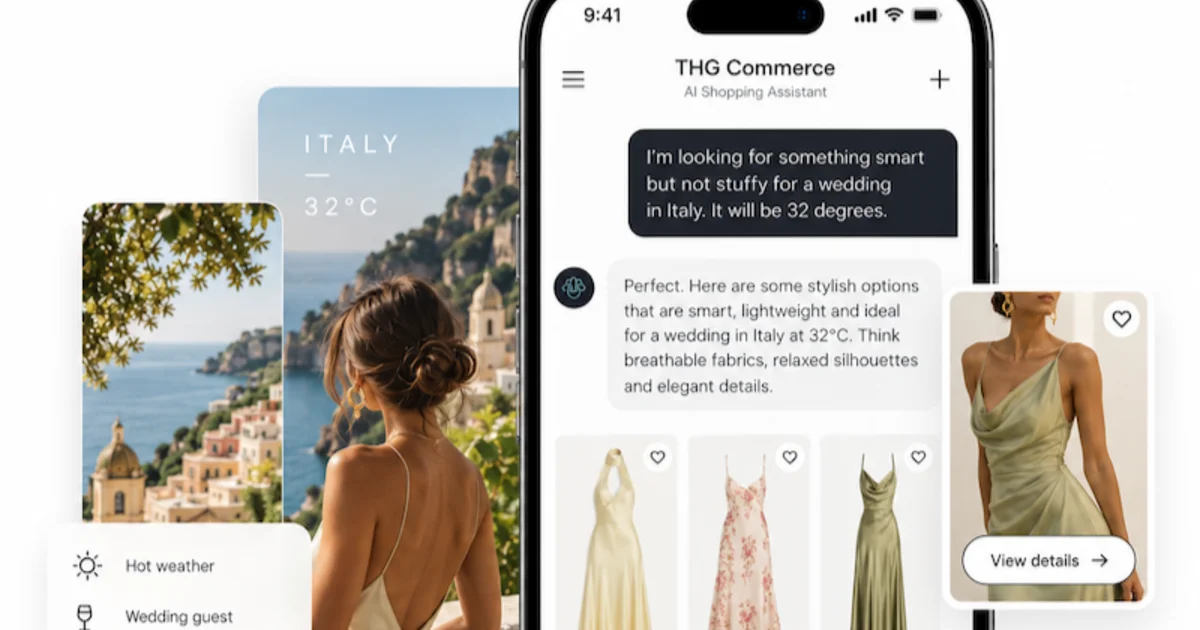
THG Commerce, part of THG Ingenuity, has integrated Criteo Sponsored Products into its AI Shopping Assistant, built using Google Cloud's Gemini Enterprise. THG Commerce says it is the first commerce technology provider in Europe to bring Criteo Sponsored Products into AI-powered conversational search...
retailtechinnovationhub.comOn October 11, 2026, THG Commerce, the commerce arm of UK ecommerce infrastructure provider THG Ingenuity, announced that it had built Criteo Sponsored Products into its AI Shopping Assistant. Retail Technology Innovation Hub reported it first, followed the next day by FashionNetwork and Prolific North. THG Commerce describes itself as "the first commerce technology provider in Europe to bring Criteo Sponsored Products into AI-powered conversational search."
Sponsored Products are the core ad unit of retail media (retailers selling their own storefront as ad inventory): products inserted into search results and similar pages with a "sponsored" label. This announcement means that slot has moved into the conversation between the shopper and the AI.
The relationship is not new. In March 2025, THG Ingenuity signed a three-year strategic partnership with Criteo, and ads on its own beauty sites such as LOOKFANTASTIC were already running on Criteo technology. The assistant itself was announced on June 17, 2026 at Google Cloud Summit London; this release adds an advertising layer on top.
The "in Europe" qualifier is there because, in the US, Criteo had already announced on June 23 that it had brought Sponsored Products into Albertsons' conversational search. Albertsons deployed it as its own feature. THG Commerce offers it to other retailers as SaaS that can work with any commerce platform. The difference is that it has become a component that can be distributed to many retailers, not a single retailer's case study.
How a conversation enters an ad auction
Break the mechanism down and it turns out to be surprisingly close to existing search advertising.
Imagine a shopper saying, "I'm looking for something smart but not stuffy for a wedding in Italy. It will be 32 degrees." The assistant extracts keywords and filters from that message and turns them into product recommendations. According to Criteo's help center guide to the AI assistant page type, Criteo's search delivery engine then selects relevant products against those keywords and filters, and existing Sponsored Products campaigns become automatically eligible.
In other words, the conversation is first translated into a search query and then run through the same auction as ordinary search ads. Relevance is judged with the same models that power search advertising: keyword matching, semantic understanding and strict relevance thresholds. Only sponsored products that clear those bars appear in the response, labelled, next to organic recommendations.
From the advertiser's side, there is almost nothing to set up.
- No new setup: existing Sponsored Products keyword targeting and cost-per-click (CPC) bids are used as is
- A page type bid multiplier lets advertisers raise or lower bids on the AI assistant surface alone
- There are no premium floors or separate ratecards; the auction runs on the same terms as search pages
- Filtering reports to the "AI Assistant" page type shows clicks, CTR, spend, ROAS and more for that surface
The design minimizes friction, but it involves a trade-off. At bidding time, the richness of the conversation is compressed into keywords and filters. How much of "32 degrees," "wedding" and "not stuffy" reaches the auction depends on the extraction, and the details have not been published.
Darren Rajanah, Chief Revenue Officer at THG Ingenuity, framed the value of this surface as follows.
That is some of the highest-intent traffic a retailer can have, and until now it has largely sat outside retail media.
A shelf of three to five products
The most structural change here is the size of the shelf the ads appear on. Criteo explains that an AI assistant typically surfaces only three to five products per response, far fewer than a traditional search results page.
On a search results page, a few ad slots at the top are followed by dozens of organic results. In a conversational response, one sponsored item out of five takes up 20% of the shelf. Criteo presents this as higher visibility for brands, but the flip side is that there is just as much room for organic products to be pushed out.
That makes the cap on ads per response critical. The announcement says only that sponsored products appear "when eligible and relevant." Neither the maximum number of ads per response nor the ordering rules relative to organic results have been disclosed.
For retailers, there is tension here. More ads mean more short-term revenue, but if the assistant comes to be seen as a tool for pushing whatever the retailer wants to sell, people will stop using the conversation altogether. Criteo says retailers "retain control of the experience," which suggests the cap is left to each retailer.
How to read 5x CTR and 2x CVR
The headline of the announcement is its early results. Sponsored products surfaced through the AI Shopping Assistant reportedly reached a click-through rate more than five times the average and a conversion rate more than double the average.
What "average" means is not stated. Whether it is the average for Sponsored Products on search pages or the average for all ads on the site changes the meaning considerably. The measurement period, the number of retailers involved and the impression volume are also undisclosed. The figures should be treated as THG Commerce's claim.
Two factors may be overlapping. The first is who uses the assistant. In June, THG Ingenuity reported that in Myprotein's pilot, assistant users had a conversion rate eight times the site average. If assistant users are already close to buying, it is natural for ads shown to them to convert well.
The second is the narrow shelf. With only three to five products shown, the click-through rate per item tends to rise mechanically compared with a search results page. The 5x CTR figure should be read as including a portion that comes from the shape of the surface itself, not only from the quality of the ads.
Separating the two would require comparing responses with and without ads among the same users, and whether any such controlled comparison exists has not been disclosed. We took a similar look at THG Ingenuity's numbers in our breakdown of AI Stylist's 6x conversion claim.
How it differs from ChatGPT Ads and MCP recommendations
THG is not the only one putting ads into conversational surfaces. Sorting them by who owns the surface and what is being bought makes this announcement's position clearer.
| Format | Who owns the conversation | What advertisers buy | Disclosed metrics |
|---|---|---|---|
| THG Commerce x Criteo (October 2026) | Retailers using THG Commerce's SaaS | Existing Sponsored Products keywords and CPC bids | CTR more than 5x the average, CVR more than 2x the average (baseline not disclosed) |
| Albertsons x Criteo (June 2026) | Albertsons | Same as above | 10% larger baskets among conversational search users (no ad-specific figures disclosed) |
| ChatGPT Ads | OpenAI | Ad placements matched to conversation context (Criteo among the buying routes) | Per Criteo, 80% new-to-brand in mid-funnel, conversions 1.5 to 2x traditional search |
| Amazon sponsored prompts | Amazon | Placement as a suggested question (prompt) | About 20% of shoppers who engage with a brand prompt continue the conversation about that brand |
| Criteo Agentic Commerce Recommendation Service | AI assistants connecting via MCP | Not ads: an API for organic recommendations | Up to 60% relevance gain versus text-based recommendations (Criteo claim) |
The biggest difference is who owns the surface. With ChatGPT Ads, OpenAI owns the conversation, and retailers and brands come in from outside as advertisers. Criteo provides a buying route into that inventory, and its track record can be read in the numbers Criteo's CEO disclosed. In the THG and Albertsons model, the retailer owns the conversation and keeps the ad revenue. For retailers, it is a way to bring conversational traffic that previously generated no ad revenue into their own retail media business.
It should also not be confused with the Agentic Commerce Recommendation Service Criteo announced in February. That is an API that uses purchase data to improve the quality of AI assistants' recommendations; it supports organic recommendations, not ads. THG's integration is the European implementation of the advertising half of what Criteo is bringing to conversational commerce, alongside recommendations.
Amazon's sponsored prompts in Rufus take a different form, turning suggested questions rather than products into ads. According to CEO Andy Jassy, nearly 20% of shoppers who interact with a brand prompt continue the conversation about that brand. Buy the entry point to the conversation, or buy the shelf inside the answer: conversational retail media is splitting in these two directions.
The shopper trust caveat
Ads inside conversations also raise a trust problem that search ads did not.
In a survey of 2,180 US adults released in April by Quad/Graphics and The Harris Poll, 75% said they would trust AI agents less if their recommendations were swayed by brand dollars. The same share said they would trust brands less if they paid to influence AI agents.
Other research points to some tolerance for ads. In a PSE Consulting study of 4,250 consumers in the UK, US, France and Germany, 43% chose a free AI shopping assistant influenced by advertising, while only 27% would pay for a fully impartial one. Even so, 40% said advertising would reduce their trust in AI-generated recommendations, rising to 48% in the UK, THG's home market.
Shoppers, in other words, are less sensitive to the existence of ads than to whether the ads make the recommendations useful. THG and Criteo's repeated emphasis on "clearly labelled" placements and "strict relevance thresholds" reads as a response to that sentiment. The specific label wording and placement have not been shown in the announcement.
What retailers with assistants and brands should take away
For retailers that run a conversational assistant on their own site, this is a signal to redesign on the assumption that the assistant will become an ad surface. The first decisions are the cap on ads per response and how labels are presented; changing them later shifts how users perceive the assistant, so the initial policy matters.
Measurement also needs to be settled before launch. Keeping a fixed share of responses ad-free makes it possible to separate the incremental sales from ads and the impact on assistant usage and satisfaction. Judging by CTR alone risks missing early signs that people are using the conversation less.
For brands, the starting point is that conversations are translated into keywords and filters before the auction. If product names and attribute data do not include the words shoppers use in conversation (use case, season, occasion), they will not clear the relevance threshold. Adjusting only the AI assistant surface with bid multipliers and comparing ROAS by surface is a realistic first step.
Summary
THG Commerce's integration is the first European example of a conversational assistant turning from a service tool into a retail media storefront. The mechanics are essentially existing search advertising; what is new is the narrow shelf of three to five products.
The next things to watch are how many retailers adopt THG Commerce's assistant and whether caps on ads per response and labelling standards are published. When the 5x CTR figure is shown as incremental lift backed by a controlled comparison, ads inside conversations will finally get a real assessment.