Merchants Have to Implement Both ACP and UCP: Best Buy's Engineering Lead on the Plumbing Behind a $65 Billion Market
A breakdown of the agentic commerce implementation notes shared by Best Buy's senior engineering manager: dual ACP and UCP support, pre-pushed product feeds, AP2 payment delegation, and eval design, in the order merchants should tackle them.

Key Takeaways
- Best Buy's senior engineering manager laid out the five-layer stack of MCP, A2A, ACP, UCP and AP2, along with the reality that merchants have to implement both ACP and UCP
- Neither ChatGPT nor Gemini calls a live catalog search, so merchants push product feeds in advance and end up maintaining separate pipelines for ACP, UCP and Meta
- Payments still require human approval by design, and AP2 is the layer being built to handle that delegation with cryptographic signatures
Conversation about agentic commerce tends to orbit market forecasts and platform announcements. What files a merchant actually sends, in what format, and to which endpoint, is discussed far less often. The briefing covered here is made up almost entirely of that second kind of detail.
Shopping Is Already 45% of Agent Sessions, and the Plumbing Is Not Finished

Agentic commerce, meaning shopping done by AI assistants on behalf of humans, is not a theoretical future. It is a $7 billion market today.
finance.biggo.comAhnaf Prio, who leads the agentic commerce team at US electronics retailer Best Buy, walked through the full implementation picture on the AI Engineer podcast. The industry estimates he cited put the market at $7 billion today and $65 billion by 2030. He also said roughly 45% of agent sessions on ChatGPT and Google Gemini are already shopping related.
Against those headline numbers, most of his explanation is spent on unglamorous work. On the proliferation of acronyms he was blunt: "One day we're talking about MCPs, another day A2A, ACP, UCP, AP2. It's like what is even real?" Anyone responsible for shipping an integration recognizes that feeling.
Best Buy's own posture is on the record. CEO Corie Barry told RetailDive that the company is evolving bestbuy.com to be more agent friendly. Best Buy supplies its product catalog to ChatGPT and also supports Google's UCP. Prio is therefore reporting from a team that already runs the dual integration, not theorizing about it.
Five Layers, Sorted by Job
Prio's framing separates a crowded field by role.
| Layer | Role | Driven by | Maturity (August 2026) |
|---|---|---|---|
| MCP | Tool discovery and invocation | Cross-industry | Widely adopted |
| A2A | Agent-to-agent communication | Open spec originated at Google | Widely used |
| ACP | Product data, cart, checkout | OpenAI and Stripe | In use, with its own schema |
| UCP | Product data, cart, checkout | In use, with its own schema | |
| AP2 | Payment delegation and authorization | Google plus 60 or more partners | Still forming |
At the base sits MCP, the Model Context Protocol, which governs how an agent discovers and calls a merchant's capabilities. Without it, an agent cannot pull product data into its context at all. A2A sits above, carrying the conversation between a customer-side agent and a merchant-side agent. Prio treats that pairing as the natural shape of agentic commerce.
Divergence begins at the commerce layer. ACP, maintained by OpenAI and Stripe, and Google's UCP both define product data, carts and checkout state transitions, using different schemas for the same territory. Selling on both ChatGPT and Gemini means implementing both. Prio's demo puts the two call formats side by side to show that identical operations do not imply identical payloads.
Checking the primary sources bears this out. On the UCP side, a merchant publishes a JSON manifest at /.well-known/ucp to declare its capabilities, works through a layer that separates payment instruments from payment handlers, and can choose REST APIs, A2A or MCP as the transport binding. ACP ships under Apache 2.0 with reference implementations from both OpenAI and Stripe. Both are open by design, but open and interoperable are different properties.
The newest layer is AP2, the specification Google published with more than 60 partners. It chains three signed mandates: an Intent Mandate for delegated authority, a Cart Mandate approving a specific cart at a specific price, and a Payment Mandate binding the payment method to that cart. Because an Intent Mandate can carry budget limits and timing conditions, it becomes the foundation for purchases made while the human is away.
Live Search Is Not Available, So Feeds Get Pushed Ahead of Time
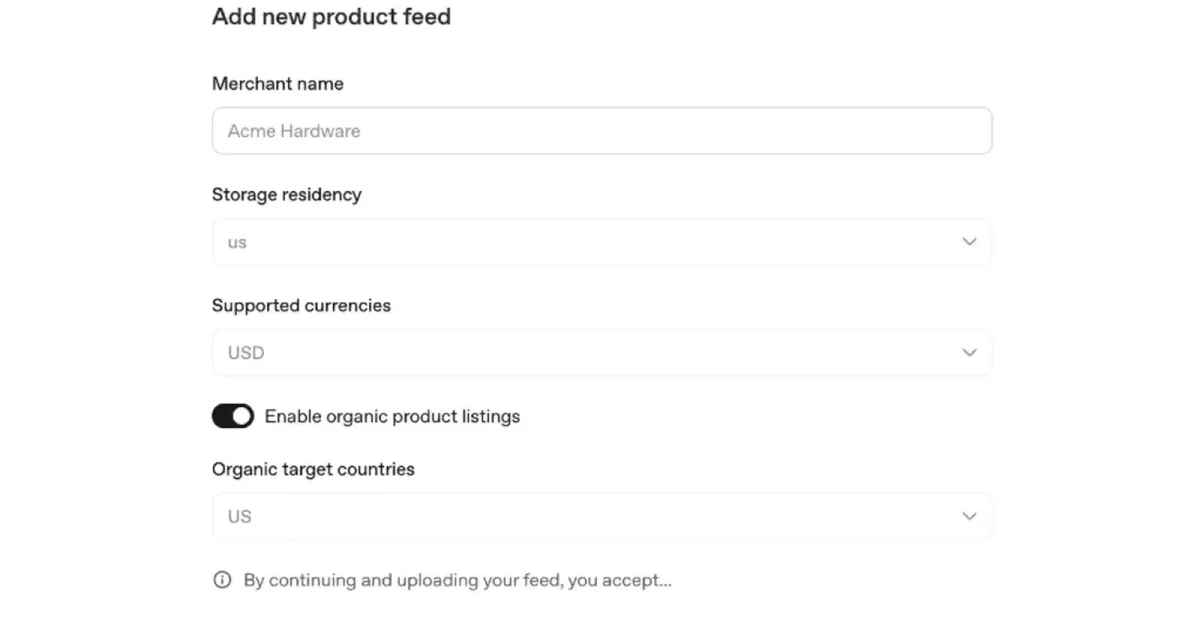
This is the detail that surprises merchants first. Neither ChatGPT nor Gemini supports a call that searches a merchant's catalog on the spot. Merchants push their product feeds in advance, and the platform indexes them for use in answers.
Prio gives two reasons. Sponsored products and retail media require the platform to keep control of ranking. And the engineering load of millions of products answering real-time callbacks on every query is not workable.
The problem is that feed formats are not standardized. "Everyone has an opinion. They think their opinion is the best one, and that's what they're rolling with," is how he put it. The result is separate pipelines for ACP, UCP and Meta. His demo includes a catalog sync step that converts a merchant's own product data into each format so the same inventory reaches all three surfaces.
Two consequences follow for merchants. First, product data hygiene translates directly into exposure. Best Buy's emphasis on consistent product naming and accurate pricing exists so AI systems can interpret the catalog correctly. Second, feed refresh frequency sets a ceiling on lost sales, because stale inventory and pricing surface as out-of-stock errors and price mismatches.
Payments Stay in Human Hands
There is distance between the picture the word autonomous conjures and the actual payment flow. Prio is direct: "We're just not there yet. We're just not confident yet."
Today neither ChatGPT nor Gemini supports fully autonomous payment initiation. ChatGPT routes through a shared payment token, and Gemini accepts payment only through Google Pay. The merchant connects to a payment processor that carries the liability, and a human stays in the loop. Getting a recommendation wrong and getting a payment wrong differ by orders of magnitude in cost, so the caution is a design decision.
AP2 is the bridge. The token issued in his demo carries a maximum amount, a currency, single-use status, and a revocation URL, so authorization can be withdrawn at any time. On top of those primitives he imagines a haggling agent that negotiates with merchants, a nod to his Bangladeshi upbringing, where bargaining is everyday practice.
The demo itself is framed as a bakery run by his orange tabby cat, Ginny. A customer agent talks to a merchant agent over A2A, the merchant agent exposes its capabilities through MCP, and checkout advances through the UCP states of not ready for payment, ready for payment, and completed. When the user asks the agent to invent a discount code, it correctly refuses. Inference runs on Cerebras hardware at 3,000 tokens per second, fast enough to keep the conversation feeling responsive.
An Agent Without Evals Is Whack-a-Mole
The most emphatic part of the briefing is about evaluation. "When we build out this demo and in my time building agentic commerce at Best Buy, we've realized working with AI and conversational experiences without evals is playing whack-a-mole," he said.
The failure mode is concrete. When Chipotle launched its agent, users worked out that asking it programming questions gave them free AI usage without paying for a cloud subscription. In commerce the stakes are heavier: an agent surfacing a discount code it should not, or revealing who else is viewing a product.
| Eval type | What it checks | What happens when it fails |
|---|---|---|
| Behavioral | What the agent answers across scenarios | Leaked discount codes, off-purpose usage |
| Protocol compliance | Whether feeds match the ACP or UCP spec | Platforms reject the ingest |
| Latency | Whether responses keep pace with a shopping journey | Every second of delay leaks sales |
| LLM-as-judge | Answer quality per use case | Quality regressions go unnoticed |
None of the four categories Prio recommends requires exotic tooling. On LLM-as-judge he says it does not need to be fancy: "just talk to product teams and write out use cases." Protocol compliance is the exception in character, since a feed that drifts from the spec gets rejected by the platform, making it a precondition for going live.
The Gap Between Enthusiasm and Results
Everything above is the builder's view. The results side of the market looks different.
Forrester principal analyst Lily Varon wrote in her April 2026 analysis that US consumer adoption of agentic commerce remains low and relatively stagnant. She has previously described the space as a train that has left the station on rickety rails.
OpenAI's Instant Checkout is the clearest illustration. Launched in September 2025, it was reported to be winding down in March 2026. Walmart had offered roughly 200,000 products through it, and purchases completed inside the chat converted at one third the rate of transactions that clicked out to its own site. OpenAI has since let retailers use their own checkout experiences and shifted its own focus to product discovery.
So the plumbing Prio describes is genuinely being laid, while the volume flowing through it is still small. Protocol readiness and consumer behavior are not moving at the same speed. On the infrastructure side, Google added an agent-specific cart and product catalog access plus identity linking for loyalty to UCP in March 2026, with Stripe and Salesforce stating they will implement it. Investment continues.
Where Merchants Can Start
As a decision framework, the ordering is clear. Normalize product data first, because three feed formats built on a broken master record produce three broken feeds. Automate feed generation next, with a conversion step that sends the same inventory to both ACP and UCP.
Payment integration can wait. As long as human approval remains in the flow, letting existing payment processors build out their support is a defensible choice. Forrester's read is consistent with this: Adyen, PayPal, Stripe and Worldpay are all positioning as connectors across multiple protocols.
Prio points to one more path: a custom implementation on your own site. Because the ACP and UCP building blocks are standardized and carefully designed, work done for external platforms can be reused for an in-house shopping agent. For merchants who want less platform dependency, that reuse is a practical exit.
Conclusion
Prio's own summary is restrained. MCP and A2A are widely adopted, UCP and ACP are out there and in use, AP2 is still forming. Identity and consent standards are unresolved, and so is checkout delegation across multiple agents. Whether the industry converges on one standard or keeps maintaining parallel implementations remains an open question.
Best Buy's implementation scale, the number of products covered, and the development cost of dual support are all undisclosed. Even so, feed format fragmentation and eval design are worth acting on before the market forecasts resolve. The next thing to watch is whether payment processors ship a middle layer that absorbs the schema differences between UCP and ACP.