Crossmint Launches Agent Commerce Toolkit, Bundling AI Agent Card Payments and Checkout Into One API
Crossmint's Agent Commerce Toolkit adds Mastercard Agent Pay and auto-selects Shop Pay, UCP, or browser automation per purchase. How it works, why merchants are pushing back on automated checkout, and what ecommerce teams should decide now.

Key Takeaways
- On October 8, 2026, Crossmint launched Agent Commerce Toolkit, a developer toolkit that combines card storage, Visa Intelligent Commerce and Mastercard Agent Pay tokens, and merchant checkout in a single API
- Crossmint's June card API was about giving agents a safe card; this release goes further, choosing among Shop Pay, UCP, and browser automation for each purchase and taking responsibility for completing the order
- Many merchants already reject automated browser checkout, as the default robots.txt on Shopify stores and Amazon's block on Meta's Muse show. Ecommerce teams now need to decide whether to offer agents a sanctioned path of their own
Crossmint launches Agent Commerce Toolkit
Crossmint, the multi-rail payment infrastructure platform, today launched Agent Commerce Toolkit, a developer toolkit that lets AI agents pay with any card and complete purchases at any online store.
www.prnewswire.comCrossmint, which builds stablecoin and wallet infrastructure, released Agent Commerce Toolkit on October 8, 2026. It is a developer toolkit that handles an AI agent's purchase in a single integration, from paying with a card to completing the order at an online store.
The product is live and self-serve, with no sales process required. Crossmint says developers can point a coding assistant such as Claude Code or Cursor at its documentation and get from SDK installation to a working checkout. An open-source reference app is also available on GitHub. Pricing has not been disclosed.
In June 2026, Crossmint released an agentic card payments API built on Visa Intelligent Commerce and Basis Theory (our earlier coverage). That launch was about delegating a user's Visa card to an agent with spending limits and without exposing the card number. This release covers the next step: actually using that card at a real store and completing the order.
Four vendors' worth of work in one integration
According to Crossmint, letting an agent pay today means combining four kinds of vendors: a card vault, a wallet, a browser automation tool, and individual card network programs. When a purchase fails, it is hard to tell which part broke.
Co-founder Alfonso Gómez-Jordana Mañas described what developers run into.
One card works and another doesn't. One store has an API and the next has a bot check. The checkout script that worked yesterday breaks today.
Based on the announcement and the documentation, here is how each step changes.
| Step | What developers stitched together before | How Agent Commerce Toolkit handles it |
|---|---|---|
| Card storage | A separate PCI-compliant card vault | Card entry renders in the developer's UI and goes straight to Crossmint's vault; the developer's servers only receive a token |
| Payment credentials | Separate integrations with each card network program | Visa Intelligent Commerce and Mastercard Agent Pay tokens for eligible cards; an encrypted card from the vault for ineligible ones |
| User approval | Redirect to a third-party wallet app with its own account | Approval inside the agent's own app (passkey in the reference app) |
| Merchant checkout | In-house browser automation or per-merchant integrations | Automatic choice among Shop Pay, UCP, and browser automation for each purchase |
Two differences from the June API stand out.
The first is support for Mastercard Agent Pay. In June, the product covered US-issued Visa cards. The toolkit now uses tokens from both Visa Intelligent Commerce and Mastercard Agent Pay. Both are issued as scoped virtual cards with expiration dates and spending limits, and the documentation argues that a leaked credential is worthless because it is bound to an amount, expires, and is revoked along with the approval.
The second is how the toolkit handles cards that the network programs do not cover. Visa Intelligent Commerce and Mastercard Agent Pay issue tokens only for certain cards. For ineligible cards, the toolkit takes the card stored in the vault, encrypts it to a key only the agent holds, and completes the payment within the approved amount. The "any card" in the headline depends on this fallback. Which cards in which countries qualify for the network programs is not stated in the documentation and remains undisclosed.
User approval also now stays inside the agent's own app. In the reference app, the agent requests a budget with an amount, merchant, and expiry, and the user approves it once with a passkey.
The core: choosing a checkout path for each purchase
The newest part of the release is merchant checkout. The agent asks for a purchase in plain language, and the toolkit handles the exchange with the store. For each purchase, it compares availability, reliability, and cost and picks one checkout method.
There are three options: embedded payment options such as Shop Pay, agentic commerce protocols such as the Universal Commerce Protocol (UCP, a purchasing standard for agents backed by Google and others), and browser automation where neither exists. Crossmint's claim is that developers do not need to integrate each protocol separately and merchants do not need to add agent support.
Why does path selection matter? Crossmint's "How Agents Buy" page argues that each existing approach covers only part of the market. Very few merchants expose a purchase API. Protocols such as UCP, ACP, and AP2 are early and fragmented, and many implementations return a checkout link instead of completing the purchase. Browser automation reaches any store a human could buy from, but it is slow and brittle, and with frontier models a single checkout can cost several dollars in tokens, according to the company.
The spec for "Agent Checkouts," the product that runs checkout, includes several details merchants should note.
- It never spends above the cap the developer sets, and each run ends with a receipt carrying the merchant order ID, a safe blocked outcome, or a clear failure reason
- Raw card details never appear in the request or the message history; at payment time only the ID of an approved "order intent" is passed
- The live browser session can be shown to the user, and the agent asks the user only for missing information
- Signed-in merchant sessions can be saved and reused, giving later checkouts access to member pricing and saved addresses
- It runs in production only, with no staging environment
The last point is easy to miss. The press release says test cards are available for quick testing, but checkout itself only runs in production. The reference app also stresses that its purchases are "live purchases, not a simulation." In other words, real orders hit real stores from the moment a developer starts trying the toolkit.
"No merchant changes needed," and the stores that say no
The promise that agents can buy without any merchant work is appealing to agent developers. From the store's side, though, it means unrequested browser automation arriving at checkout. That runs straight into a pushback that is already visible.
The default robots.txt on Shopify stores contains the line "Checkouts are for humans." It prohibits scripted form fills, browser automation, and end-to-end agent flows that finalize payment without an explicit, contemporaneous human approval step. Instead, it directs agents to UCP/MCP endpoints or Shopify's shopping skill, both of which require buyer approval before payment. According to Forkast, the policy took effect on July 15, 2025. The robots.txt file is an advisory directive, however, not a technical block.
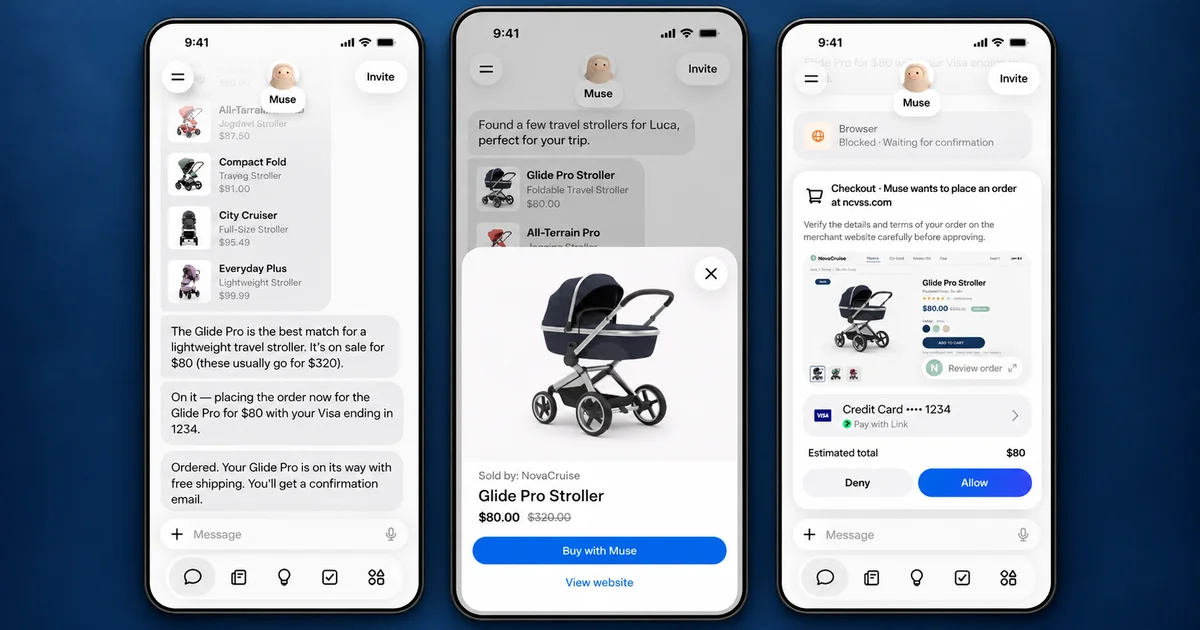
Amazon went further. On the night of September 20, 2026 (US time), it began blocking Muse, the AI agent Meta launched in September, from its site. Muse users trying to shop on Amazon see a message saying that access by an unauthorized AI agent violates Amazon's Conditions of Use. Adweek reported that Amazon objected to receiving no advance notice or authorization, to Muse not identifying itself, and to Muse appearing to store customer credentials and scrape account data. We covered the background in our piece on Muse and Shop Pay.
The blocking is not an isolated clash. In Jefferies research reported by Proactive Investors, Muse was tested on several hundred leading US ecommerce, airline, hotel, and reservation sites. About one-third blocked it, about one-third challenged or restricted it, and only the remaining third were easy to navigate. Jefferies said new restrictions were appearing almost daily, making site access, rather than model quality, the main bottleneck for agentic commerce.
Crossmint's announcement does not address how the toolkit deals with these merchant policies. Whether its browser automation identifies itself as an agent to the store is also undisclosed. Per-purchase routing leaves room to choose Shop Pay or UCP at Shopify stores, which those stores accept. At stores without any protocol, however, the fallback is exactly the kind of access Shopify and Amazon are pushing back on.
Liability is unsettled too. Forkast cites PYMNTS Intelligence data from September 2026 showing that 93% of merchants believe AI providers should bear losses from agent errors. Payment systems still have no standard reason code for "agent error."
What ecommerce teams should decide
As toolkits like this spread, agents will reach store checkouts without their developers negotiating with each merchant. For ecommerce teams, the question shifts from "whether to accept agents" to "through which path."
Start with how paths get chosen. Crossmint says it routes by availability, reliability, and cost. Stores that support UCP or offer embedded payments such as Shop Pay are the ones that get priority over browser automation. If you offer a structured entry point, you can pull agent orders into it. Without one, the choice narrows to agents operating your pages or blocking them and giving up the sale.
Next, consider how these transactions reach you. For the fallback that uses an encrypted ineligible card, Crossmint's materials do not say whether the merchant receives anything identifying the payment as agent-initiated. How you will recognize agent transactions is worth confirming with your payment service provider, not least for fraud rules.
Finally, publish a policy. Amazon lists its conditions: agents should operate transparently, let services opt out, offer a mutual value exchange, and improve the customer experience. Shopify spelled out its preferred paths in robots.txt. Stating which paths you accept and which you refuse, in robots.txt, your terms of service, and an agent-facing endpoint, is the basic preparation.
Summary
Agent Commerce Toolkit packs two hard problems, delegating a card and completing checkout, into one API, so agent developers can build all the way to "buy" without becoming payment experts. Where the June card API sorted out the means of payment, this release takes on the connection to the merchants being paid.
Part of that checkout, though, relies on the browser automation stores are trying to refuse. The thing to watch is how far per-purchase routing shifts toward merchant-sanctioned paths such as UCP and Shop Pay. That depends on how many merchants build structured entry points.