AI Commerce News Digest (August 20, 2026)
AI commerce news for August 20, 2026: U.S. retail homepages average 61% machine readability in Adobe's measurement, Stripe agreed to acquire AI gateway OpenRouter, and OSL launched stablecoin payment rails for AI agents.


Key Takeaways
- Adobe measured average machine readability of U.S. retail homepages at 61%
- Stripe agreed to acquire AI gateway OpenRouter, uniting payments and AI usage billing
- Payment rails for agents keep advancing, yet the question of liability remains open
Here is the AI commerce news for August 20, 2026. Two questions moved in parallel today: whether agents can read you, and whether they can pay. Yesterday we covered deployment results at JB Hi-Fi and 11st Street, and today the story is the groundwork underneath them. AI-referred traffic keeps climbing, yet 40% of the sites receiving it are not readable by machines. On the payments side, Stripe and OSL both laid down rails, while the question of who is responsible when something goes wrong stayed unanswered.
Today's Top Stories
U.S. retail homepages average 61% machine readability

Artificial intelligence continues to drive higher amounts of online retail visits, but e-commerce sites are frequently not optimized for it.
chainstoreage.comAdobe released July 2026 data showing AI-referred traffic to U.S. retail sites up 62% year over year, and up 1,219% cumulatively since measurement began in October 2024. Conversion from AI sources ran 60% higher than non-AI traffic, marking the eleventh consecutive month of that advantage. Visitors also spent 59% more time on site, bounced 33% less, and added items to cart at a 28% higher rate.
What stands out is not the volume but what happens next. When Adobe widened its analysis to a broader set of U.S. retail sites, average homepage machine readability came in at 61%. The April figure was 75%, but Adobe attributes the change to the expanded sample rather than a decline in the same cohort. Roughly 40% of homepage content is not visible to shopping agents.
By vertical, apparel led at 76% and grocery trailed at 59%, a 17-point spread. Because the score depends on what appears in the HTML before JavaScript executes, categories that render prices and inventory dynamically score worse by construction. Quality traffic keeps arriving at the front door while 40% of the shelves stay invisible.
Full article: U.S. Retail Sites Average 61% Machine Readability, Leaving Nearly 40% of Homepages Invisible to AI Agents
Stripe agrees to acquire AI gateway OpenRouter

Stripe, the programmable financial services company, today announced that it has agreed to acquire OpenRouter, a leading AI model gateway and routing platform.
stripe.comStripe announced on August 19 that it had agreed to acquire OpenRouter, the AI gateway that routes requests across more than 400 models from over 80 providers, with users including NVIDIA, Zoom, and Lovable. Stripe did not disclose the price or the expected closing date. Bloomberg reported the deal at over $7 billion.
What Stripe is claiming is the billing and metering layer for AI usage itself. The company already co-authored the Agentic Commerce Protocol with OpenAI and handles agent-driven checkout. Machine-to-machine token spend and agent-driven consumer purchases now sit inside the same company.
For e-commerce operators, that means the cost of running search and support and the revenue line of checkout increasingly converge on a single vendor. Counterweights remain: routing layers commoditize easily, and research showing that Chinese-origin models account for a substantial share of U.S. enterprise token usage raises regulatory and neutrality questions for a gatekeeper.
Full article: Stripe Agrees to Acquire OpenRouter, Bringing AI Token Billing and Agent Payments Under One Roof
Agentic Commerce
Agent payments are solved, liability is not

Since AI initially went mainstream, users immediately began leveraging it for shopping and product discovery. As a result, it has quickly risen to one of the most influential shopping sources for consumers behind search engines.
innotechtoday.comPetr Marek of InvoiceHome argues that the final barrier in agentic commerce is not payment technology but responsibility. In the company's consumer research, 53% of shoppers worried that an agent would make purchase errors without flagging them, and 42% worried a bot might share their financial data with third parties.
The payments side has moved. Visa secured payment credentials, defined user permissions and spending controls, and strengthened fraud detection. Marek notes that these mechanisms stop transactions that should not go through, but they cannot help an agent interpret a request correctly.
Failure is not the only risk. Parameters can be met, payment can clear, and the order can arrive, and the shopper can still receive something they did not intend. Merchants that adopt quickly without their own safeguards end up absorbing the returns and disputes.
Preparing a brand for AI agent discovery

Being included in an AI answer isn't the same as being chosen. Here's what determines the difference.
martech.orgAngelina Eng of Enso Horizon separates appearing in a generative AI answer from actually being chosen. Describing her own search for lodging through Gemini, she notes the assistant did not simply find options, it evaluated them. The question for marketers is not whether the brand showed up but what the AI decided about it.
Most product and service information was written for people rather than machines. Eng points to OpenAI's Agentic Commerce Protocol and Google's Universal Commerce Protocol as open standards meant to make structured product data, checkout, payments, and order management interoperable.
Consumer readiness lags the infrastructure. Asking AI for a recommendation is one thing; letting it sign into an account and use a stored card is another. The rails are being built while shoppers still want the final say.
Payments and Fintech
OSL launches stablecoin payment rails for AI agents

OSL Group has launched AgentPay, a stablecoin infrastructure that allows developers to process micro-payments between AI agents.
fintechnews.hkHong Kong's OSL Group launched OSL AgentPay, a stablecoin infrastructure that lets AI agents execute payments autonomously. It targets high-frequency, micro-value transfers between agents and supports multiple stablecoins including USDT, USDC, and the group's own USDGO.
Supported protocols include x402, AP2, and MPP, with developers integrating through an API. Developers express payment intent such as amount, asset, and payee, and AgentPay handles routing, signing, and settlement. Fiat on- and off-ramps will be integrated progressively through group company Banxa.
OSL plans to work with developers across Asia first, then pursue global enterprise opportunities. Building the rails ahead of a world where every agent action triggers a small payment echoes the logic behind Stripe's move.
UnionPay and Standard Bank expand e-commerce acceptance across nine African markets

Through the partnership, online merchants in Botswana, Ghana, Kenya, Malawi, Namibia, Tanzania, Uganda, Zambia and Zimbabwe can now offer secure UnionPay e-commerce acceptance, with nearly 900 participating merchants across the continent.
techafricanews.comUnionPay International and Standard Bank Group expanded UnionPay online acceptance across nine African markets: Botswana, Ghana, Kenya, Malawi, Namibia, Tanzania, Uganda, Zambia, and Zimbabwe. Nearly 900 merchants across the continent now participate.
Merchants can accept online payments from UnionPay cardholders, opening broader access to cross-border transactions. The move targets Chinese travelers and businesses operating across multiple markets.
In markets where payment options are limited, adding a card brand translates directly into fewer abandoned carts. For merchants planning international expansion, payment infrastructure in Africa is a precondition rather than an afterthought.
AI Commerce Tools
Queen One raises $25M to scale its AI commerce platform

Queen One Raises $25M to scale AI commerce infrastructure, expand advertising and support brands migrating from legacy platforms.
ventureburn.comQueen One raised $25 million led by Mercury Fund, with Full In, Connecticut Innovations, and CP Overture participating alongside Charge Ventures and Inspired Capital. Total funding now exceeds $37.5 million.
Founded by former Wunderkind executives Ryan Urban and Maricor Resente, the company says more than 30 specialized AI models power a platform that unifies recognition, product intelligence, creative intelligence, CRM, and advertising. It claims technology cost reductions of 50% to 75% and counts more than 300 launch partners.
The capital goes toward expanding the commercial organization, accelerating AI infrastructure development, launching a new advertising business, and supporting migrations off legacy commerce platforms. The pitch is a single layer in place of a fragmented stack.
Meesho builds its own LLM for Indian addresses

Meesho's custom tokenizer has been trained on 67 million Indian addresses.
analyticsindiamag.comIndian e-commerce platform Meesho developed a language model specialized for parsing addresses. Indian addresses are often written as directions, such as behind the Hanuman temple or opposite the grocery shop, and inconsistent spellings and missing house numbers compound the difficulty for machines.
The company built a custom tokenizer trained on 67 million Indian addresses to convert informal notation into a form systems can act on. It is a case of solving a delivery-critical problem with domestic data rather than a general-purpose model.
Because the work maps directly to logistics costs and failed-delivery rates, results show up quickly in the numbers. Meesho has also disclosed that more than 75% of its orders now come through personalized feeds, extending AI from discovery through to delivery.
Logistics and Fulfillment
Amazon expands drone delivery to roughly 500 U.S. locations

The e-commerce giant will soon launch Prime Air deliveries in metro Atlanta, Chicago and Cleveland, giving customers another fast shipping option.
www.supplychaindive.comAmazon plans to expand Prime Air drone delivery to nearly 500 U.S. cities and towns by the end of 2026, roughly a sixfold increase from the current 11 sites across seven states. The company says it has completed hundreds of thousands of deliveries this year, with some packages arriving in as little as 30 minutes.
The service carries packages up to five pounds, a threshold Amazon says covers more than 60% of its most commonly purchased products, including groceries, medications, and electronics. Prime members pay nothing on orders of at least $50, while smaller Prime orders cost $2.99 and non-members pay $4.99.
Competition is active: Alphabet's Wing has passed one million commercial deliveries and Zipline more than two million worldwide. Amazon holds FAA Part 135 certification, but federal investigations following accidents in Arizona and Texas remain a constraint on expansion.
Walmart installs its first Symbotic in-store fulfillment system
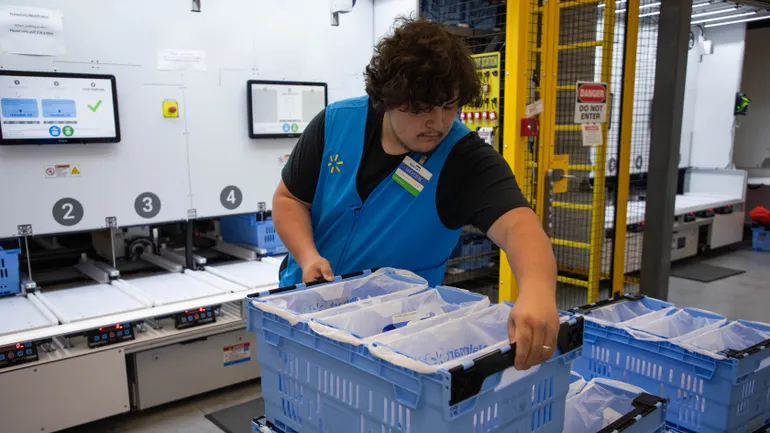
The SymMicro system is expected to come to life in about six months, advancing the retailer's efforts to accelerate in-store pickup and delivery operations.
www.retaildive.comSymbotic began installing SymMicro, an automated e-commerce fulfillment system, in the back of a Walmart store. President and CEO Richard Cohen expects the system to come to life in about six months, advancing a partnership the two companies announced last year.
SymMicro is designed to fit into the back of a retail store and turn the backroom into an automated inventory and order fulfillment operation. Walmart is purchasing 400 systems under the agreement, and Symbotic plans to overbuild the first installation to prove it works before redesigning for a smaller, cheaper footprint.
Using the store network as fulfillment capacity directly determines pickup and same-day delivery speed. A second site follows shortly, with wider rollout expected once Walmart sees results.
Corporate Moves and Partnerships
Seel launches resale for items past the return window

Seel, an AI-driven operations platform for commerce, today launched a new resale capability within its order center that allows shoppers to recover value from their gently used clothes when they are no longer eligible for a return or refund.
www.forbes.comSeel, an AI-driven commerce operations platform handling $6 billion in GMV annually, added a resale capability inside its order center. Shoppers can recover value from gently used clothing once the retailer's return window has closed.
AI handles the work. The platform generates listings, cross-posts to seven marketplaces, manages inventory, and fulfills orders, removing the friction that keeps most shoppers out of secondhand selling. The company says it scaled 7x over the past year to a profitable triple-digit revenue run rate.
CEO Zack Peng frames AI as a way to create customer experiences that extend the relationship past the initial purchase. Secondhand still accounts for less than 3% of U.S. e-commerce, so reducing friction is where the opportunity sits.
TikTok cuts 75 e-commerce jobs in the Seattle area

TikTok is laying off 75 workers in Bellevue, most of them in TikTok Shop and Global E-Commerce roles, according to a notice filed with Washington state.
www.geekwire.comTikTok is laying off 75 workers in the Seattle region according to a notice filed with Washington state. The roles are almost entirely in TikTok Shop and Global E-Commerce, based in Bellevue.
Affected titles include anti-fraud and governance program managers, seller and creator operations staff, campaign managers, data scientists, and backend and frontend engineers. The notice was filed by TT Commerce and Global Services LLC on TikTok letterhead, with a separation date of October 19.
The company had used the Seattle region as the base for its commerce push, expanding its Bellevue offices as the business grew. The cuts land on the core team behind TikTok Shop, the in-app business that lets brands and creators sell directly through videos and livestreams.
Global E-Commerce
China blocks cooperation with the EU's JD.com probe

China said on Wednesday that a European Union investigation into Chinese e-commerce giant JD.com constituted improper extraterritorial jurisdiction and ordered entities not to implement or assist with the probe.
www.reuters.comChina said on August 19 that the European Union investigation into JD.com constitutes improper extraterritorial jurisdiction, and its justice ministry ordered entities not to implement or assist with the probe.
This is the second time China has invoked its regulations countering unlawful extraterritorial jurisdiction measures. Introduced in April 2026, the rules expanded Beijing's economic pressure toolkit amid strained ties with trading partners including the EU.
The EU issued a formal warning to JD.com over the Ceconomy deal in July. European expansion by Chinese commerce platforms remains a regulatory flashpoint, with implications for how cross-border sellers choose partners and route logistics.
Wrapping Up
Two layers are hardening around agents at once. On the payments side, Stripe and OSL each laid rails from their own position, and machine-to-machine payment became a shippable product rather than a concept. Adobe's 61% points the other way: the side that has to hand over product information is not ready.
Liability is still unresolved. Payment can clear and the package can arrive, and a mismatch with intent still becomes a dispute. The more the machinery firms up, the more visible that gap becomes.
Peak season is just under four months out. Measuring how much of your product page a machine can actually read is one of the few preparations that still fits in the window.