
AI Commerce News Digest (August 21, 2026)
AI commerce news for August 21, 2026: Alibaba merged three e-commerce units and spun out Qwen, Target disclosed AI-sourced traffic growing 3.5x the industry rate, and OpenAI is expanding ChatGPT Ads to 31 European markets.


Key Takeaways
- Alibaba merged three e-commerce units and spun Qwen out as its own segment in a quarter with net income down 75%
- Target disclosed that traffic from external AI platforms is growing more than 3.5 times faster than the industry
- OpenAI expands ChatGPT Ads to 31 European markets on August 24, accelerating commercialization of the answer surface
Here is the AI commerce news for August 21, 2026. Two giants, one in the East and one in the West, used earnings in the same week to show where their AI investments currently stand. One reshaped its org chart around agentic commerce even at the cost of 75% of its profit, while the other said traffic from external AI is growing 3.5 times faster than the industry and then acknowledged that the volume is still small. As a follow-on to Adobe's 61% machine readability figure covered yesterday, a survey from inriver showed that companies claiming to be ready scored zero against the operational benchmark. The pattern holds again today: the entrances are widening faster than anyone is preparing to receive what comes through them.
Today's Top Stories
Alibaba merges three e-commerce units and spins Qwen into its own segment
Alibaba is focusing on agentic commerce innovations as it spends heavily on artificial intelligence.
www.pymnts.comAlibaba reported its June quarter on August 20: revenue of RMB268.9 billion, up 9% year over year, and net income of RMB10.4 billion, down 75%. Capital expenditure swelled to RMB67.7 billion, a 75% increase from the prior year. The profit decline came from deliberate technology spending rather than any slowdown in demand.
The restructuring announced the same day will matter longer for e-commerce operators. China commerce, international commerce, and Freshippo were bundled into a newly created Alibaba E-commerce Group, and the Qwen business became a standalone segment called AI Labs and Applications. The line that once separated domestic retail from cross-border trade is gone, and everything from model development to consumer applications now sits in a single box. The reporting structure itself has been rebuilt around agentic commerce.
There are user-side numbers as well. A cumulative 250 million people have now had their first AI-led shopping experience through the Qwen app. Transaction value completed through AI and retention rates were not disclosed, so the distance between the size of the entrance and actual revenue remains untested. The market response was not straightforward either, with the stock falling after the report.
Full article: Alibaba Merges Three E-Commerce Units and Spins Out Qwen: The 75% Profit Drop Behind Its Agentic Commerce Bet
Target says traffic from external AI is growing 3.5 times faster than the industry

As more consumers begin to explore the benefits of agentic shopping, Target's digital traffic sourced from external AI platforms is growing more than 3.5 times the industry.
aimmediahouse.comOn the August 19 earnings call, Target CEO Michael Fiddelke pointed to two AI metrics. The first was that traffic from external AI platforms such as ChatGPT and Google Gemini is growing more than 3.5 times faster than the industry average. Neither the definition of that industry comparison nor the underlying numbers were disclosed, and Fiddelke himself described the channel as still small in total.
The second metric is the more practical one. For the AI wish lists aimed at teachers and college students, list creations rose more than 50% year over year, items added more than doubled, and conversion on back-to-school pages improved by nearly 20%. That result came not from external referrals but from placing AI recommendations inside Target's own app.
For the quarter as a whole, revenue reached $26.5 billion, up 5.3%, with comparable sales up 3.8%. Price cuts on more than 10,000 items and major collaborations ran during the same period, so the conversion improvement cannot be attributed to AI alone. The sequence that emerges is clear: AI traffic is something to measure and prepare for, while AI deployed on your own surfaces is where results can be verified first.
Full article: Target's Q2 AI Disclosures: 3.5x Industry AI Traffic Growth, but the Wish List Conversion Lift Matters More
Agentic Commerce
ChatGPT Ads reaches 31 European markets on August 24, with ads in 32% of answers

ChatGPT Ads is expanding to 31 European markets. Learn how advertisers can reach people as they explore, compare and decide.
openai.comStarting August 24, OpenAI is expanding ChatGPT Ads to 31 European markets including Germany, France, Spain, Italy, and the Netherlands. Since the U.S. pilot began in February, the company has added eight markets including Canada, the U.K., Japan, and South Korea, but this move covers more countries at once than all of those combined.
Ads reach only users on the free plan and the Go plan at 7.99 euros per month, with no ads shown on Plus or higher paid tiers. Buying runs through OpenAI's Ads Solutions team and through agency and technology partners, with the self-serve Ads Manager arriving later and no specific European availability date disclosed.
The measured delivery volume is what deserves attention. According to Promptwatch, 32.4% of ChatGPT answers involving web search contained an ad over the past seven days, with the 90-day average at 20.1%. That figure was zero until late May. This reflects one particular measurement scope rather than a country-level benchmark, so it should be read as an indicator of how quickly the AI answer surface is being commercialized as paid inventory.
Full article: ChatGPT Ads Reaches 31 European Markets, and Ads Now Appear in 32% of Answers
Unilog launches CX1 Sigma, an AI-native B2B commerce platform
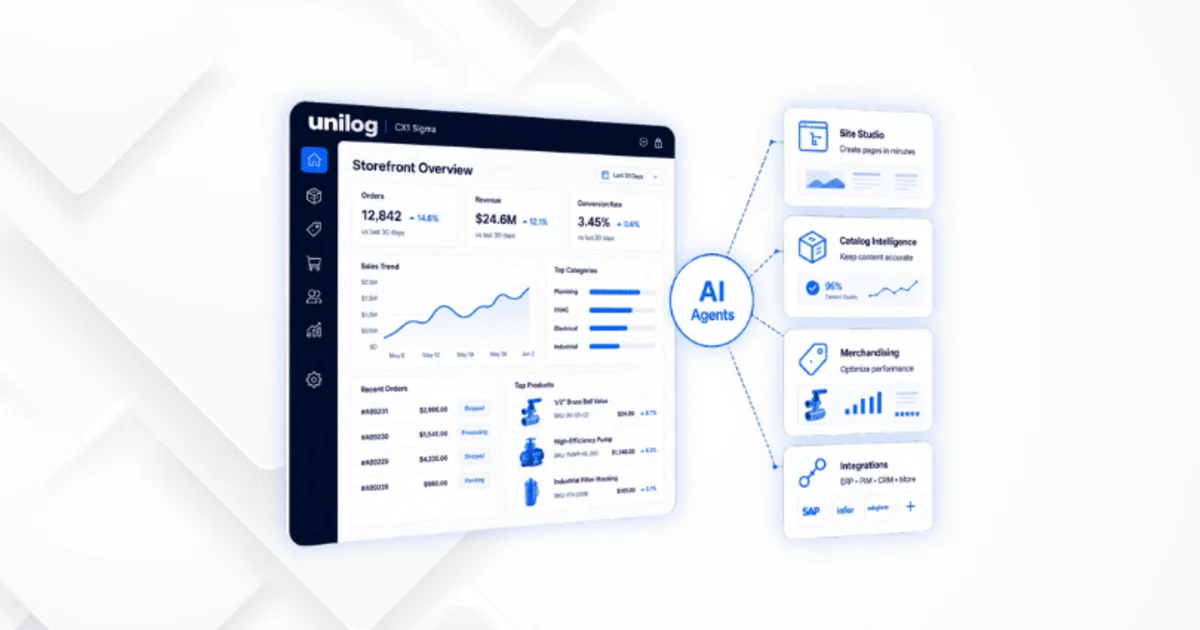
Dubbed CX1 Sigma, the AI-native B2B commerce platform combines commerce, content and AI-powered agents in one system.
www.mdm.comUnilog announced CX1 Sigma on August 20, a new B2B commerce platform built for wholesale distributors. The design brings commerce, content, and AI agents together in a single system.
At its core is the HyperScale Growth Agent Suite, with agents mapped onto the flow of acquiring demand, converting it, and running operations. Site Studio assembles production-ready pages from plain-language descriptions or a URL, and automatically applies the structure required for discovery through search and AI. The company also claims self-healing that detects and fixes problems before customers notice them.
Whether capabilities like these deliver still depends on the quality of the underlying product data. In research from Master B2B, data quality ranked as the single largest barrier to B2B e-commerce growth for the second consecutive year. Pricing, availability timing, and customer deployments were not disclosed.
AI Commerce Tools
Of 117 companies claiming full agentic commerce readiness, none met the benchmark

Of the 117 organizations that claimed to be fully prepared for agentic commerce, not a single one met the operational benchmark.
www.sdcexec.comProduct information management vendor inriver published a benchmark study on product data maturity in manufacturing. Among the 117 organizations that said they were fully prepared for agentic commerce, not one met the operational benchmark.
Looking at the details, roughly half experience integration failures between product data systems at least once a month. Only 13.6% have implemented end-to-end automation with audit trails, and fewer than one in three keep more than 85% of active SKUs continuously publishable. Under 12% regularly monitor answer engine optimization (AEO) data.
CMO Jay Roxe described the confidence as genuine but uncalibrated. The problem is not a lack of ambition or awareness around AI, but an inability to see accurately what state their own product data is actually in. Read alongside yesterday's Adobe research on machine readability, it shows how far behind the receiving end is in preparing for AI-referred traffic.
Corporate Moves and Partnerships
Walmart raises its full-year outlook, and the stock falls 9% despite digital growth

Walmart beat Wall Street expectations for its fiscal second-quarter sales and hiked its full-year outlook. CFO John David Rainey said tariff refunds will be used to lower prices.
www.cnbc.comWalmart's fiscal second quarter of 2027 delivered revenue of $187.9 billion, up 5.9% year over year and ahead of market expectations. The company raised its full-year outlook. Net income of $6.37 billion declined from a year earlier, while gross margin rose to 25.4% with support from tariff refunds.
The digital side is where growth sits. Membership income rose 17% companywide, and Walmart+ posted a record quarterly net addition. Global advertising revenue rose 38%, continuing a pattern in which pickup and delivery, the marketplace, and advertising lift overall margins. CFO John David Rainey said the $2.9 billion in tariff refunds would fund price reductions.
The stock still fell 9%. U.S. comparable sales growth came in below expectations, and the view spread that falling prescription drug prices would weigh on results. Even with e-commerce and advertising growing, the market is still grading the company on total growth including stores.
Rosenblatt initiates coverage on e-commerce names, splitting on who benefits from AI
Rosenblatt starts Shopify (SHOP) at Buy with a $175 target.
seekingalpha.comRosenblatt Securities initiated coverage across a set of e-commerce names in quick succession. It started Shopify at Buy with a $175 price target and took a bullish view on Etsy and eBay, while rating Chewy Neutral.
On Etsy, the firm judged that gross merchandise sales had improved for four consecutive quarters and reached an inflection point. Selling Depop to eBay for $1.4 billion narrowed management focus onto the higher-margin core business, and adjusted EBITDA margin reached 29.2% in the first half of 2026. For Wayfair, analyst Scott Devitt positioned the company as an AI beneficiary with 17% upside.
More important than the ratings themselves is that how well a company uses AI has settled in as an axis for evaluating individual names. Market attention is shifting from what a company announced about AI toward where differences in execution are showing up.
Global E-Commerce
JD.com offers EU remedies as the Ceconomy deal reaches a decisive stage

Chinese e-commerce giant JD.com has offered remedies in the European Union's probe of its $2.5 billion bid for German electronics retailer Ceconomy.
www.reuters.comA regulatory filing revealed that Chinese e-commerce group JD.com has offered remedies in the EU review of its acquisition of German electronics retailer Ceconomy. The deal is valued at $2.5 billion. The substance of the proposed remedies was not disclosed in the filing.
The European Commission opened an in-depth investigation in May under the Foreign Subsidies Regulation (FSR), citing concerns that foreign subsidies JD.com may have received could distort competition. The Chinese government has pushed back, calling the investigation improper, which has added diplomatic friction.
For a major Chinese platform, acquiring a physical store network in Europe is far from trivial. Designs that combine stores with inventory and pickup become more valuable as agent-driven purchasing spreads. How the review lands will shape the pace of European expansion by Chinese platforms.
Payments and Fintech
Recurly integrates chargeback specialist Justt, targeting subscription disputes

Chargebacks have plagued the card-payments economy for years, leading payments providers to seek solutions. The latest move involves subscriptions.
www.digitaltransactions.netRecurly, which handles roughly $16 billion in annual subscription payments, announced an integration with chargeback management provider Justt. The aim is to automate evidence collection and raise the win rate on disputes.
Chargeback rates for subscriptions and digital goods run between 1% and 1.85% of transactions, well above the 0.5% to 0.9% average across e-commerce. Mastercard research puts the average subscription chargeback at $69, and Datos Insights projects merchant losses growing from $36.9 billion this year to $46.1 billion by 2029.
As AI agents begin handling subscription signups and cancellations, proving after the fact who actually consented becomes harder still. Automated evidence collection is an area that grows more important as agent-mediated transactions increase.
Logistics and Fulfillment
Amazon signs a global supply agreement with AutoStore, with no purchase commitments
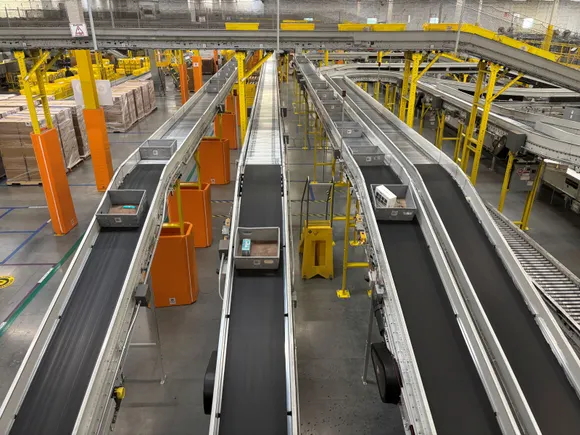
The agreement, which doesn't include any purchase commitments, adds to the e-commerce giant's efforts to boost its automation.
www.supplychaindive.comFulfillment technology provider AutoStore agreed to a framework deal to supply products and services to Amazon globally. According to the company, the agreement sets the terms for future procurement of AutoStore systems and includes no purchase commitments at this point.
AutoStore provides automated storage and retrieval systems for e-commerce operators and 3PLs. Robots move stacked bins and bring the needed items to workers, delivering high throughput in a limited footprint. Amazon has been rolling out its own in-house robotics in parallel.
Putting a framework in place with an outside vendor signals a decision not to confine automation to internally designed systems. As agent-driven orders increase, order sizes get smaller and lead-time demands get tighter. Warehouse throughput becomes the constraint that determines how fast AI commerce can actually move.
Consumer Trends
In Southeast Asia, 24% use generative AI to shop, while human recommendations still drive purchases

Two in three consumers buy on creator recommendations.
asianbusinessreview.comA Southeast Asia study from impact.com, Cube, and Dentsu found that while generative AI is becoming a new entry point for product discovery, trust in people still decides purchases. The survey covered 2,400 consumers.
On influence, recommendations from family and friends scored 2.42 out of 4, online reviews 2.36, and creators 1.98. 67% said they had purchased a product after a creator recommendation. Generative AI is used by 24% for shopping, rising to 28% during the product research stage. By country, Vietnam led at 34% while Singapore came in at 14%.
E-commerce sales in the region are projected to reach $219 billion in 2026, up roughly 15% year over year. The picture is one of divided roles, with AI handling discovery and people providing corroboration. Even when building for agents, the trust signals such as reviews and creator voices need to be present in the product data.
Advertising and Retail Media
Google expands AI Max testing, adding A/B tests for budget and ROI targets in September

Use new AI Max tools, like A/B tests and performance planners for budget and bidding changes, to maximize your results.
blog.googleGoogle expanded the testing capabilities around AI Max. Starting in September, advertisers can run A/B tests that vary budget and ROI targets across multiple search campaigns as a single experiment.
Google also added the ability to run experiments while brand and location controls stay enabled. Until now, granular targeting controls and testing automation were hard to combine, which gave advertisers a reason to hold back. Performance Planner estimates how bid and budget changes would affect results in existing campaigns and lets advertisers apply the recommendations directly.
The wider the scope handed to AI, the harder it becomes to isolate what worked. The fact that experiment design is now being built into the product means the foundation for advertisers to account for their results is starting to come together.
Wrapping Up
Line up the numbers that came out of earnings season and AI commerce reduces to a single sentence: the entrances are widening fast, and the receiving side is behind. Both Alibaba and Target acknowledged that a gap remains between what they are investing in AI and the metrics they can point to. One rebuilt its org chart, and the other is verifying results inside its own app.
OpenAI, meanwhile, is not slowing the pace at which it turns the AI answer surface into paid inventory. Ads appearing in roughly 30% of answers means AI-driven product discovery has entered a stage that requires designing for both paid and organic exposure. As the inriver study showed, the prerequisite work on product data is in a state where companies saying they have it handled are not actually meeting the benchmark.
ChatGPT Ads begins serving in Europe next week. How delivery volume and ad presentation shift, and where the first cases of AI-referred traffic converting into real transactions emerge, are the next things to watch.