Oxfam GB Grows Daily Listings 292% with AI: Why Product Data Granularity Decides AI-Era Discovery
Oxfam GB signed with AI resale listing platform Thriftify after a pilot lifted daily listings 292% and average sale price 24%. What the underlying attribute data means for AI-driven product discovery.

Key Takeaways
- Oxfam GB signed an enterprise agreement with Thriftify, an AI listing platform built for resale, after a pilot grew average daily online listings per lister by 292%
- The driver was not photo automation but data: listing data per item grew up to 1,200%, with size grids, fabric composition, fit, rise and season filled in automatically
- That same structured data is what AI agents need to understand, compare and recommend products. Merchants should audit whether their own product data is granular enough for machines to read
Oxfam GB signs with Thriftify after a pilot lifts daily listings 292%
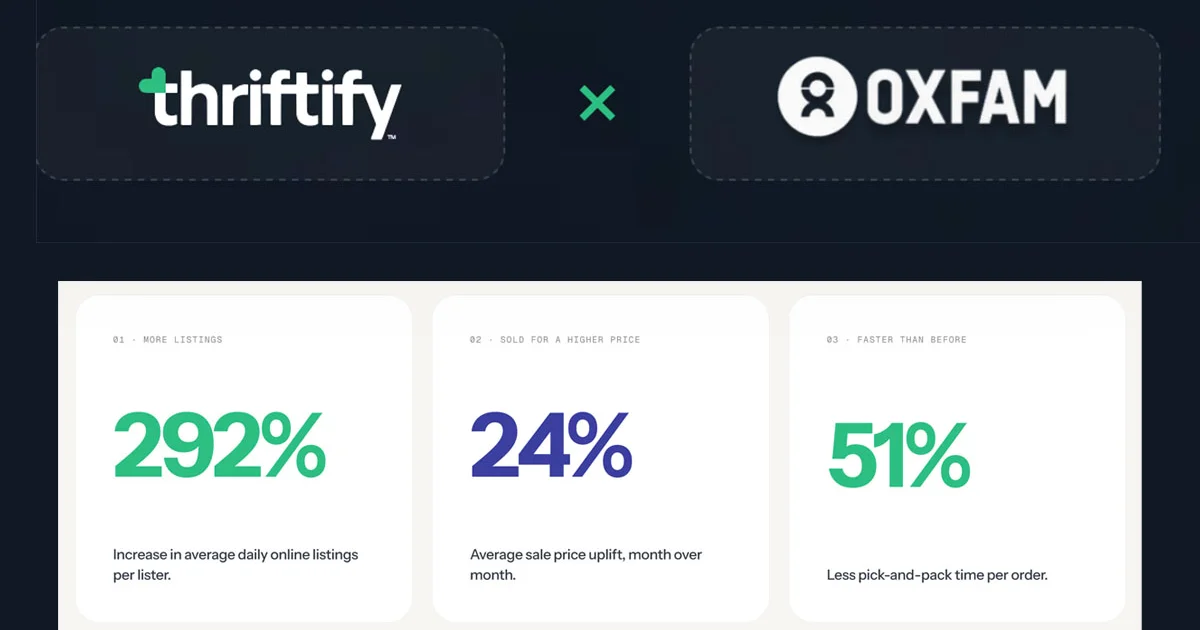
Thriftify grew Oxfam's daily online listings 292%, lifted ASP by 24% month-on-month, and cut pick-and-pack time per order by 51%
channelx.worldOn August 24, 2026, ChannelX reported that UK charity Oxfam GB had signed an enterprise agreement with Thriftify, the omni-channel listing platform built for resale. The deal followed a pilot.
Three numbers define it. Average daily online listings per lister grew 292%, average sale price rose 24% month-on-month, and pick-and-pack time per order fell 51%. Thriftify's published Oxfam GB case study calls this the e-commerce hat-trick.
Scale makes the result easier to read. According to the same case study, Oxfam GB runs around 500 shops across the UK, booked £102.8m in retail gross income in FY23/24, and processes more than 12,000 tons of donated clothing a year. Getting that volume of one-of-a-kind stock online with limited staff was the structural bottleneck.
Julie Tyrrell, who leads e-commerce and retail sustainability at Oxfam GB, framed it in terms of mission funding.
Every pound we generate from donated goods is a pound we can put towards our work fighting poverty. Thriftify's platform is enabling us to list more items, sell them at a higher Average Sale Price and a faster Sell Through Rate.
The result came from attribute granularity, not photo automation
This is the part worth dwelling on. Thriftify's platform uses AI to turn photographs of donated items into full marketplace-ready listings, then publishes them across several channels at once. But the variable that explains the pilot outcome was never the photograph.
Under "what changes under the hood," the case study names one thing: listing data per item grew up to 1,200%. Full size grids, fabric composition, care instructions, fit, rise, season. Every eBay item specific, the structured attribute fields that describe a product, filled in automatically and accurately. Manual listings had vague titles, no measurements, and almost no attributes a shopper could filter on.
Why do filled attributes sell? eBay's search engine, Cassini, treats structured attribute data as a relevance signal. As Frooition puts it, if a buyer filters on "Brand: Nike" and your item specific is empty, your listing does not appear, even with Nike in the title. Attributes are not a bonus. They are eligibility.
eBay also uses item specifics to populate its feeds into Google Shopping and Google organic results. Missing brand or GTIN values can suppress a listing entirely. Growing listing data per item by up to 1,200% therefore widens the set of filters and feeds an item can surface in. The 24% ASP lift follows from that expanded exposure plus the buyer confidence that comes from published measurements and fabric content.
The 51% cut in pick-and-pack time runs on a different logic. The case study attributes it to unifying the product journey starting at barcoding: accuracy upstream means less reconciliation downstream. Data granularity pays in the warehouse as well as in search.
AI agents read the same structured data
Cassini is not a legacy story for e-commerce. It is a preview.
Ask ChatGPT or Gemini to find vintage workwear trousers that fit a slim 170cm frame with a 71cm waist, and the assistant does not paste that into a search box. It decomposes the request into several queries, gathers candidates, compares them attribute by attribute, and narrows to roughly three. What gets consulted during that comparison is machine-readable attributes, not evocative product copy. An item without a structured waist measurement never reaches the comparison table.
In agentic commerce, the primary consumer is a machine. In its analysis of AI-ready product data, commercetools notes that zero-click commerce is eroding brand visibility and points to schema markup, live API feeds and AI crawler readiness as the practical starting points. The brands capturing agent-driven demand are not the ones with the prettiest sites but the ones with the most complete and consistent product data.
At the implementation layer, the requirements are fairly settled: schema.org/Product structured data on product pages, product feeds pushed to marketplaces and ad surfaces, and feeds or MCP servers aligned with agentic commerce specifications such as UCP and ACP. We cover the detail in product data design for the AI agent era and our structured data implementation guide. Every path demands the same class of data: title, brand, GTIN, category, price, availability, condition, and category-specific attributes.
The question a merchant should ask is concrete rather than abstract. What share of your SKUs carry fabric composition in a structured field? Are sizes held as numeric measurements or as free text? What is your fill rate on category-specific attributes such as fit and rise for apparel, or power draw and supported standards for electronics? Is your feed shipping a summary of the description while the attribute fields sit empty?
What the Oxfam case demonstrates is how much headroom usually exists. A 1,200% increase implies the starting point held less than a tenth of the available attributes. Most merchants judge their catalogue to be "mostly complete." Whether it is granular enough for a machine to compare is a different test.
Why one-of-a-kind resale is the leading indicator
Resale is where this problem bites hardest.
In first-hand e-commerce, standardized SKU data already exists because a manufacturer produced it. Scan a barcode and specs appear. Donated clothing has no master data at all. Every item must be photographed, measured and assessed individually, at a volume of 12,000 tons a year.
On secondhand platforms every listing is one-of-a-kind, described inconsistently and photographed under variable conditions, which is precisely why conventional keyword search and collaborative filtering underperform there, as Cybernews sets out. That is also what makes it the category where AI attribute extraction earns its keep fastest.
UK charity retail generates over £387 million in profit a year across more than 10,000 shops, according to the Charity Retail Association. The association's quarterly survey found online channel sales up 14.3% year on year in Q1 2024, far outpacing in-store growth. Online resale is measurably the fastest-growing part of the sector. And the race to convert stock into income faster runs well beyond charity retail, as eBay's acquisition of Depop showed.
Thriftify now serves charity retailers and resale operators across the UK, Europe, the Middle East and Australia, and the Oxfam GB agreement adds to a run of enterprise wins.
How much to trust these numbers
A caveat is warranted. The 292%, 24%, 51% and 1,200% figures all originate in a case study Thriftify publishes on its own site. It is vendor-supplied, and no third party has verified it.
Pilot duration, the number of sites involved, and the baseline performance of the manual listing process it was measured against are not disclosed. The 24% ASP lift is stated month-on-month, so seasonality and shifts in listing category mix cannot be ruled out from the outside. Contract value, rollout scope and pricing model are all undisclosed.
That said, the underlying causal claim, that structured attributes drive search exposure and conversion, is a well-established property of eBay's Cassini rather than a Thriftify-specific assertion. Discount the magnitude if you like. The direction holds.
Conclusion
What happened at Oxfam GB was not that AI took the photographs. It was that AI absorbed the attribute entry work that never justified a human's time. More search surfaces opened up, prices rose, and the warehouse got faster.
The same structure applies to agent-mediated purchasing. Whether an agent can recommend a product depends on whether that product's attributes exist in machine-readable form. One-of-a-kind resale is where that precondition is tested most severely, which is exactly what makes it a leading indicator for conventional e-commerce.
Watch next for how attribute data generated by tools like this flows beyond the container of one marketplace's item specifics into agent-facing specifications such as UCP and ACP. Listing automation and LLMO are still discussed as separate toolsets. The data underneath them is the same.