Amazon Adds Update Me When, Turning Alexa for Shopping Into the Channel That Creates the Purchase Trigger
A breakdown of Amazon's new Update Me When feature in Alexa for Shopping, how its web-wide proactive alerts work, and what they mean for merchants' own acquisition channels.

Key Takeaways
- Amazon added Update Me When to Alexa for Shopping, so the assistant proactively alerts shoppers when new products, seasons, or announcements arrive.
- The feature monitors the wider web as well as Amazon's own catalog, which puts the trigger for a purchase under Amazon's control.
- For merchants, whether your launch information exists in machine-readable form on the public web now decides whether you make it into those alerts.
Amazon gives Alexa the ability to tell you before you ask
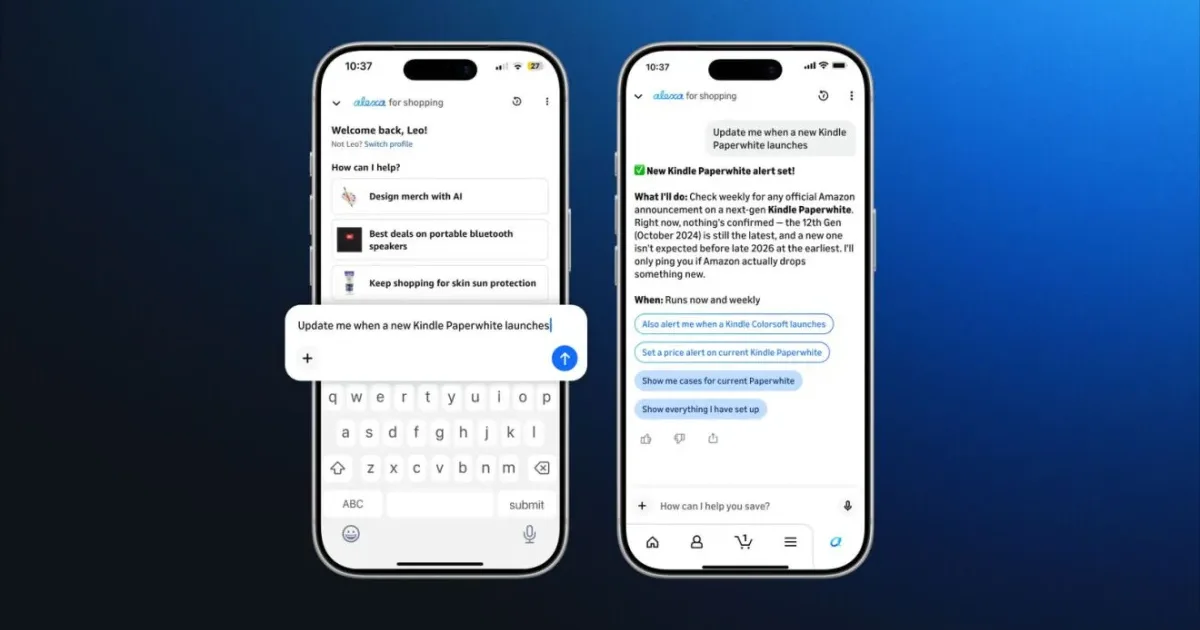
Amazon is adding a new Alexa-powered feature called “Update Me When” that can send personalized alerts about product launches, tours, books, shows, and other events that could trigger a purchase.
techcrunch.comOn September 1, 2026, Amazon added a feature called Update Me When to its AI shopping assistant, Alexa for Shopping. Shoppers register the things they care about in advance, and the assistant sends a personalized alert when something new happens around them.
The use cases in Amazon's official announcement are concrete. A favorite brand launching a new product line. A new season of a show you follow. An artist announcing a tour. An author releasing a new book. A tech company confirming a launch date for a device you have been waiting on. You register in plain language, with phrases like "Update me when new cooperative board games for 4+ players release" or "Update me when a new Kindle releases."
Setup happens entirely in conversation, either in the Amazon Shopping app or on Amazon's website. There is no separate settings screen to hunt for.
What deserves attention is the scope of monitoring. Amazon states that the assistant checks not only its own catalog but the broader web. An announcement about something Amazon does not even sell can still qualify as an event worth notifying you about.
From an assistant that answers to one that creates the moment
The significance here is not one more convenient notification. It is that the role of the shopping assistant itself has changed.
Alexa for Shopping traces back to Rufus, which launched in February 2024, and reached its current form when Amazon merged it with Alexa+ in May 2026. Throughout that period, one structure held constant: the shopper asks, and the AI answers. A question comes up on a product page, so you ask. You want a comparison, so you ask. The AI always arrived after the intent to buy had already formed.
Update Me When removes that precondition. Sarah Perez of TechCrunch frames the shift plainly: Alexa has historically answered product questions when shoppers ask directly, and can now help anticipate what might prompt a purchase before the shopper even thinks to ask. Rather than waiting for demand to appear, the system positions itself at the moment demand is created.
The same article notes that while shoppers currently have to configure these alerts themselves, it is not hard to imagine Amazon automatically generating alerts, or suggesting alert subscriptions as people browse products they like. Read along that line, Update Me When also looks like a learning phase for collecting explicit statements of intent.
The groundwork was already laid. In 2025, Amazon shipped a feature called Interests, where shoppers describe what they care about in natural language and receive alerts when matching products arrive on Amazon or come back into stock. Update Me When reads as its successor, extending the monitored surface beyond Amazon's catalog and broadening the trigger from stock events to announcements and releases.
Where it sits among the features shipped the same day
Amazon refreshed its official page on September 1 with several AI features at once. Lined up together, they show which parts of the shopping journey Amazon intends AI to occupy.
| Feature | What it does | Stage of the purchase journey |
|---|---|---|
| Update Me When | Searches Amazon and the wider web for new developments on registered topics and sends an alert | Discovering the trigger |
| Scheduled Actions | Runs recurring shopping tasks, adding items to the cart or notifying you | Automating repeat purchases |
| Questions in the search bar | Recognizes questions typed into Amazon's main search bar and answers conversationally | Research and comparison |
| Compare from search results | Puts selected products side by side across specs, price, and reviews | Research and comparison |
| Gen AI overviews | Shows category summaries at the top of search results and on product detail pages | Research and comparison |
| Price alerts and auto-buy | Notifies you at a target price or completes the purchase with your default payment method | Executing the transaction |
On the transaction side, price alerts and automated purchasing are already live. Ask it to "Set a price alert for when this face cream is $75" or "Buy these headphones when they're 30% off," and Alexa for Shopping monitors the price, then either notifies you or completes the purchase with your default payment method. Scheduled Actions automate repeat buying, such as adding snacks to the cart monthly or restocking pet food and detergent.
In other words, Amazon is automating both the entrance to a purchase (discovering the trigger) and the exit (executing payment). Update Me When fills the entrance, which had been the empty half.
Two complications with proactive alerts
Taken on the vendor's terms this is a convenience story, but consumer data paints a more cautious picture.
Alchemer's 2026 Retail Report, based on 1,002 U.S. shoppers, found that only 35.4% trust AI recommendations completely or mostly, while 22.2% do not trust them at all. Against other sources the gap widens: 15.4% trust AI more than alternatives, versus 36.1% for online reviews and 31.2% for friends and family. Data privacy around personalized recommendations concerns 35.1% of respondents.
The same survey found that 17.4% discovered their most recent purchase through AI tools, ahead of in-store browsing at 14.4%. Used but not trusted, in short. In that state, rising push notification volume invites a backlash where shoppers simply switch everything off.
The second complication comes from the regulatory side. A 2026 study by Gasinski and colleagues in the European Research Studies Journal surveyed 429 online shoppers, measuring susceptibility to manipulative AI design (dark AI patterns) against impulsive buying, and reported a statistically significant positive relationship between the two. The authors call for responsible design that limits excessively persuasive algorithmic techniques.
Update Me When is an explicit opt-in that shoppers configure themselves, so it does not sit squarely inside that debate today. But if Amazon moves toward generating alerts on its own, the line between an alert the shopper wanted and an alert Amazon wanted to send becomes blurry. Amazon has not disclosed whether the notification slot will become sponsored inventory. Frequency caps and any timeline for markets outside the United States, including Japan, are also undisclosed.
What merchants should prepare for
The practical implication moves a step beyond the familiar work of getting AI to find your products.
The critical point is that Update Me When does not confine its inputs to Amazon's catalog. A brand announcing a new product line, a launch date being confirmed, a new series starting to stream. Most of these events surface first on a company's own newsroom, a press release wire, or an official social account. Whether Amazon's AI can pick them up depends on whether that information exists in machine-readable form on the public web.
Concretely, the announcement page needs the product name, model number, release date, and price range written as body text. That information cannot be locked inside an image or a PDF. Dates need to be explicit and expressed in structured data. Those three conditions are the minimum for an AI to determine what happened and when. Structuring product data is no longer only about appearing in results; it is becoming the work of qualifying as a notification trigger.
The other shift is that control over the channel that delivers the purchase trigger changes hands. Announcing a new product has been the job of channels the merchant owns: the email newsletter, the app push, the messaging account. If Update Me When takes hold, Amazon's notification absorbs part of that job. As more shoppers learn about a new product through Amazon and buy it inside Amazon, merchants lose one more direct point of contact with the customer.
That this shift carries real value is visible in the numbers. In its October 2025 earnings, Amazon said Rufus was on track to contribute $10 billion in incremental annualized sales. Walmart is moving the same way, saying that shoppers using its Sparky agent have an average order value roughly 35% higher than non-users, with units purchased through Sparky more than quadrupling quarter over quarter. The two strategies converge on lifting AI from a passive guide into an active sales channel.
So what should merchants outside Amazon's orbit do? Both things at once: earn a place in the alerts, and reach customers through your own channels before the alert arrives. The first means making announcement data machine-readable. The second means moving up the timing of direct notice to existing customers. Reacting after Amazon's notification lands is simply too late in the sequence.
Conclusion
As a standalone feature, Update Me When is a modest addition. Placed in the context of agentic commerce, though, it shows the line for how far into the purchase process AI reaches being redrawn one step earlier.
Watch two things next: whether Amazon starts generating alerts automatically, and whether that notification slot gets sold as an advertising product. The first would put the formation of consumer demand itself under platform control. The second would create a new auction market for the right to appear in an alert. Signs of either should show up in Amazon's next quarterly disclosures.