
AI Commerce News Digest (October 16, 2026)
AI commerce news for October 16, 2026. Google's Universal Cart is now available in Search and Gemini in the US, and Glance lets shoppers complete purchases inside its app with PayPal checkout. Also covered: Lightspeed handing inventory and ordering to agents, DRESSX's analytics that track AI-driven sales, and the surge in Stripe's agent transactions.


Key Takeaways
- Google's Universal Cart is now available in the US
- PayPal checkout has arrived in Glance's AI shopping
- AI agents are moving into retail operations and measurement
Here is the AI commerce news for October 16. The main story today is that Google's Universal Cart, announced in May, is now actually available in the US. It gathers products from multiple stores into one cart, alerts shoppers to price drops and even suggests how to pay. InMobi-backed Glance has built PayPal checkout into its app, so shoppers can go from finding a product with AI to paying for it without leaving. Following yesterday's Chronopost and Conga stories, which opened delivery and order processing to AI, today brings Lightspeed, which hands store inventory and ordering to agents, and a DRESSX measurement tool that tracks how a brand appears inside AI all the way through to sales.
Top Stories
Google Launches Universal Cart in the US, Available in Both Search and Gemini
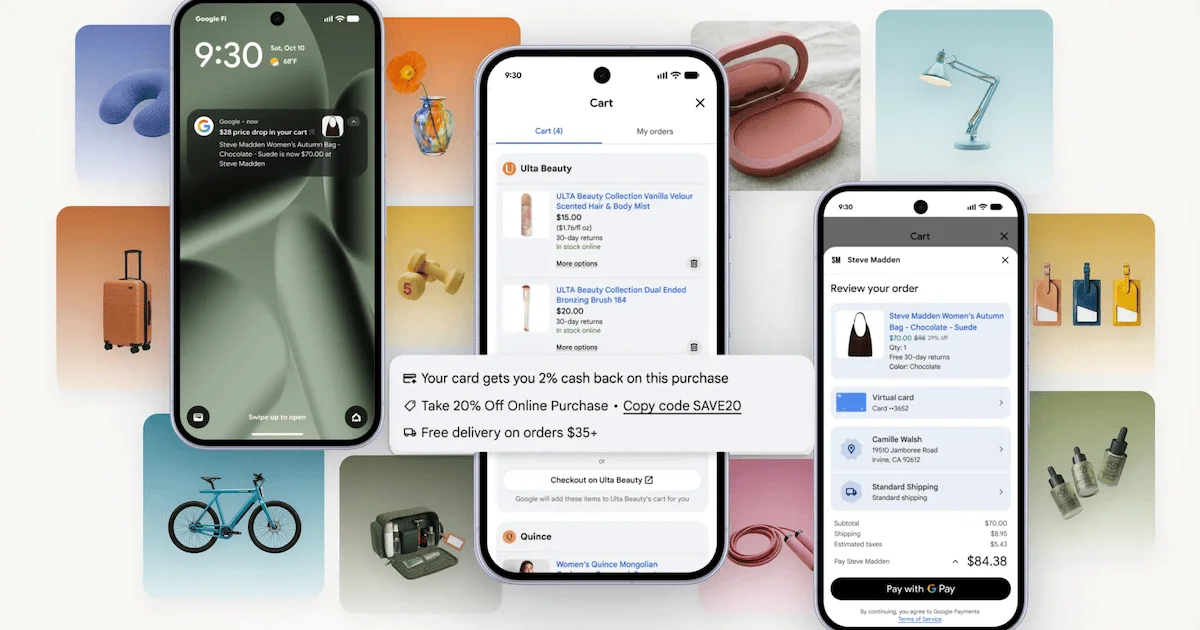
The new shopping tool is available in the U.S. across Google Search and the Gemini app.
techcrunch.comOn October 15, Google began offering Universal Cart in the US, a feature for collecting and managing products found in Search and the Gemini app. It was previewed at Google I/O in May, and the official Google blog presents it as a way to help with holiday shopping.
Because products from multiple stores can sit in one cart, shoppers do not have to search for the same item again when they come back later. Notifications arrive when a saved product drops in price or an out-of-stock item is restocked. When it is time to choose a payment method, it makes suggestions that take the benefits of the shopper's credit cards into account, and it shows promo codes that can be applied. Checkout connects to UCP (Universal Commerce Protocol), the standard for linking agents and retailers that Google released this year.
For e-commerce businesses, this means the "middle" of a purchase now sits on Google's side. If Google's cart, rather than the cart on the retailer's own site, holds products while shoppers compare and wait, Google also takes over price drop alerts and payment suggestions. The holiday season will be the first occasion where whether a retailer's products appear in this cart with the correct price and stock feeds directly into sales.
Full article: Google's Universal Cart Launches in the US: What Changed Since I/O and What Merchants Need to Get Their Products In
Glance Partners With PayPal to Complete Purchases In-App, Reaching Tens of Millions in the US

Glance, an AI-powered personal shopping platform backed by global technology company InMobi, today announced an agentic commerce integration with PayPal, bringing real-time product data and native checkout directly to Glance for tens of millions of consumers in the United States.
www.financialcontent.comOn October 15, Glance announced an integration with PayPal's agentic commerce services. Consumers can find products in Glance, check them visually, build a cart and pay with PayPal, all without moving to another site. According to the announcement, PayPal is the only provider of native in-app checkout within Glance.
On the merchant side, the companies say a single PayPal integration connects merchants to multiple AI shopping surfaces, letting them show real-time inventory and pricing while keeping the customer relationship. Glance has already extended its shopping experiences to smartphone lock screens and Samsung smart TVs. With this integration, shoppers can now complete payment inside the app. The companies have not said whether checkout can also be completed on the TV.
When payments are built directly into the place where AI recommends products, the distance between "finding" and "buying" disappears. For PayPal merchants, it is one more route onto AI shopping channels without building separate integrations of their own.
Full article: Glance Adds PayPal Native Checkout, Letting Its AI Shopping App Go from Discovery to Purchase
Agentic Commerce
Elon Musk Hints at a Rival Service After Amazon Blocks Grok

Elon Musk has hinted at launching an Amazon rival after a user claimed the e-commerce giant was blocking Grok bots from shopping on its platform. His comment comes as Amazon tightens restrictions on third-party AI shopping agents over privacy and security concerns.
www.indiatoday.inA user on X posted that Amazon was blocking orders placed by Grok bots. The user said they had been letting a Grok bot handle their returns, and suggested that Elon Musk build an "X Shop." Musk replied to the effect that his companies could compete with Amazon directly. He did not, however, say what kind of service he has in mind or whether he is actually planning one.
Amazon has been tightening restrictions on shopping by outside AI agents. According to India Today, Amazon has also blocked Meta's AI agent Muse from shopping on Amazon.com. The reasons given were that Meta did not notify it in advance, and that Muse appeared to browse without identifying itself as an agent and to obtain and store customer credentials.
Amazon's position is that it is up to the store to decide whether to accept agents. As major marketplaces begin screening outside agents, those who build agents are being asked for ways to identify themselves and follow each store's rules.
AI Commerce Tools
Lightspeed Extends Lightspeed AI From Insights to Action, With Agents Handling Inventory and Ordering
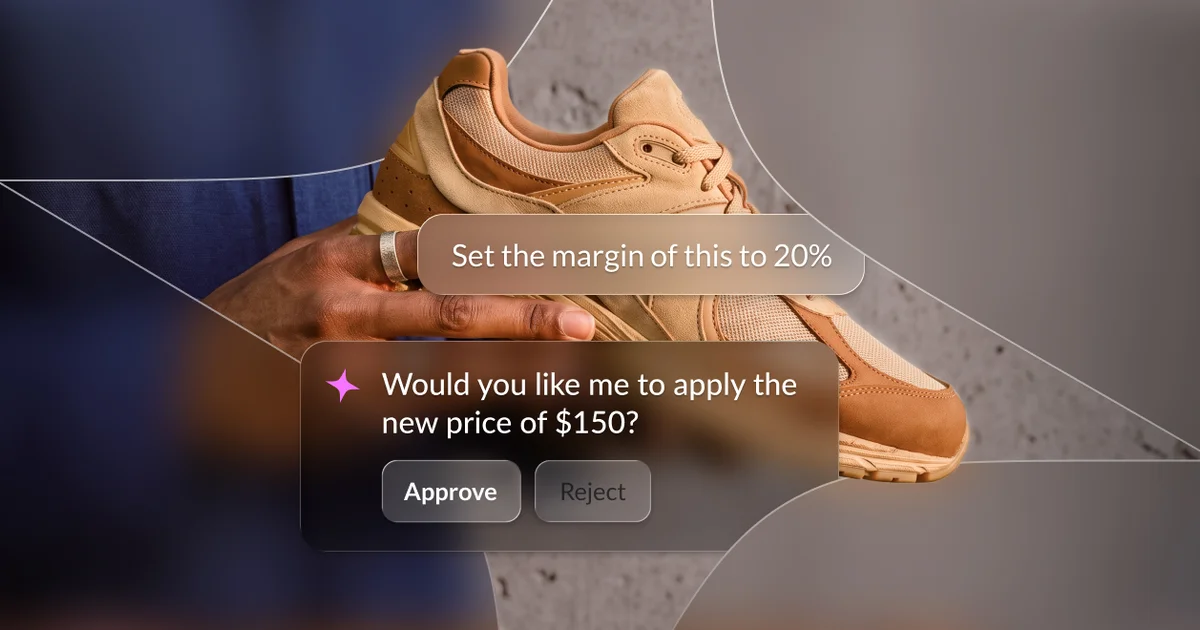
Lightspeed Commerce Inc., the unified omnichannel platform powering ambitious retail, golf and hospitality businesses in over 100 countries, today announced new agentic capabilities within Lightspeed AI that go beyond answering…
www.lightspeedhq.comOn October 15, Lightspeed Commerce, which provides POS and commerce platforms, announced that it will add agentic capabilities for retail to Lightspeed AI, the conversational tool it released in January. Going a step beyond answering questions about best sellers, it will carry out tasks such as managing inventory and updating product information based on what is said in the conversation.
The aim is to connect catalog, inventory, sales and purchasing data so that operations across multiple stores can move forward within a single conversation. The rollout is phased, starting with a subset of retail customers.
For small and mid-sized retailers that want to handle complex operations without adding staff, agents built into the POS are the most accessible entry point. At the same time, usability will depend on where the line is drawn between what runs automatically and what a person approves.
DRESSX Launches Analytics That Track the Journey From an AI Question to a Purchase
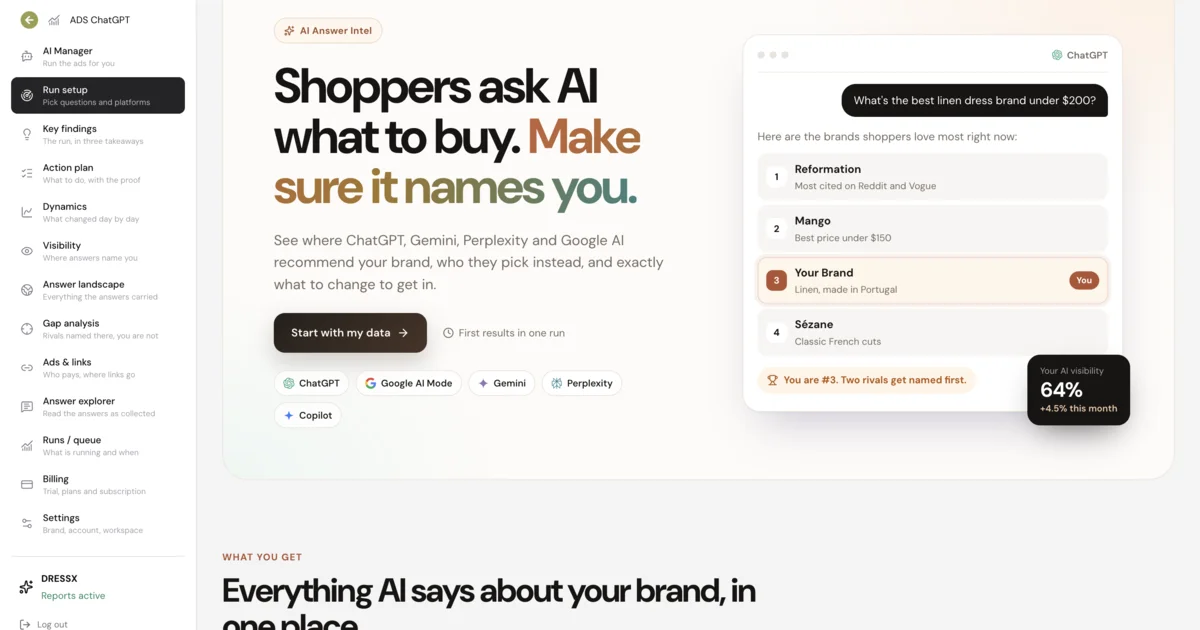
DRESSX is launching a new suite of AI commerce analytics tools designed to change that, giving brands a 360° view of how consumers discover and engage with…
retailtimes.co.ukOn October 15, DRESSX, known for virtual try-on, launched a suite of AI commerce analytics tools for brands. The company says brands can see, as a single flow, what consumers ask AI, what recommendations they receive, and how many visits, add-to-carts and purchases result. The tools cover AI services such as ChatGPT, Gemini and Perplexity.
Efforts to measure how a company appears in AI answers are spreading among brands and retailers. DRESSX goes a step further, pitching its ability to link visibility in AI to actual e-commerce sales. The co-founders said that just as the impact of search and social media became measurable, the impact of AI needs to be measured too. The product is offered through More Dash Ads, an OpenAI ads reseller operated by DRESSX.
The more purchase decisions advance inside AI conversations, the less a retailer's own site analytics can see of the first half of the customer journey. How to measure AI-driven sales becomes the very basis for spending budget on AI visibility.
France's WiziShop Releases an MCP Server, Opening More Than 410 Features to ChatGPT and Claude
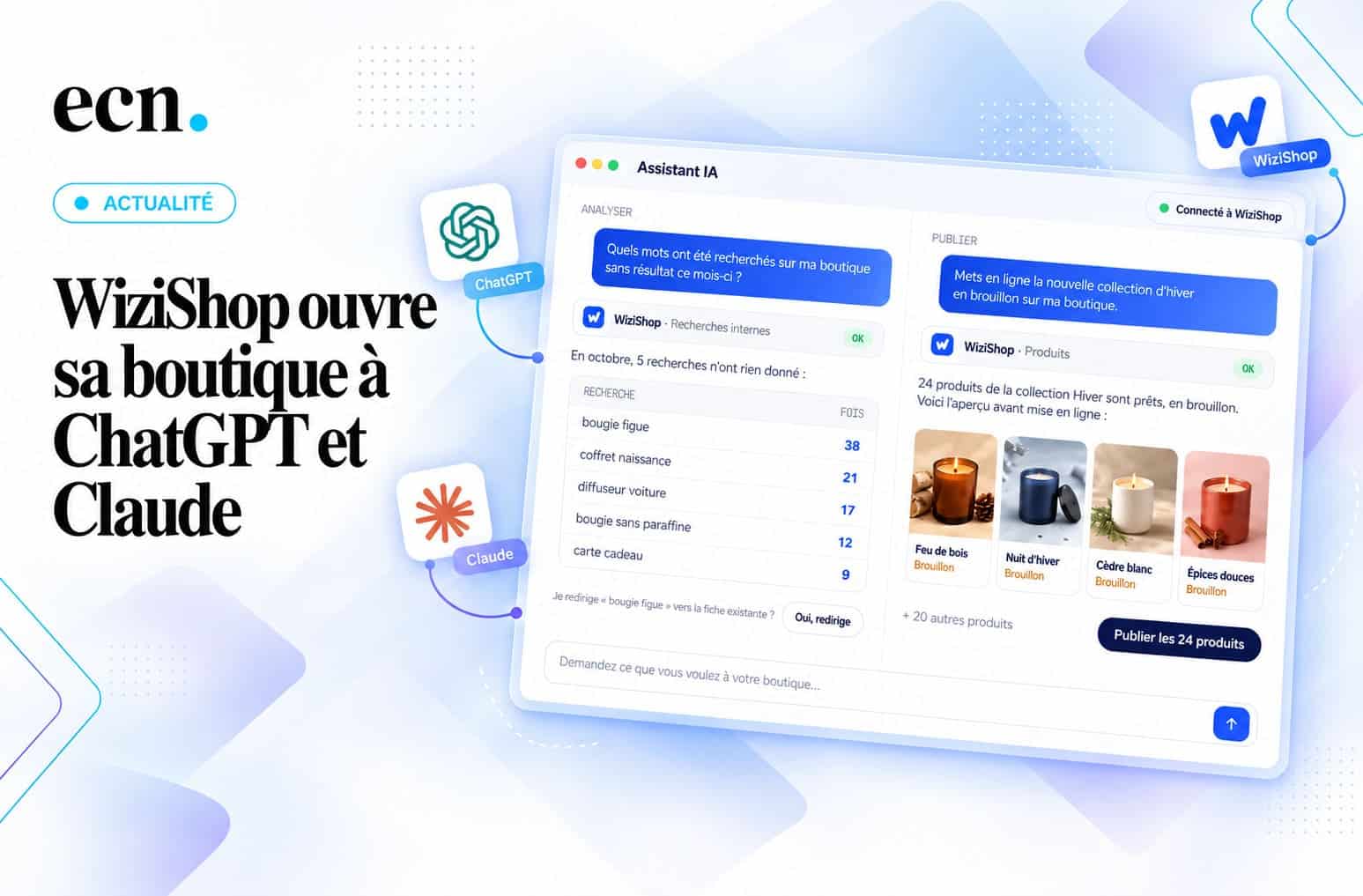
WiziShop lance son serveur MCP : 410 fonctionnalités e-commerce deviennent accessibles depuis ChatGPT, Claude ou un autre assistant IA compatible.
www.ecommerce-nation.frFrench online store builder WiziShop has released an MCP server for connecting to AI assistants. MCP (Model Context Protocol) is a common way for AI to use the features and data of outside services. Merchants can check their store data from Claude or ChatGPT and carry out tasks with plain-language instructions.
According to the company, more than 410 features across 48 areas are available, covering products, orders, customers, promotions, SEO, content and design. A single instruction can edit up to 100 products or create 200 unique coupon codes, and merchants can ask it to list on-site search terms that returned zero results. It can also be used to migrate product catalogs from other e-commerce services, with the merchant reviewing the changes before they go live.
Rather than pushing an AI assistant of its own, the design opens the admin panel's features to the AI the merchant already uses. The admin panel is ceasing to be the only place where a store is run.
Alibaba's QwenWork Opens an Invite-Only Beta of an E-commerce Edition for Multi-Marketplace Sellers

QwenWork's e-commerce edition adds a cross-platform operations dashboard, trend and selling-point analysis and batch content generation. It cannot yet run ad campaigns or take over stores.
pandaily.comOn October 14, QwenWork, Alibaba's AI agent for work, released an e-commerce edition by invitation. It is QwenWork's first industry-specific edition. Aimed at the daily work of merchants who sell on several marketplaces, it offers a cross-platform operations dashboard, analysis of trends and product selling points, batch creation of promotional content, and cross-platform ROI optimization.
QwenWork CEO Chen Yusen positions it as an independent, third-party e-commerce agent open to sellers on any marketplace. It connects to Alibaba's seller analytics and advertising tools as well as outside tools such as Youzan, FastMoss and LinkFox. According to LatePost, nearly 100 people worked on its development.
For now it is closer to a workbench for analysis and content creation, and it cannot change ad delivery plans or spend promotion budgets directly. Proactive features, such as automatically watching for anomalies in inventory and ads, are planned for later.
GoDaddy Adds Hosting, Email and Commerce APIs to Its Developer Platform, Usable by AI Agents

New APIs for hosting, email and commerce give developers a connected, programmable path through one platform.
finance.yahoo.comOn October 15, major domain registrar GoDaddy added hosting, professional email and commerce APIs to the GoDaddy Developer Platform. The expansion builds on the domain APIs released in July.
Developers and AI agents can work with the services needed to bring a business online using the same credentials, the same API conventions and the same command-line tools. Node.js apps can be created, published and managed without opening a dashboard, with HTTPS, a firewall and a CDN included as standard.
This lets an agent carry an app built with AI coding tools all the way to launch as a business with a storefront. For developers and agencies, setting up an online store is being designed to happen through AI agents rather than an admin panel.
Payments and Fintech
Stripe President John Collison Says Agent-Driven Transactions Went "Vertical" in September

The digital payment juggernaut’s agentic commerce activity went “vertical” last month, President John Collison said this week.
www.paymentsdive.comOn the podcast he hosts, Stripe President John Collison spoke with Meta CEO Mark Zuckerberg and Chief AI Officer Alexandr Wang. During the conversation, he said that after a series of announcements at the Stripe Sessions event in May, agentic commerce numbers "started going vertical" in September. He did not give specific figures.
The conversation turned to Muse, the personal AI agent Meta is developing. Zuckerberg said far more companies are reaching out wanting to integrate deeply with Muse than are blocking it, and that those blocking it will come to regret it as a strategic mistake. He did not name Amazon, which recently blocked Muse.
Payments Dive notes that, compared with AI helping people shop, AI actually paying has been seen as further off. No figures were given, but it is notable that one of the largest payment companies is talking about a surge ahead of the holiday season.
Agent Payment Tokens Reach Millions per Week in Three Months: VGS's Terry Angelos

In a detailed interview on the a16z podcast, VGS chief strategy officer Terry Angelos lays out how a brand-new payment standard for AI agents is…
finance.biggo.comOn the a16z podcast, Terry Angelos, chief strategy officer at VGS, which stores card data, talked about "agentic tokens" that let AI agents pay on a person's behalf. VGS stores the card data behind roughly a third of US e-commerce volume. He said it now issues millions of these tokens each week, though they did not exist three months ago.
He gave the example of using an agent to buy lighting at Walmart. His card details were in Stripe Link, but Link was not directly connected to Walmart. So Stripe made the purchase with a single-use Visa virtual card and charged him in a separate transaction. The purchase went through, but Walmart was left with only the single-use card. When Walmart later sent a Walmart+ credit as a shipping refund, it could not be charged to that card. He described this approach as "the AOL of agentic commerce," in other words, a walled garden.
His point is that a payment method is needed that keeps the relationship between store and customer intact even when an agent does the buying. Who bears the cost when an agent makes a mistake has yet to be settled.
Purchases Completed by Agents Themselves Are Under 1% of Transactions: Accertify

Accertify Inc. released a post outlining the distinction between agentic shopping and agentic checkout…
www.digitaltransactions.netFraud prevention company Accertify published a post separating "agentic shopping," in which AI helps people shop, from "agentic checkout," in which AI completes the purchase itself. In the company's data, the latter is less than 1% of all transactions, small enough to be counted in basis points (0.01%).
AI is quickly being used more for finding and comparing products, but transactions where AI also handles the final payment are still a tiny share. Read alongside Stripe's talk of a surge in the same week, it suggests a stage where growth rates are high but the base is still small.
For fraud and returns policies, the starting point is to count "transactions AI was involved in" separately from "transactions AI paid for."
Southeast Asian E-commerce to Near $400 Billion by 2031 as Cash on Delivery Falls Well Below a Third: Xendit Report

E-commerce in Southeast Asia could near US$400bn by 2031 as cash-on-delivery fades, a new Xendit and Cube report finds.
fintechnews.sgPayments company Xendit and e-commerce analytics firm Cube published a report finding that the Southeast Asian e-commerce market could near $400 billion by 2031. It was $197 billion in 2025, which works out to roughly doubling in six years. Combined GMV on the three big marketplaces, Shopee, Lazada and TikTok Shop, grew 33% year on year in the first quarter of 2026, rising from $29 billion to $39 billion for the quarter.
In payments, cash on delivery, which made up about half of transactions in 2019, is now well below a third. The report expects it to fall below 25% of the region's e-commerce GMV by 2027. What replaces it varies by country, and merchants have to support different payment methods in each market.
For businesses selling into Southeast Asia, the decline of cash on delivery is a welcome change, but the burden of building payments country by country remains.
Corporate Moves and Partnerships
Ericsson Cuts B2B Quotes From Two Weeks to Seconds and Explores Handing Quote Creation to AI Agents

Ericsson is exploring how AI agents can help transform complex B2B commerce processes, reducing quote times from weeks to seconds.
news.sap.comTelecom equipment maker Ericsson has used SAP Commerce Cloud to let customers handle contract-specific products, quotes and orders themselves. Many of its deals rest on multi-year framework agreements, and sales staff used to build quotes by hand while checking contract terms, which could take more than two weeks. Now many requests are completed in minutes or seconds.
As the next step, the company is exploring ways to have AI agents create quotes. The agent would read a customer's request, look up the relevant contract information, assemble a proposal and send the draft quote for human review. Employees make the final decision.
It is a B2B case that follows a clear order: digitize manual work first, then hand it to agents.
Flipkart Internet Grows FY26 Revenue 18% and Narrows Losses With a Listing in View

Flipkart Internet achieved an 18% increase in revenue to Rs 1,45,880 crore in FY26. The company's net loss decreased by Rs 178 crore to Rs 8,468 crore during the same period.
m.economictimes.comFlipkart Internet, the core company of Walmart-owned Indian e-commerce group Flipkart, grew consolidated revenue 18% year on year in FY26 (the year ended March 2026) to Rs 1,45,880 crore (about Rs 1.46 trillion). Its net loss narrowed by Rs 178 crore to Rs 8,468 crore. The Economic Times reported the figures based on regulatory filings.
Gross margins improved from the previous year, and adjusted operating losses shrank by about Rs 1,600 crore. The adjusted operating margin improved by 2.3 percentage points. Flipkart is restructuring the group and has a public listing in view.
With India's festive sales underway, one of the largest players has shown narrowing losses. On the road to a listing, the question is how convincingly it can show growth and profitability together.
Advertising and Retail Media
India's Myntra Fully Rolls Out Affiliate Commerce on Instagram, With 1 Million Sign-ups in a Month

Myntra today announced the full rollout of its affiliate commerce programme on Instagram, becoming the first lifestyle e-commerce platform in India to do so in partnership with Meta, enabling creators to tag Myntra products directly within their posts and reels.
infashionbusiness.comIndian fashion e-commerce platform Myntra has fully rolled out its affiliate program on Instagram in partnership with Meta. Creators can tag Myntra products directly in their posts and Reels and earn a commission on resulting purchases. It follows the Facebook integration that launched in June.
On Instagram, more than 1 million people signed up in a month, and 200,000 creators have already created content. On Facebook, 1.3 million have signed up and more than 650,000 are active. Posts across Instagram and Facebook total about 3 million, and the company says they now drive notable traffic to Myntra.
The company expects creator posts to double during the festive sales season. It is a move by a marketplace to widen the path from discovery on social media to purchase on its own initiative.
Global E-commerce Trends
China's Double 11 Begins: Tmall Leads With AI and Flagship Stores, JD.com Drops Presales

China's 2026 Double 11 shopping festival kicked off on October 15 with Alibaba, JD.com, and Douyin all launching their campaigns on the same day.
finance.biggo.comChina's biggest annual sale, Double 11, began on October 15, with Alibaba and JD.com holding launch events on the same day and Douyin starting its sale that day too. Tmall put AI and flagship stores front and center, with 1 million participating brands and 72 million products, both records. Presales started on the evening of the 15th, and the main event begins on the 20th.
JD.com started three days earlier and replaced deposit-based presales with direct discounts. Douyin has extended coupon distribution beyond its main app to ByteDance's AI assistant Doubao and the short drama app Hongguo. All three dropped complex stacked discount schemes in favor of simple price cuts. Before the start, seven authorities including the Ministry of Commerce issued rules cracking down on practices such as "automatic price matching" and claims of "the lowest price online."
The article says that as the rapid growth of instant delivery takes demand from traditional e-commerce, sellers' attention is shifting from GMV growth to profit and repeat purchases. How AI is used has become one of the axes on which the companies set themselves apart.
Taobao Revamps Its Experience for Overseas Shoppers, Selecting Products With AI and Human Curation

Taobao Tmall World ("Taobao") today announced a comprehensive upgrade to its cross-border shopping experience, expanding direct access…
www.prnewswire.comOn October 15, Taobao Tmall World, Alibaba's service for overseas shoppers, announced a comprehensive upgrade of its cross-border shopping experience. Building on more than 3 billion products available to overseas buyers, it created the "Taobao Curated Supply System," which combines AI and human judgment to select stores and products on four criteria: quality, uniqueness, price competitiveness and service.
In the app, it is revising its recommendation algorithm, strengthening its AI shopping assistant and adding DISCOVER, a new channel that features distinctive brands. According to the company, overseas users' preferences are shifting from "cheap" to "quality and uniqueness," and during Double 11 in 2025 the number of users spending more than 500 yuan per order rose 10% from the previous year.
The direction is to move from shelf-style search to shopping that starts with discovery. To shed its image as a cross-border bargain outlet, it is putting AI recommendations at the center.
AliExpress Launches Elite, a Free Membership in Europe With an Extra 5% Off and Hassle-Free Returns

AliExpress, the international online retail marketplace, has launched Elite, its new membership programme, rewarding its most loyal shoppers…
www.prnewswire.comOn October 15, AliExpress launched Elite, a free membership program for its most frequent customers. It is invitation-only and applies automatically to customers who spent more than $800 and ordered on five or more days in the past year. It is first available in European markets including Germany, the UK, France, Italy, Spain, Poland and the Netherlands.
Members get an extra 5% off millions of products marked with the Elite badge, rising to 8% on Elite Day, the first of each month. Under certain conditions, eligible products can be returned within 15 days of delivery without additional proof. Dedicated customer support is also included. A company vice president said it is the company's first free membership program, and that not charging a fee was a deliberate choice.
It is a strategy to lock in top customers without charging them. It aims to offset a weakness of cross-border e-commerce, namely long delivery times and troublesome returns, with a benefit that makes returns easier.
80% of GMV at Europe's Top 100 Marketplaces Comes From Cross-Border Sales: Cross-Border Commerce Europe

The 100 biggest marketplaces that are active in Europe are expected to generate a gross merchandise volume (GMV) of 175.8 billion euros.
ecommercenews.euAccording to the seventh "Top 100 Cross-Border Marketplaces Europe" from Cross-Border Commerce Europe, the top 100 marketplaces active in Europe are expected to generate GMV of 175.8 billion euros in 2026. Of that, 139.8 billion euros, or 79.5%, comes from cross-border sales.
For next year, it forecasts that GMV at the top 100 will grow about 8% to about 190 billion euros, and that cross-border sales will grow 10% to 154 billion euros, raising their share to 81%. Amazon, Temu and AliExpress top the list.
Marketplace sales in Europe are tilting toward sellers who sell across borders rather than local stores. Retention moves such as AliExpress's membership program are part of this competition for cross-border sales.
Logistics and Fulfillment
Britain Runs Short of New Large Warehouses as Speculative Building Hits a Near 10-Year Low

Britain is running out of new warehouses: speculative building at its lowest in almost 10 years as demand stays strong
trans.infoAccording to real estate services firm Colliers, take-up of large UK warehouses over 100,000 square feet reached 21.8 million square feet from January to September 2026. Meanwhile, completions of speculatively built warehouses, those built without a tenant lined up, fell in the third quarter to their lowest level in nearly 10 years.
Retail, e-commerce and fulfillment companies accounted for 78% of this year's take-up. In the first half, Chinese e-commerce brands accounted for 13% of large warehouse take-up, up from about 6% in 2025. Full-year take-up is expected to reach about 30 million square feet.
Fewer new warehouse options make rent increases more likely. For e-commerce businesses and logistics companies that want to add sites in the UK ahead of the holiday season, securing space is getting harder.
Summary
Today's news shows AI agents spreading beyond the "find" and "compare" stages to holding carts, completing payments and doing store operations. With Universal Cart, Google is gathering shoppers' in-progress purchases into its own cart, and Glance used PayPal checkout to let shopping finish inside its app. Lightspeed, WiziShop and QwenWork are opening ways for merchants to hand inventory, product and promotion work to AI.
The numbers, however, are still at an early stage. Stripe spoke of a September surge, but Accertify's data shows that transactions AI pays for itself are less than 1% of the total. Rule-making has not caught up, whether on payment methods that keep the store-customer relationship intact when an agent buys, as VGS's Angelos pointed out, or on how agents should identify themselves, as Amazon demands.
In the coming days, watch how widely retailers appear in Universal Cart and how far agent-driven orders grow over the holiday season.