
AI Commerce News Digest (August 31, 2026)
AI commerce news for August 31, 2026: Salesforce and Anthropic announce Claudeforce, Rezolve Ai allies with Tech Mahindra on enterprise agentic commerce, and U.S. e-commerce reaches a record 17.1% of retail spending.

Key Takeaways
- Salesforce expands its Anthropic partnership and makes Claude the default model across its stack
- Rezolve Ai and Tech Mahindra ally to move agentic commerce into large enterprise production
- U.S. e-commerce hits a record 17.1% of retail spending as AI channel buildout accelerates
Here is the AI commerce news for August 31, 2026. Across the past few days, the center of gravity in agentic commerce shifted from the companies building AI toward the companies delivering it into enterprises. A CRM vendor and an AI lab tied themselves together at the default-model level, and an AI vendor paired with a systems integrator to handle production rollouts. On the retail side, Best Buy used its earnings call to report that its commerce integration with OpenAI is complete. Meanwhile, U.S. quarterly figures show e-commerce growing at its fastest pace in five years. The share of retail moving online is expanding again, which is worth keeping in view as the AI channel buildout continues.
Top Stories
Salesforce and Anthropic expand their partnership, making Claude the default model across the stack

Salesforce and Anthropic have expanded their partnership to develop Claudeforce, an AI tool integrating both companies' technologies.
www.digitalcommerce360.comSalesforce and Anthropic announced on August 26 that they are expanding their existing partnership to build Claudeforce. The first release is Salesforce in Claude, which ships with 37 prebuilt sales skills so that sellers and AI agents can act on live revenue context. It is available to select pilot customers now, with an open beta planned for September 2026.
What stands out is where Claude now sits. Slack AI, Headless 360, Agentforce Coworker, and Claude Code across Salesforce's engineering organization all run on Claude as the default model. Salesforce CEO Marc Benioff framed it as a fusion, arguing that probabilistic intelligence alone does not run a company and deterministic systems do not reason.
The commerce relevance comes from a shift in referral traffic. According to AI Rankings from Digital Commerce 360 and ReFiBuy, the number of North American Top 1000 retailers for which Claude was the largest AI referral source rose from one in Q1 2026 to 15 in Q2. Over the same period ChatGPT fell from 844 retailers to 722.
There is an important boundary to read carefully, though. The commerce layer, including Agentforce Commerce, does not appear in the announcement. On the Salesforce side, connecting product catalogs and checkout to AI still runs through ACP from OpenAI and Stripe and through Google's UCP. The AI gaining referral share and the AI that can close a transaction remain different surfaces, and merchants managing AI channel revenue should hold that asymmetry in mind.
Rezolve Ai and Tech Mahindra form a global alliance to push agentic commerce into production
Rezolve Ai and Tech Mahindra announced a global strategic alliance to accelerate the deployment of agentic commerce across large enterprises worldwide.
rezolve.comAgentic commerce vendor Rezolve Ai (NASDAQ: RZLV) and Indian IT major Tech Mahindra (NSE: TECHM) announced a global strategic alliance on August 28. Their stated goal is to move AI beyond pilots and customer-service chatbots into secure experiences that understand intent, recommend products, and complete transactions.
The division of labor is clear. Rezolve Ai's Brain Suite supplies the commerce intelligence and transaction layer, while Tech Mahindra brings industry expertise, enterprise integration, cloud and data capabilities, and global delivery. The target sectors extend past retail and consumer goods into financial services and other transaction-intensive industries.
Scale is what Tech Mahindra contributes. Its 1,100-plus clients, 146,000-plus professionals, and operations across 90 countries become a route to market for Rezolve Ai. Chairman and CEO Daniel M. Wagner described the alliance as a way to turn technology leadership into a global distribution and growth engine. For enterprises evaluating deployment, choosing a product and choosing an implementation partner are starting to converge into a single procurement path.
Read more: Rezolve Ai and Tech Mahindra Forge a Global Alliance: Agentic Commerce Enters Its SI-Procured Era
Agentic Commerce
Best Buy completes its OpenAI commerce integration and begins rolling out Ask Blue
Best Buy is reaching customers in new ways, both in stores and online, executives said Thursday (Aug. 27) during the specialty consumer electronics retailer's quarterly earnings call.
www.pymnts.comOn its August 27 earnings call, Best Buy disclosed that it has completed its commerce integration with OpenAI, saying customers can discover products, receive recommendations, and complete purchases inside ChatGPT. Jason Bonfig, chief customer, product and fulfillment officer and incoming CEO effective November 1, called it an important step in expanding the digital ecosystem and positioning the retailer at the forefront of AI-enabled commerce.
That phrasing deserves scrutiny. OpenAI stepped back from Instant Checkout, its in-chat payment flow, in March 2026, and when Shopify used nearly identical wording, OpenAI publicly corrected it to mean available for purchase rather than payment completing in-chat. Best Buy has not disclosed where the transaction actually settles.
On its own channels, the retailer has started rolling out a conversational AI assistant called Ask Blue. It covers product knowledge, support resources, customer reviews, availability, and pricing, and can compare products or check compatibility. Depending on the need, it either guides shoppers to self-service resources or connects them to a live specialist.
Best Buy is also expanding its third-party marketplace, adding international sellers later this quarter. The U.S. marketplace passed its one-year mark, and the company reports encouraging expansion in new SKUs and categories. Running external AI channels, an owned conversational assistant, and a marketplace in parallel fits a retailer that has already published the practical details of its protocol implementation.
Payments and Fintech
Visa and Upbit operator Dunamu partner to explore stablecoin payments and AI commerce
Visa and Upbit parent Dunamu will explore stablecoin payments, global remittances and AI-driven commerce across major markets.
financefeeds.comDunamu, the operator of South Korean crypto exchange Upbit, and Visa agreed to explore stablecoin payments, cross-border remittances, and AI-powered financial services. The announcement followed an August 26 meeting in San Francisco between Dunamu CEO Oh Kyung-seok and Visa Global President Oliver Jenkyn.
On the AI side, the scope includes systems capable of finding products or services and completing payments on behalf of users. The companies will look at the infrastructure required for such transactions and how AI could operate alongside stablecoin payment and settlement systems. Open USD (OUSD), a dollar-backed stablecoin, is named as one of the business models they will assess.
No commercial product or launch date has been disclosed. The companies said services would be developed in stages while accounting for applicable laws and regulatory requirements. Similar pairings are stacking up in Korea, including Dunamu with Samsung SDS and Circle with Kakao and Toss Bank, while Visa itself works with Shinhan Financial Group. Whether an actual product emerges remains to be seen.
Affirm and Shopify bring Shop Pay Installments to Australia, their fourth market
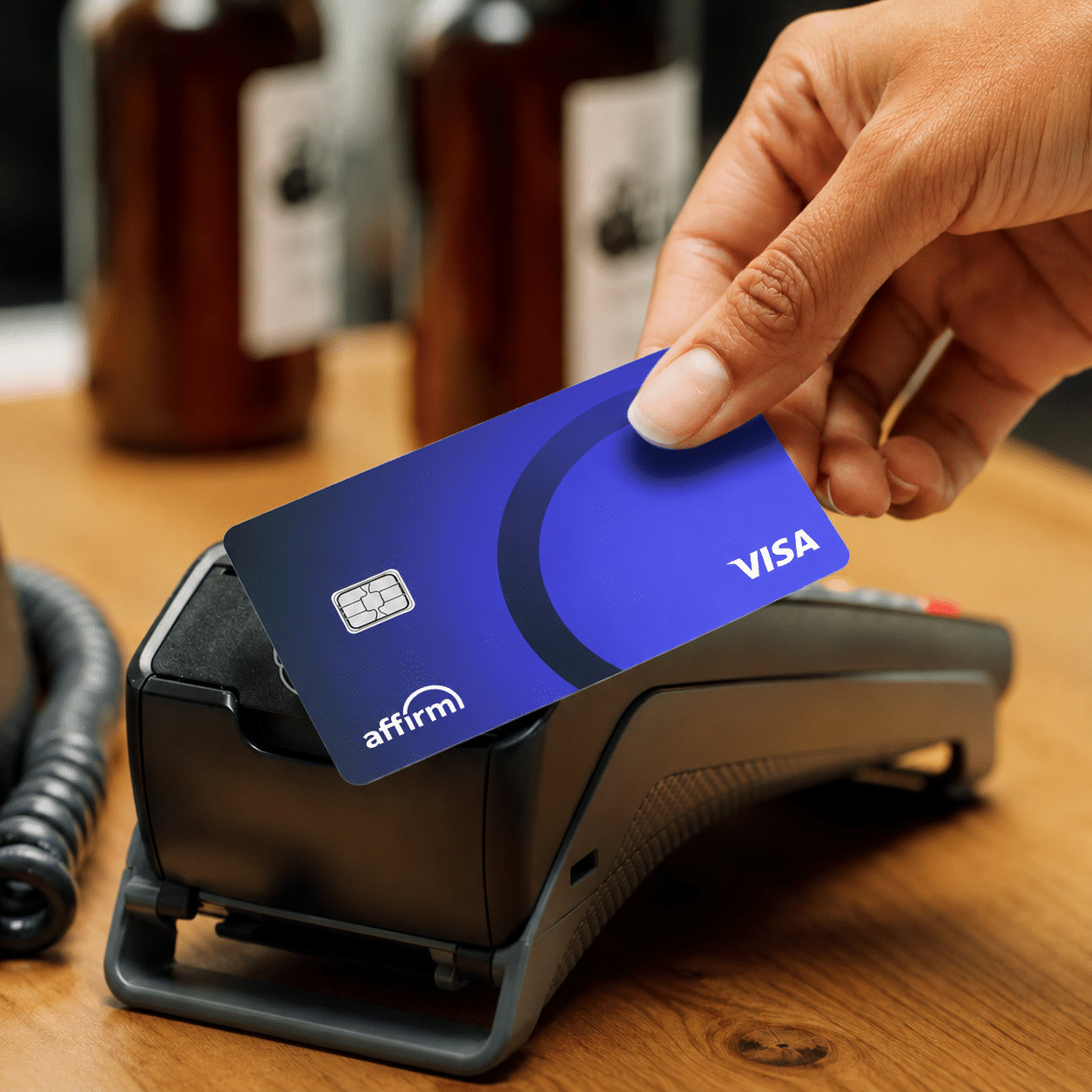
The installment-payments platform Affirm Holdings Inc. and online commerce service Shopify late Thursday announced they have expanded their 5-year-old collaboration, Shop Pay Installments, to Australia.
www.digitaltransactions.netAffirm and Shopify announced on August 27 that they are extending their five-year-old Shop Pay Installments collaboration to Australia, following the U.S., U.K., and Canada. For Affirm it marks a return to a market it exited in February 2023 as a cost-cutting measure.
Shopify says Shop Pay is used by more than 250 million shoppers where it is available, describing it as the world's highest-converting checkout. Merchants enable the service from the Shopify admin dashboard, and it carries no additional fee beyond ordinary card-processing costs.
Affirm's June-quarter results, released the same day, showed gross merchandise volume up 36% year over year to $14.1 billion, an eleventh consecutive quarter of growth above 30%. Active merchants reached 571,000, up 51%. The company still frames itself as early, noting availability at about 80 of the 250 largest global e-commerce sites and roughly 10% of e-commerce merchants.
AI Commerce Tools
Microsoft deploys more than 25 AI agents across its own supply chain, targeting 100 by year end

Microsoft is finding an early business case for artificial intelligence agents in a decidedly unglamorous corner of the enterprise: freight routes, spare parts and demand forecasts.
www.pymnts.comMicrosoft has deployed more than 25 AI agents and related applications across its supply chain. The systems simulate demand, anticipate shortages, and recommend shipping routes after weighing cost, speed, and carbon impact. Logistics teams are reported to be saving hundreds of hours each month.
Three applications illustrate the pattern: a demand planning agent that runs simulations for data center rack components, a spare parts system combining computer vision with multiple agents to predict storage needs and flag stockouts, and CargoPilot, which continuously compares transportation modes, routes, costs, and delivery times. The foundation was not built overnight, starting in 2018 when the company consolidated more than 30 systems into an Azure supply chain data lake. Microsoft plans to operate more than 100 agents by the end of 2026, and the next phase moves agents past recommendations into governed connections that can update orders, adjust supply plans, or initiate inventory transfers.
Dow provides a payments-focused example. The materials company handles invoices tied to as many as 4,000 shipments a day, with about 20% arriving as PDFs, exceeding 100,000 documents a year. One agent monitors incoming email, extracts invoice data, and scans for billing discrepancies, while a second lets employees investigate flagged charges through natural-language prompts. The agents are said to save Dow millions of dollars, though that figure comes from Microsoft and Dow rather than an independent audit.
Nisum report identifies data infrastructure as the most common failure point for AI commerce projects

E-commerce companies investing in artificial intelligence could struggle to get the desired results if they do not first build clean, structured and centralised data systems, according to a report.
www.aninews.inTechnology consultancy Nisum published a report on AI investment by e-commerce companies. Its central claim is blunt: the single most common failure point is data infrastructure. When product information, inventory records, and customer data are spread across separate systems, AI tools cannot work with a complete picture of the business.
The report warns that poor data does more than limit performance. Inaccurate inventory counts or customer records duplicated across databases get reproduced and amplified at far larger scale. One example: a marketing system with advanced AI capabilities that is not connected to inventory can end up promoting products that are out of stock.
The heaviest figure cited is that only 5.5% of organizations using AI see real financial returns from their investments. Nisum recommends identifying and unifying scattered data sources, establishing clear ownership of data quality, and introducing governance processes before scaling AI. It also cautions against treating data preparation as a one-time exercise.
Company News and Partnerships
Philippine enabler Great Deals targets P20 billion in H2 sales through AI live selling

The Philippines' largest e-commerce enabler Great Deals E-Commerce Corp. is ramping up its AI-powered commerce operations in the second half of the year as it targets P20 billion in sales.
mb.com.phGreat Deals E-Commerce Corp. (GDEC), the Philippines' largest e-commerce enabler, is expanding its AI commerce operations while targeting P20 billion in second-half sales. CEO Steve Sy shared the plan at the company's ninth anniversary event on August 28.
AI live selling is the core of it. About 20 AI livestream sellers currently operate across 28 studios, and the company plans to add 40 more this year. Sy told reporters that a single AI live-selling account on Shopee generated P730,217 over 241 straight hours of livestreaming. The AI sellers are modeled on the company's own staff and agents.
Asked whether wider AI adoption would come at the expense of workers, Sy argued the technology creates different kinds of jobs and business opportunities instead. He described the company as running a blended culture of human talent plus AI-powered systems. It becomes a test case for how far Southeast Asian live commerce can decouple streaming hours from human working hours.
Global E-Commerce Trends
U.S. e-commerce reaches a record 17.1% share as double-digit growth returns for a second quarter

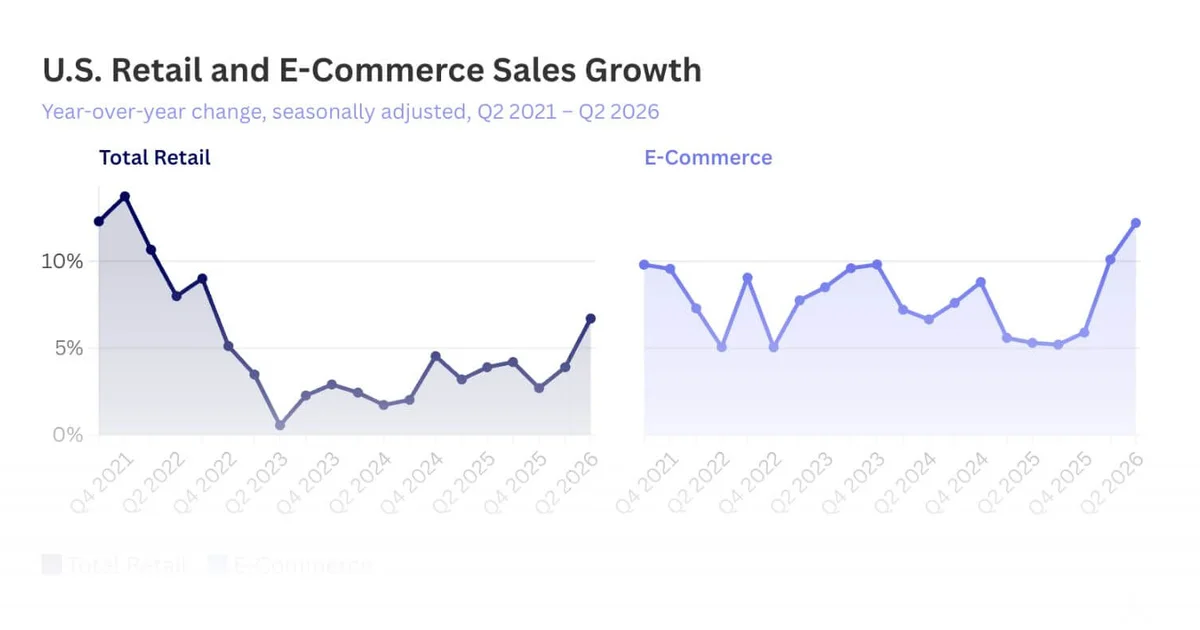
U.S. e-commerce grew 12.2% in the second quarter, its fastest in five years, and reached a record 17.1% of all retail spending.
www.marketplacepulse.comU.S. e-commerce grew 12.2% year over year in the second quarter, the fastest pace in five years, and reached a record 17.1% of all retail spending. It was the second consecutive quarter of double-digit growth and the fourth consecutive record for share.
Marketplace Pulse cautions against reading the number at face value. Total retail grew 6.7%, its fastest since 2022, and when every part of retail accelerates at once, price is usually the reason rather than demand. Roughly a third of the recent acceleration comes from bigger price tags, leaving real growth near 8%, which is about where it ran in 2024.
The heavier point for sellers is that the largest platforms are growing faster than the market they sit in. Walmart's U.S. online sales rose 24% and its advertising business 38%, against 3.5% growth for its overall U.S. business. Shopify's North American merchants sold 28% more, and Amazon's own online store sales grew 15%. Growth above the market rate has to come from the rest of the market.
Consumer Trends
Retailers under pressure to prove AI returns as Accenture research shows a readiness gap

Retailers face economic uncertainty, shifting consumer behavior and rapid AI adoption. Three priorities can help them stay ahead this holiday season.
www.forbes.comThe latest edition of Accenture's Pulse of Change research puts numbers on the position retail leaders find themselves in. The survey covers 3,000 C-suite leaders and 3,000 employees across 19 industries and 20 countries. Confidence that AI will drive productivity, growth, and competitive advantage persists, yet halfway through the year leaders feel less prepared to manage disruption than before.
Macroeconomic volatility is a large part of it. Globally, 73% of leaders anticipate a surge in inflation and 70% expect a reduction in global economic growth. That outlook is pushing executives toward a more pragmatic stance, both in responding to economic pressure and in measuring returns from AI.
Contributor Jill Standish notes the conversation has moved from investment size to measurable impact. Many companies expect AI to produce results, but few report business value at scale. A gap also persists between employees who benefit from AI and their confidence in company reskilling efforts. The holiday season is where that gap shows up in day-to-day operations.
Logistics and Fulfillment
Amazon opens paid slots in its sub-same-day network, letting sellers bid to add products

Amazon lets sellers pay extra to get additional products into its Sub Same Day Shipping network that generates 12 percent greater sales.
www.ecommercebytes.comAmazon has introduced a way for sellers to pay to add products to its Sub Same Day (SSD) network, which delivers in two to five hours. Until now Amazon selected eligible products itself based on demand and supply signals, moving them to dedicated fulfillment centers near 2,300 metro areas. That automatic placement continues at no cost.
Under the new arrangement, FBA sellers bid a per-unit price and pay only for units that actually ship through Sub Same Day. Participation is optional, and sellers are never charged more than the price they set. Amazon told sellers that products placed in the SSD network have seen 12% higher sales compared with standard FBA delivery in areas where the program is available.
Seller reaction is split. One seller noted that Amazon already charges customers for very fast delivery even with a Prime membership, and now wants sellers to contribute too. Consultants advised checking that incremental sales actually materialize and that the fees do not eat into margin. As more sellers pay in, Amazon may also place fewer products in the network for free.
Conclusion
What these few days show is that the contested ground in agentic commerce is moving from who has the best model toward who can carry it into enterprise production. Salesforce and Anthropic tied their products together at the default-model level, while Rezolve Ai and Tech Mahindra turned an integrator's headcount and client base into a deployment route. Retailers like Best Buy are running external AI channels and owned conversational assistants at the same time.
The underlying numbers still call for caution. U.S. e-commerce growth has returned, but a third of it is price, and only 5.5% of organizations using AI report real financial returns. Worth watching next: the September open beta of Salesforce in Claude, and how many companies put concrete numbers on AI channel revenue as the holiday season approaches.