Inside Ulta Beauty's AI Search Playbook: Studying Shopper Prompts, Publishing Answer Content and Tracking Rankings, and Why AI Makes Stores Matter More
Ulta Beauty's CMO explains how the retailer works to be chosen by ChatGPT and Gemini (prompt research, answer content, ranking tracking) and why stores still matter. For retailers and e-commerce teams preparing for AI search and agentic commerce.

Key Takeaways
- Kelly Mahoney, CMO of Ulta Beauty, the largest US beauty specialty retailer, described how the company markets to AI agents: it studies the questions shoppers type into ChatGPT and Gemini, places content that answers them, and tracks and adjusts its position in the results
- The content comes from creators, TikTok Shop affiliates and store associates, and Mahoney argues that shoppers who research with AI are more likely to visit stores. In the NielsenIQ study she cites, 57% of Gen Alpha AI tool users visit stores to browse and try products, versus 36% of non-users
- For retailers and e-commerce teams in Japan, the lessons are to build content from full-sentence questions rather than search keywords, to measure AI visibility as an appearance rate because a single ranking is unreliable, and to redesign stores and staff as the landing point for AI-informed shoppers
Ulta Beauty's CMO on marketing to the agents

Ulta Beauty CMO Kelly Mahoney on marketing to AI agents and why AI makes the in-store experience matter more.
www.thedrum.comOn October 12, 2026, the UK marketing publication The Drum ran an interview with Kelly Mahoney, Chief Marketing Officer of Ulta Beauty. It is part of the outlet's "All Media Is Commerce Media" series and was conducted by Jenni Baker. Mahoney has been with Ulta for 11 years.
The interview turns on one idea. Ulta has always tried to be the best marketer to its guests every day. Now, Mahoney says, it also has to be the best marketer to the AI agents those shoppers use.
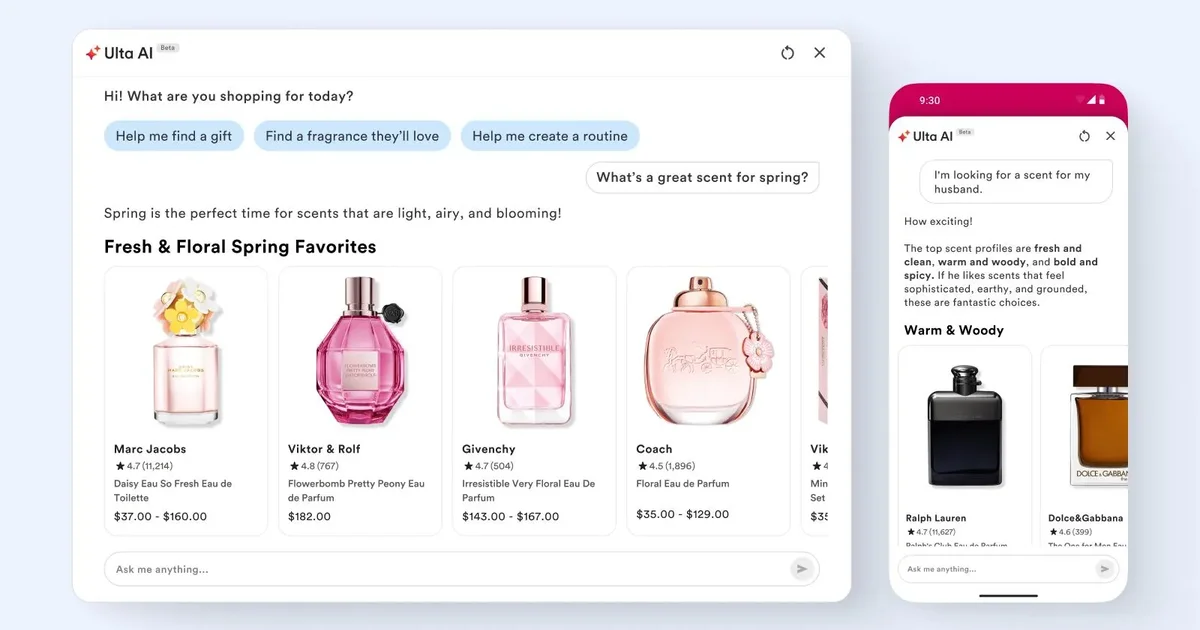
In April 2026, Ulta partnered with Google to launch Ulta AI, a Gemini-based assistant, and used UCP (Universal Commerce Protocol) to make its products buyable inside Google's AI Mode and the Gemini app (see our analysis of the Ulta Beauty and Google Gemini partnership). That announcement was about the plumbing for buying inside AI. This interview addresses the question that comes before it. When ChatGPT or Gemini recommends products, does Ulta's name show up in the answer at all? The interview does not discuss the partnership or payment mechanics.
Research the prompts, place the answers, track the rankings: Ulta's process
The process Mahoney described has three stages.
The first is studying the full-sentence questions (prompts) shoppers type into ChatGPT and Gemini. A search engine could be served with a word combination such as "acne toner." With AI, people typically ask in a single sentence that includes skin condition, age, budget and ingredients to avoid. The shift in what gets researched, from keywords to questions, is the starting point for the whole process.
In the second stage, Ulta creates content that answers those questions and places it on platforms known to feed large language models (LLMs, the AI at the core of ChatGPT and Gemini). The interview does not name those venues (not disclosed). What matters is the underlying assumption that writing on your own site alone is not enough.
The third stage is measurement. Ulta measures where it appears in prompt results and revises its content based on what it sees. How many prompts it tracks, which tools it uses and how much its position has improved are all undisclosed.
Who creates the content? Ulta's answer is people: macro influencers, creators who promote products through TikTok Shop, and store associates. Ulta runs a program called "Ulta Beauties" that trains store associates to create their own content. The people who hear customers' concerns on the shop floor every day become publishers themselves.
Mahoney calls creator content "a new form of working media." Working media is an advertising term for the money spent on media that actually reaches consumers, as opposed to production costs and fees. Treating creator posts not as a side activity but as a core channel worth paid investment is a deliberate statement. Since that content also becomes material that AI picks up when it assembles answers, the positioning makes sense.
TikTok Shop is one of those supply sources. In March 2026, Ulta became the first US specialty beauty and wellness retailer to open on TikTok Shop. According to Cosmetics Business, it launched with more than 15 brands and more than 25 exclusive bundles, working with creators and affiliates through performance-based programs. Mahoney says new customers acquired through TikTok Shop later visit stores to see the full assortment. No numbers were given.
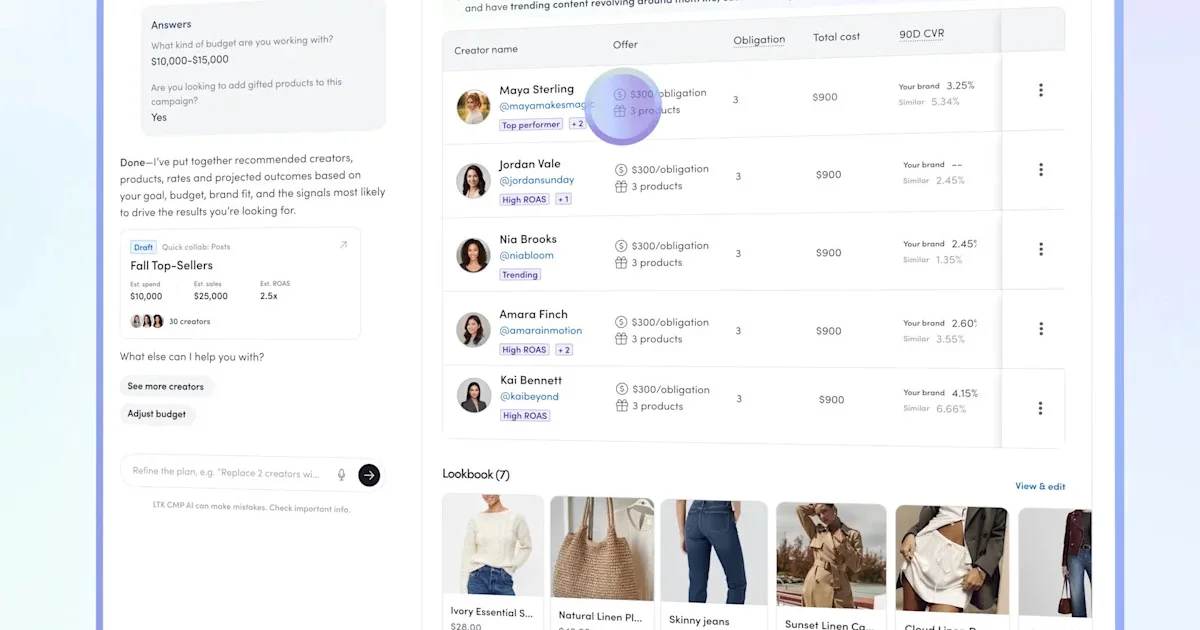
These three stages point in the same direction as what is called LLMO or GEO in Japan. The difference is that Ulta runs it as routine work in its marketing organization and involves its store associates. We also covered creators becoming source material for AI search in our explainer on LTK's AI search tab.
How reliable is an AI "ranking"?
Rankings inside AI answers are far less stable than search engine rankings.
In November and December 2025, Rand Fishkin of SparkToro and Patrick O'Donnell of Gumshoe.ai ran 12 brand-recommendation prompts 60 to 100 times each through ChatGPT, Claude and Google's AI (AI Overviews and AI Mode), for 2,961 runs in total. According to Search Engine Journal's summary, ChatGPT and Google's AI returned the same list of brands less than 1% of the time, and the same list in the same order less than 0.1% of the time.
The people asking vary too. When 142 participants wrote their own headphone prompts, the semantic similarity score across them was just 0.081. Yet across the 994 headphone responses, Bose, Sony, Sennheiser and Apple appeared 55% to 77% of the time. The authors conclude that while the order changes every time, the share of runs in which a brand appears is relatively stable.
The study has not been peer reviewed, and Gumshoe.ai, which sells AI visibility tracking, partly funded it. Even so, anyone running this kind of program should recognize the risk of reacting to "we ranked third" from a single query. From the outside, the details behind Ulta's "ranking tracking" are unknown. A company doing the same should prepare many phrasings of each question, run each one repeatedly, and read the results as an appearance rate.
Ulta's bet that AI won't make stores obsolete
The example Mahoney found surprising was young men. A group that has long hesitated to ask store associates about skin problems now consults ChatGPT or Gemini first. Having done that research, they know what to ask and walk into the store with the confidence to talk to an associate. In her view, the barrier for this group was a lack of confidence to enter the store.
Her evidence is "Smart Beauty: AI, Personalization & the Gen Alpha Consumer," a study Ulta commissioned from NielsenIQ (NIQ). According to Ulta's June 18, 2026 announcement, it surveyed 522 US Gen Alpha consumers and 500 of their parents and guardians in April and May 2026. The main figures:
- 57% of AI tool users visit stores to browse and try products, compared with 36% of non-users
- 78% discover beauty products online, and 77% then validate them, for example by trying products in store or asking family and friends
- 26% of teen boys use AI shopping assistants, nearly double the rate of other Gen Alpha groups (about 15%)
These numbers need careful reading. The 57% versus 36% gap shows a difference in behavior between AI users and non-users. It does not show that AI caused more store visits. Children who use AI may be older or more interested in beauty to begin with. The release does not state the respondents' age range either. And the study was commissioned by Ulta, a company with a large store network, so its conclusions should be read with that in mind.
Still, it is a coherent view for a retailer with physical stores. In its second quarter fiscal 2026 results (13 weeks ended August 1), Ulta reported net sales up 8.9% to $3,035.7 million, comparable sales up 3.8%, and 1,622 stores at quarter end. For a company with that footprint, it is more rational to treat AI not as a threat that pulls shoppers away from stores but as a guide that resolves their anxiety before they arrive.
Mahoney also said she does not want to put an iPad between the associate and the guest. Technology should help associates, not get in the way of service. Her position is that AI agents cannot replace the associates who greet, educate and support guests.
Fusion teams organized by customer segment
Ulta forms small teams that mix marketers, creatives, media specialists, product owners and technologists, and gives each team a customer segment to own. Each team is also responsible for measuring whether the experiences it builds create value. They used to be called "agile pods," but Mahoney disliked the name and changed it to "fusion teams."
AI is used for product recommendations and media decisions, while people set what to say and the creative direction. A structure in which one team can run everything from prompt research to content revisions appears to be what supports the three-stage process above.
What retailers and e-commerce teams in Japan can take from this
Translated into day-to-day work for a retailer or e-commerce business in Japan, Ulta's approach looks like this.
| Ulta's move | What it involves | How a retailer in Japan could adapt it |
|---|---|---|
| Prompt research | Studying the full-sentence questions shoppers type into ChatGPT and Gemini | Collect 'concern + conditions' questions from customer service inquiries, in-store consultations and review text |
| Answer content | Creating content that answers those questions and placing it where models draw information (specific venues not disclosed) | Publish concern-based comparisons and how-to guides on your own site and on external sources |
| Ranking tracking and adjustment | Measuring where Ulta appears in prompt results and revising content | Judge by appearance rate across many repeated runs, not a single ranking |
| Content supply | Creators, TikTok Shop affiliates and store associates (Ulta Beauties) | Turn the know-how of store staff and beauty advisors into publishable content |
| Role of the store | A place that welcomes AI-informed shoppers, lets them try products and answers their questions | Prepare service and try-on space that respond to customers arriving with AI research |
The easiest place to start is collecting questions. Customer service inquiries, in-store consultations and reviews already contain sentences such as "dry and sensitive skin, in my 30s, under 5,000 yen," which are nearly identical to what people type into AI. Starting from these gets you closer to content that AI is likely to use in its answers than starting from a keyword list.
Retailers with stores should also consider ways to bring their staff's knowledge outside. Japanese cosmetics counters have beauty advisors, a specialist role whose knowledge is the same kind of asset as Ulta Beauties. Turning it into publishable content, rather than letting it end with conversations on the floor, creates material AI can pick up and also prepares a landing point for customers who arrive after researching with AI.
Conclusion
What Ulta Beauty's CMO described is a company running its response to AI agents not as a special project but as everyday marketing work. Research the questions, place the answers, measure and revise. Associates and creators supply the material, and stores welcome customers who have gained confidence through AI.
How Ulta measures its rankings and what results it has achieved remain invisible from outside. The next things to watch are which metrics Ulta uses to show the impact of this work, and how purchases inside TikTok Shop and Gemini, along with store visits, are discussed in its earnings.