eMAG Reports Six-Month Results for iZi AI Shopping Assistant: 900,000 Users and Over RON 100 Million in Assisted Sales
Romania's largest online retailer eMAG shared six-month results for its in-house AI shopping assistant iZi. We break down the 900,000 users and RON 100 million in assisted sales, compare it with Rufus and Sparky, and flag what the numbers leave out.

Key Takeaways
- eMAG, the largest online retailer in Romania, announced six-month results for iZi, its in-house AI shopping assistant. More than 900,000 people have used it, sales assisted by iZi exceeded RON 100 million (about EUR 18.7 million), and one in six visitors interacted with it
- iZi answers using real stock, prices and delivery dates and guides shoppers up to adding items to the cart. eMAG also disclosed rare usage detail: three in four questions are about specific products, and recommendation requests return five to seven products
- All figures are self-reported, and the definition and attribution window of "assisted sales" are not disclosed. The case shows why e-commerce teams should set KPIs and attribution rules before launching an assistant
eMAG reports iZi's first six months: 900,000 users and over RON 100 million in assisted sales
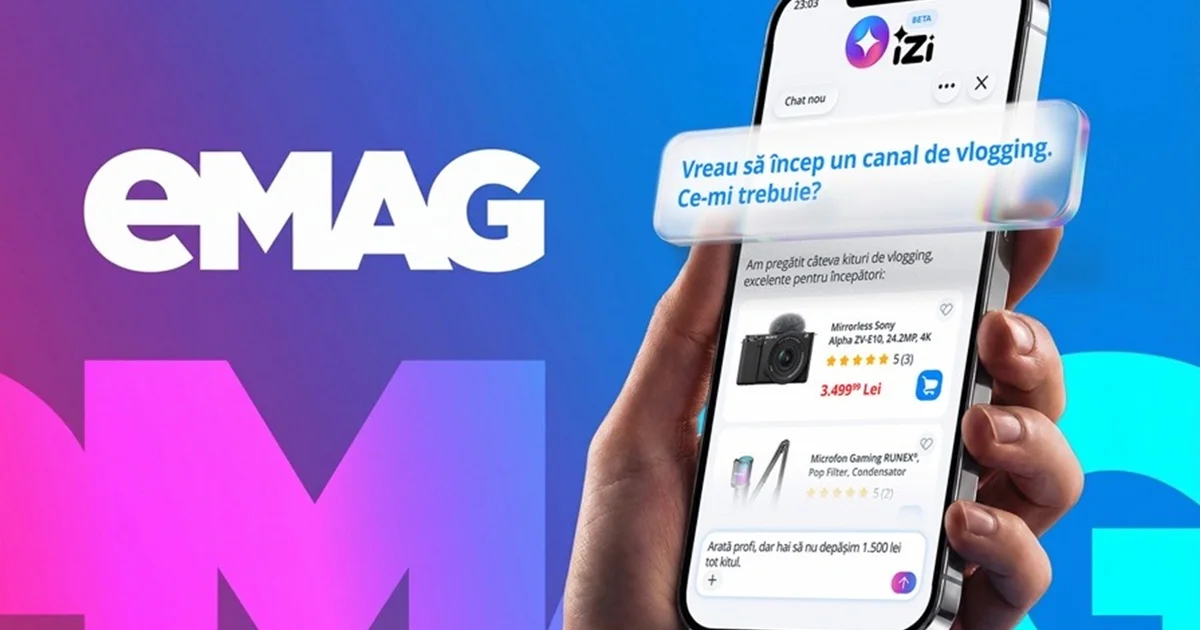
eMAG has announced the six-month results for iZi, the first AI shopping assistant developed entirely using local technology. In just half a year since its launch, sales facilitated by iZi have exceeded RON 100 million, and 900,000 people have used the assistant whilst shopping on the platform.
business-review.eu900,000. That is how many people used iZi, the AI shopping assistant of eMAG, in the six months after launch. eMAG runs e-commerce operations in Romania, Hungary and Bulgaria. According to Business Review on October 22, 2026, sales assisted by iZi have passed RON 100 million. At the European Central Bank reference rates for October 23, 2026 (EUR 1 = RON 5.3492, EUR 1 = JPY 175.51), that is roughly EUR 18.7 million, or about JPY 3.3 billion.
The announcement included more numbers. One in six customers who visited eMAG during those six months interacted with iZi, and for nearly 400,000 of them the shopping journey began in iZi. CEO Tudor Manea described how it differs from a general-purpose assistant.
Unlike a general AI assistant, iZi works with actual stock levels, prices and delivery times, and guides you right through to adding the product to your basket.Source: Tudor Manea, CEO of eMAG
iZi officially launched on March 25, 2026. According to Capital.ro, eMAG positioned it as "the first conversational shopping agent developed in Romania" and spent about a year building it. Before the official launch, it ran a soft launch (limited release) with about 50,000 users.
What the numbers say about how shoppers use it
The most valuable part of the announcement is not the user count or the sales figure. It is the breakdown of what customers actually ask the AI. Many retailers have launched AI assistants, but few publish what people ask or when they ask it.
Start with question types. Three in four questions to iZi are about a specific product, such as whether a part is compatible or how hard a product is to assemble. The remaining quarter are requests for advice, along the lines of "what should I buy for...". People write in natural language, averaging six to seven words per question. When asked for a recommendation, iZi selects and presents five to seven products that match the stated needs.
This mix reads differently from what eMAG said in May. In its annual results announcement, eMAG said that 60% of iZi interactions involved customers describing needs, budgets or occasions rather than searching for specific products. Six months in, specific product questions account for three quarters. eMAG has not explained whether the definitions differ or whether usage shifted as the user base grew. For now, though, iZi appears to work less like an advisor deciding what to buy and more like a store clerk who clears up doubts while you look at a product page.
Timing stands out too. Usage peaks between 8 pm and 11 pm, and 6% of conversations take place between midnight and 6 am. Comparison and confirmation questions cluster at hours when no store staff would be available. By category, electronics and IT generate the most conversations, followed by home décor and homeware, motoring and sports, consumables and fashion. Popular searches included washing machines and tumble dryers, mobile phones, CCTV cameras, all-season tyres, thermostats, air purifiers and air fryers. These are products that need spec comparisons and are costly to return if bought wrong.
The soft-launch figures add context. Capital.ro reported that users asked 2.6 questions per conversation on average and one in three came back the following week. Each session included five to six product page views, and about 5% of users placed an order directly from the chat.
Why "real stock, prices and delivery dates" matters
When Manea stressed real stock, prices and delivery dates, he was drawing a line against general-purpose AI such as ChatGPT. A general assistant may know about products, but it cannot tell you whether this store has an item in stock or whether it arrives tomorrow. iZi connects directly to eMAG's catalog and inventory data, so its answers can lead straight to a purchase.
At launch, StartupCafe reported that iZi builds recommendations from three inputs: the assortment on eMAG, the need expressed in the conversation, and external web information including independent review sites. Internal data alone gives a weak basis for saying which product is genuinely good, while external information alone has no stock guarantee. Connecting the two is what lets iZi guide shoppers all the way to the cart.
iZi does not yet handle payment, however. eMAG has listed image and voice input and in-conversation payment as upcoming features. Its parent company Prosus sees the market the same way. In a January 2026 predictions piece, Prosus Global Head of AI Euro Beinat noted that 50% of consumers now use AI shopping assistants to search, compare and decide, while agents complete about 0% of end-to-end transactions. He pointed to unresolved secure agentic payments as one reason. Stopping at the cart looks like a choice that fits this reality.
Why eMAG is investing in its own assistant now
The backdrop is slowing growth and a large AI budget. According to StartupCafe, eMAG's platform sales in Romania reached RON 10.6 billion in 2025, up only 3.9% year over year. Profit.ro, reporting on Prosus's results, said adjusted EBITDA for eMAG Romania fell 23% to USD 60 million in fiscal 2026. The company plans to invest RON 1.2 billion in fiscal 2027 (April 2026 to March 2027), including about RON 200 million (about EUR 40 million) for AI. iZi is one of the pillars of that plan.
The emphasis on in-house development is also visible in the announcement. eMAG called iZi "the first AI shopping assistant developed entirely using local technology." Owning stock, price and delivery data and tuning the assistant for Romanian-language conversations is also a choice not to hand the entry point of AI-driven shopping to outside platforms.
How it compares with Rufus and Sparky
Set against the results of global leaders, iZi's scale and the differences in how each company defines its numbers become clear.
| Item | eMAG iZi | Amazon Rufus | Walmart Sparky |
|---|---|---|---|
| Launch | March 2026 (official launch) | February 2024 (beta) | June 2025 |
| Reach | 900,000+ users in six months; 1 in 6 visitors | 300 million+ users in 2025 | About half of app users |
| Sales metric | RON 100 million+ in assisted sales (six months) | About $12 billion in incremental annualized sales (2025) | Users' order value about 35% higher than non-users' |
| How it is counted | Not disclosed | Purchases within a seven-day window after interaction | Users compared with non-users |
| How far toward purchase | Up to adding to cart (in-chat payment planned) | Buy for Me and price-triggered auto-buy | Baskets fulfilled via delivery or store pickup |
In its fourth-quarter 2025 results, Amazon said Rufus generated nearly $12 billion in incremental annualized sales in 2025 and was used by more than 300 million customers. According to Fortune, Amazon counts purchases that follow a Rufus interaction within a seven-day rolling window. Walmart said customers who use Sparky have order values about 35% higher than those who do not, and that roughly half of its app users have used Sparky.
The three companies are not using the same yardstick. Amazon frames its number as sales that would not have happened without the AI. Walmart compares the order values of users and non-users. eMAG reports sales "assisted" by iZi. More important than which number is bigger is what each one actually counts.
How to read the numbers
Every figure above comes from eMAG itself. There is no third-party verification, and several caveats apply.
The biggest question is the definition of assisted sales. The English announcement uses both "sales facilitated by iZi" and "iZi-assisted sales," but it does not say how long after an interaction purchases are counted, whether only carted items count, or whether other purchases in the same visit are included. These points are not disclosed. Nor does eMAG say whether it counts only incremental sales, as Amazon claims to. Shoppers who open an AI assistant on their own tend to be high-intent buyers already. Some of the assisted sales could well be purchases that would have happened without iZi.
Scale also deserves a sober look. The periods differ, so the comparison is rough, but RON 100 million in six months of assisted sales is under 1% of eMAG's RON 10.6 billion in annual sales in Romania for 2025. One in six visitors is a high adoption rate, yet the impact on total sales remains limited. Manea also mentioned a very good "product retention rate," but neither its meaning (whether it refers to low returns) nor its value was disclosed. Conversion rates and order values for iZi-driven purchases were not published either, so effects beyond user count and sales cannot be judged.
Lessons for e-commerce teams
The lesson from eMAG is less about whether to deploy an AI assistant and more about what to measure once you have one.
First, classify what people ask. At iZi, three in four questions were about specific products. That also signals that product pages lack information or that it is hard to find. Frequent topics such as compatibility and assembly difficulty can feed directly into better product pages and richer product data for AI to read.
Second, connect AI answers to stock, price and delivery data. The only reason an on-site assistant can beat general-purpose AI is that it knows whether an item can be bought right now. Put an assistant on top of stale product data and that strength turns into a weakness.
Third, set attribution rules before launch. Decide how many days after a conversation purchases count, and how to separate incremental sales from the total. The eMAG, Amazon and Walmart figures are hard to compare precisely because these definitions differ. To explain impact internally, build in a control group that compares users with non-users from the start.
Details such as the evening peak and five to seven recommendations are also useful inputs for design. Demand is highest when human staff are thin, and options should be narrowed to a number that is neither too many nor too few. Operational details like these separate assistants that get used from those that do not.
Conclusion
iZi's first six months show that a regional retailer can reach meaningful usage with an in-house AI assistant. Yet as long as the definition of assisted sales stays undisclosed, it remains unclear how much of the RON 100 million is truly additional.
The next thing to watch is the in-conversation payment eMAG has announced. When the flow moves from stopping at the cart to completing payment in the chat, how will conversion and return rates change? Whether consistent, well-defined numbers come with that step will be the real test of how to measure conversational commerce.